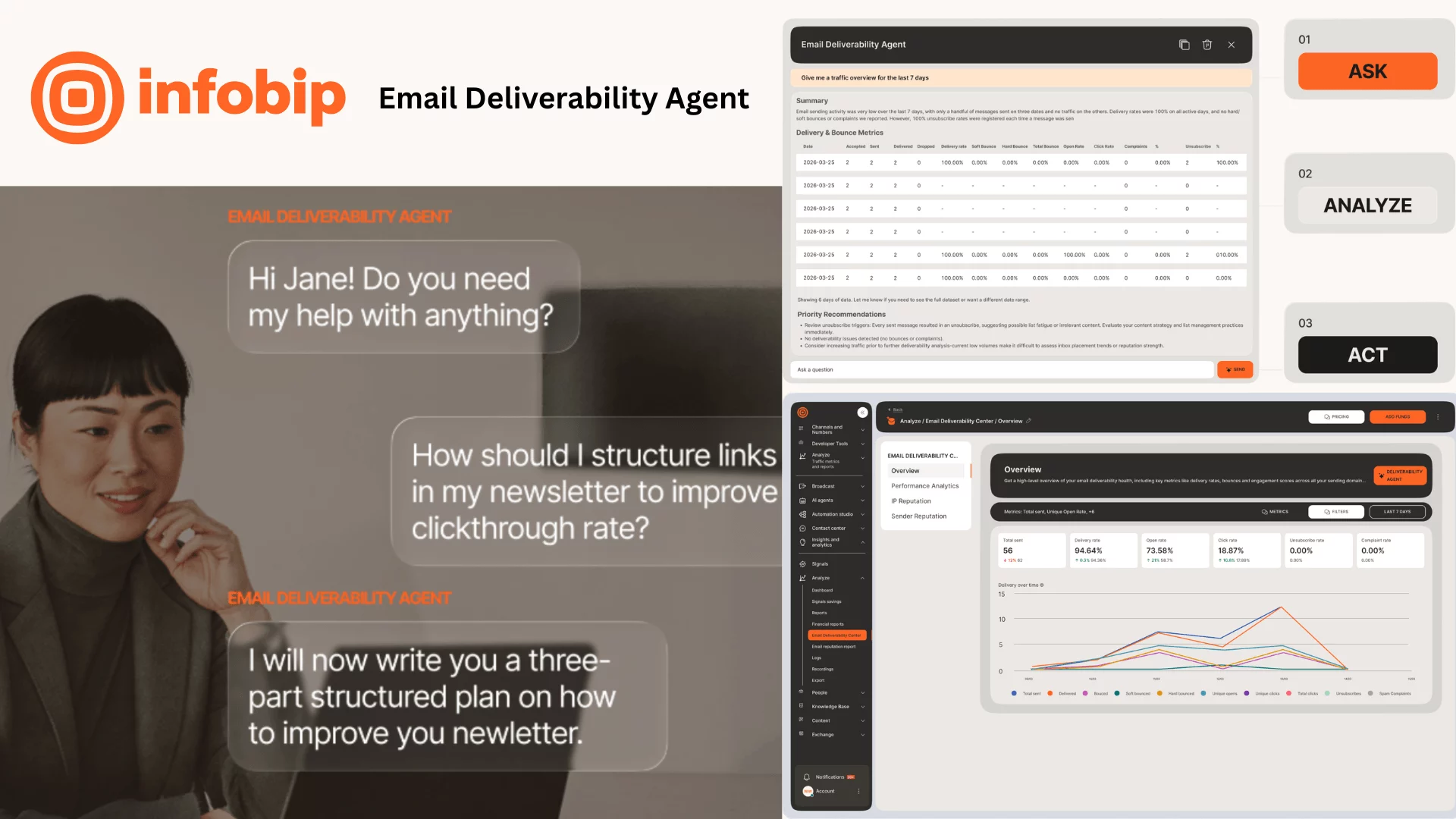
The landscape of email marketing is undergoing a profound structural shift. As mailbox providers like Google and Yahoo enforce increasingly stringent requirements for bulk senders, the complexity of maintaining a healthy sender reputation has reached a breaking point for many organizations. Into this breach steps Infobip, the global cloud communications platform, with the launch of its new "Email Deliverability Agent." Integrated directly into its AgentOS platform, the tool promises a paradigm shift: the ability to analyze real-time sending data and provide actionable, expert-level remediation steps without the need for a dedicated deliverability specialist.
This development is not merely another feature update; it is a signal of the "industrialization" of email expertise. By automating the interpretation of complex bounce codes, reputation metrics, and authentication logs, Infobip is positioning itself at the center of a trend that is rapidly commoditizing the human role in email operations.
The Convergence of Three Forces
To understand the significance of Infobip’s announcement, one must look at the broader industry context over the last several weeks. The discipline of email deliverability is being squeezed from three distinct directions, forming what might be termed the "third jaw" of an industrial pincer movement.
First, the mailbox providers themselves have begun to democratize data. Gmail’s recent updates to its Postmaster Tools now provide plain-language verdicts, effectively telling senders in simple terms whether their audience actually desires their content. No longer must a marketer dig through cryptic error codes to understand their standing; the platform is providing the diagnosis directly.
Second, the infrastructure layer is absorbing the tooling. Amazon SES has recently integrated inbox placement testing, cross-provider analytics, and comprehensive blocklist monitoring directly into its console as a subscription-based service. What was once the domain of third-party monitoring tools is now becoming a native feature of the sending infrastructure.
Third, Infobip has introduced the "interpretation layer." By deploying an AI agent designed to sit between these data sources and the actual sending configuration, the company is targeting the most expensive and rare component of the stack: the human deliverability consultant. For years, the industry relied on specialists to read dashboards, interpret trends, and make high-stakes decisions. Infobip’s agent aims to replace that interpretive step with algorithmic precision.
Chronology: A Season of Agentic Acceleration
The speed at which this transition is occurring is unprecedented. In the span of a single month, the industry has witnessed a cascade of "agentic" product launches.
- Early Month: Gmail enhanced its Postmaster Tools, providing clearer signals on user engagement and sender reputation.
- Mid-Month: Amazon SES launched its integrated deliverability suite, consolidating monitoring and testing within the AWS ecosystem.
- Current Week: Infobip officially unveiled the Email Deliverability Agent within its AgentOS framework, marking the first time a major CPaaS (Communications Platform as a Service) has attempted to fully automate the interpretive phase of deliverability management.
This rapid sequence of events suggests that the industry has reached a tipping point where the "black box" of email reputation is being opened by AI. The competitive race is no longer just about who has the best data or the fastest delivery speed; it is about who can best synthesize that data into a "fix-it" button for the end user.
Supporting Data and The "Autonomous" Promise
The core value proposition of Infobip’s agent is "expert-level deliverability guidance, no specialist required." This is a bold claim that addresses a genuine market pain point. The vast majority of small-to-medium-sized enterprises (SMEs) have never employed a full-time deliverability specialist. They have been forced to navigate the increasingly hostile landscape of spam filters and authentication protocols using little more than guesswork and generic documentation.
For these senders, the Infobip agent offers a form of "deliverability literacy." It translates complex concepts—such as SPF/DKIM/DMARC alignment, feedback loops, and volume throttling—into prioritized remediation steps. If the agent successfully lowers the barrier to entry for professional-grade email management, it could significantly improve the health of the overall email ecosystem.
However, the industry is currently obsessed with the term "autonomous." When a vendor labels an agent as autonomous, it implies that the software can make decisions on behalf of the user. In the context of email, where a single misconfiguration can result in an entire domain being blacklisted globally, "autonomy" is as much a risk as it is a benefit.
Official Response: The Question of Agency
The most critical question for any AI agent in this space is: What can the agent actually do, as opposed to recommend?
In an exclusive exchange regarding the launch, Infobip provided clarity on this vital distinction. When asked if the agent acts on its own or merely advises, the company confirmed: "Our AI Deliverability Agent gives teams near real-time visibility into the issues affecting reputation and deliverability performance, then turns those findings into prioritized remediation steps."
Crucially, Infobip outlined a roadmap that prioritizes safety over speed. The company stated: "The product roadmap moves from insights to selective automation for low-risk actions, with human approval, audit logs, and rollback built in. Each new agentic step is designed to improve performance without removing control from the sender."
This response is a landmark for the industry. While other vendors have been vague about the limits of their agents, Infobip has gone on the record to define the boundary between "advisory" and "empowered" AI. By committing to a model where humans implement recommendations and automation is gated by audit logs and manual approval, Infobip has set a standard for "send-authority" that other AI-native platforms have yet to meet.
The Implications for the Future of Work
The rise of the Email Deliverability Agent carries profound implications for both the software industry and the workforce.
1. The Death of the "Black Box"
For decades, deliverability was an arcane art. Specialists protected their knowledge, and companies relied on the mystery of "inbox placement" to justify high consulting fees. That mystery is evaporating. As tools become more capable of diagnosing their own issues, the value of the human practitioner will shift. The expert of the future will not be the one who knows how to read a bounce code, but the one who knows how to manage the strategy and the AI agents that handle the tactical execution.
2. The Limits of Diagnosis
While the Infobip agent will undoubtedly excel at checklist-based remediation—such as fixing a broken DMARC record or flagging a sudden spike in invalid addresses—it remains to be seen how it will perform in the "gnarly" cases. Mystery throttling, shared-pool contamination, and complex, multi-layered reputation issues often require a level of context that an AI may lack. The agent may provide the data, but the "why" behind a sudden drop in engagement often requires human intuition and industry networking.
3. The Risk of Over-Automation
As Infobip moves toward its roadmap of "selective automation," the industry must remain vigilant. If an AI agent misreads a reputation signal and automatically throttles a high-volume stream, the impact on a business could be catastrophic. The company’s commitment to "human approval" is the necessary guardrail that prevents this from happening. The challenge will be ensuring that as the technology matures, that guardrail does not become a hurdle that hinders the very efficiency the agent was designed to create.
A Fair Assessment
Infobip’s entry into the agentic space is a balanced, measured step. It is easy to interpret the phrase "no specialist required" as an aggressive marketing ploy, but a fairer reading is that it is "marketing compression" for "no specialist required to achieve basic competence."
The agent is likely to be a powerful tool for those who were previously priced out of high-level deliverability support. For the expert community, it serves as an opportunity to offload the rote, repetitive aspects of monitoring, allowing them to focus on high-level strategy and crisis management.
We will continue to watch this space closely. The true test of Infobip’s agent—and indeed, all agentic tools in the email sector—will come when the first major practitioner write-ups appear. We are looking for the moment when the tool moves from "advising" to "acting," and how that transition affects the stability of the global email infrastructure. For now, Infobip has done something that the rest of the category has failed to do: they have answered the hard questions about control, authority, and safety, and they have done so on the record.
In a market currently dominated by hype, that transparency is perhaps the most valuable feature of all.
Disclosure: Infobip is an Enterprise Member of Emailexpert. Coverage decisions and editorial judgments for this article were made independently of commercial relationships.