There is a precise, transformative moment in every major technological cycle when a tool shifts from being a competitive advantage to a fundamental utility. For the B2B marketing sector, that moment has arrived. Artificial intelligence is no longer a peripheral experiment for the tech-savvy few; it has cemented itself as the bedrock of modern professional efficiency.
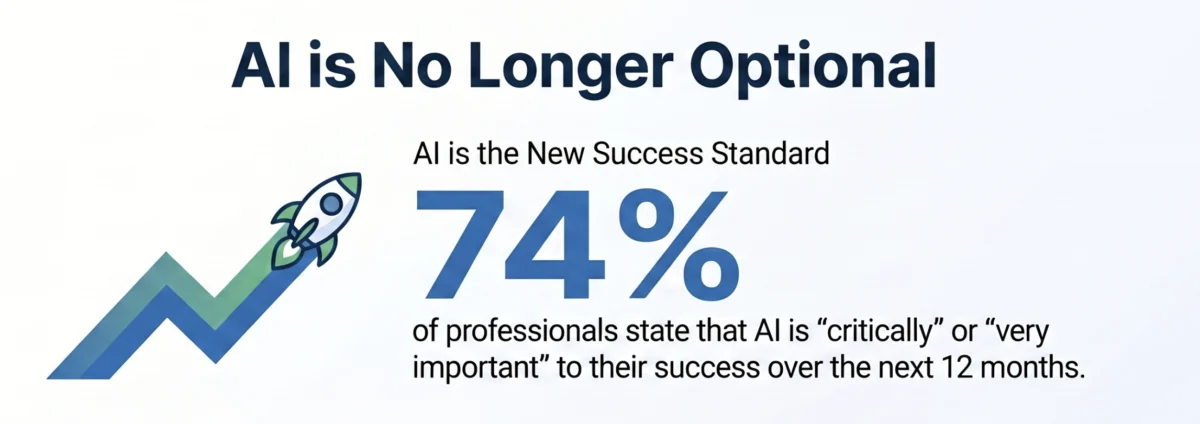
According to the 2026 State of AI for Business Report, a comprehensive study surveying over 2,100 professionals, the consensus is near-universal: 74% of respondents now classify AI as "critically" or "very" important to their professional success over the next year. With 84% of that cohort operating within the B2B landscape, the signal is clear—the era of AI-optional marketing is officially over.
The Chronology of Adoption: From Curiosity to Core Infrastructure
To understand where we are, one must look at how we arrived here. Just a few years ago, AI was largely viewed through the lens of "innovation theater." It was the side project, the pilot program, or the "cool tool" demoed in isolated marketing meetings.
In 2024 and 2025, the narrative began to shift toward competency, as marketers moved from asking, "What can this tool do?" to "How can I integrate this into my daily workflow?" By 2026, the trend has reached a crescendo. The report highlights that we have moved past the phase of speculative curiosity and into a phase of structural expectation. Leadership teams are no longer just allowing AI; they are increasingly mandating it as a prerequisite for productivity and scale.
“You’re starting to see a definitive shift in sentiment,” says Paul Roetzer, CEO of SmarterX and the Marketing AI Institute. “The people seeing these tools every day—the AI-forward professionals—are no longer speculating about the potential. They are experiencing the tangible impact on their output and quality of work.”
Supporting Data: The Anatomy of a Disconnect
While the sentiment among individual practitioners is overwhelmingly positive, the 2026 State of AI for Business Report reveals a startling paradox: a growing "Implementation Gap" between the workforce and the organizations that employ them.
The Individual-Organization Mismatch
The data suggests that while the human capital is ready for a digital revolution, institutional structures remain tethered to legacy processes:
- Individual Progress: 53% of professionals report they have reached the "Integration" or "Transformation" phases of AI adoption. They are actively embedding AI into their daily workflows or, in many cases, fundamentally reimagining their roles to leverage machine intelligence.
- Organizational Stagnation: In stark contrast, only 25% of the organizations represented in the survey have reached the "Scaling" phase of AI maturity.
- The Pilot Trap: Nearly half (47%) of all organizations remain stuck in "pilot mode," unable to move beyond initial experimentation into a repeatable, scalable framework.
Taylor Radey, Director of Research at SmarterX, emphasized the nuance of this finding during the report’s launch webinar in May. "This is not a knowledge gap," Radey noted. "The employees inside these organizations understand the potential of AI. They are already using it. The failure lies with the organizations themselves, which have not yet built the infrastructure—the governance, the training, and the workflows—to operationalize these tools."
Official Perspectives: Bridging the Divide
The tension between individual agility and corporate rigidity is the defining challenge for B2B leadership in the latter half of the decade. Experts argue that the disparity isn’t merely a technological issue; it is a management crisis.
The Leadership Responsibility
Marketing leaders are now finding themselves in a precarious position. Their teams are often two or three steps ahead of the corporate policy, experimenting with automation, generative text, and predictive analytics while the C-suite remains focused on broad, often nebulous, "AI strategies."
According to the SmarterX research team, the successful organizations of 2026 and beyond will be those that prioritize four key pillars:
- Governance: Establishing clear guidelines for ethical, secure, and brand-compliant AI use.
- Roadmapping: Moving from ad-hoc tool selection to a strategic integration plan that aligns with business objectives.
- Dedicated Training: Moving beyond simple tutorials to comprehensive upskilling that empowers employees to use AI for high-level creative and analytical tasks.
- Protected Time: Recognizing that if employees are not given the time to master these new tools, the transition will remain incomplete.
The Implications for B2B Marketers
For the individual marketer, the implications of these findings are profound. The question of whether AI is "optional" has been settled by the data. The new question is: How fast can your organization evolve to support your potential?
The Risk of Institutional Lag
If an organization fails to catch up to its workforce, the result is twofold: inefficiency and attrition. High-performing marketers who have integrated AI into their daily lives will find themselves increasingly frustrated by legacy workflows that hinder their speed. This creates a retention risk, as top talent will naturally gravitate toward "AI-native" or "AI-mature" organizations that facilitate, rather than obstruct, their modern workflows.
The Strategic Imperative
The shift we are currently witnessing feels less like a temporary trend and more like a permanent, foundational workplace transition. For B2B firms, the urgency is real. If the team is ahead of the company, and the company is struggling to create an operational framework, the "business progress" that AI promises will never be fully realized.
What Can B2B Marketers Do Now?
The transition to an AI-first organization requires immediate, practical steps. To close the gap, B2B professionals and leaders should consider the following actions:
1. Conduct an AI Inventory Audit
Identify every AI tool currently in use by your team. If your employees are using unauthorized, "shadow" AI tools to get their work done, that is a clear indicator that the organization’s current software stack is insufficient.
2. Standardize the Workflow
Instead of allowing each department to operate in silos, create a centralized repository for prompt libraries, best practices, and successful use cases. This helps turn individual "hacks" into institutional knowledge.
3. Prioritize AI Literacy Programs
Move beyond basic "how-to" sessions. Implement a tiered training program that covers AI ethics, data privacy, and advanced prompt engineering. The goal is to elevate the entire team’s capability, not just to show them how to use a chatbot.
4. Align AI with ROI
Stop treating AI as a "productivity experiment" and start treating it as a performance lever. Map AI initiatives to specific KPIs, such as content production speed, lead qualification accuracy, or customer acquisition costs.
Conclusion: The Path Forward
The 2026 data is a wake-up call for the B2B sector. We have reached a point where the individual marketer is ready to transform the industry, but the corporate apparatus is lagging behind.
The transition is no longer about the technology itself—the tools have matured significantly. It is now about the human and organizational capacity to adapt. Those who successfully navigate this transition will see exponential gains in efficiency, creativity, and market share. Those who remain stuck in "pilot mode" risk becoming obsolete as their competitors harness the power of AI to work faster, smarter, and more effectively.
As the industry moves into the second half of the decade, the winners will be those who successfully close the gap between their people’s capabilities and their organization’s infrastructure. The technology is here; the question remains whether the leadership is ready to catch up.
For more in-depth insights, readers are encouraged to download the full 2026 State of AI for Business Report at stateofbusiness.ai. Additionally, industry professionals looking to navigate these changes in real-time are invited to register for the upcoming AI for B2B Marketers Summit.
About the Author:
Cathy McPhillips is the Chief Marketing Officer at SmarterX and the Marketing AI Institute. She is a recognized thought leader in the intersection of digital marketing and artificial intelligence, dedicated to helping B2B organizations navigate the complexities of the modern marketing landscape.