In the current gold rush for artificial intelligence, most software companies are treating AI as a "bolt-on" feature—a thin layer of polish applied to legacy systems. However, Rippling is taking a diametrically opposed approach. By prioritizing a unified data architecture over rapid model integration, the HR and IT management platform is positioning itself as the blueprint for the next generation of enterprise software.
At the heart of Rippling’s strategy is a simple, yet profoundly difficult, technical reality: AI is only as good as the data it acts upon. While competitors have grown through a patchwork of acquisitions—resulting in fragmented data silos—Rippling has spent a decade building a singular, connected "employee graph" from the ground up. This architecture is the company’s "moat," and it is currently redefining what it means for a system of record to become a system of intelligence.
The Foundation: A Unified Data Graph
For most enterprise platforms, "data" is trapped in isolated compartments. Payroll data resides in one system, benefits in another, and IT device management in a third. When these companies attempt to implement AI, they are forced to build bridges between disconnected databases, leading to hallucinations, inaccuracies, and security vulnerabilities.
Rippling’s AI product team, led by Luke Prokopiak, argues that the model itself is a commodity. The true differentiator is the "data layer" beneath the interface. Rippling’s platform covers over 25 products—including HR, recruiting, payroll, benefits, and IT spend—all sharing a single, deeply integrated database.
With more than a million queryable fields, the system doesn’t just store information; it understands the relational context between those fields. It knows not only an employee’s title and compensation but also the complex tax implications for a part-time worker in a specific region of Germany. By enforcing strict "strong typing" and granular permissioning across this entire graph, Rippling ensures that when an AI agent makes a decision, it does so with the authority and accuracy of a seasoned HR professional.
The Evolution of Utility: From Insights to Proactive Workflows
During a recent demonstration, Prokopiak illustrated a three-stage product arc that serves as a masterclass in how B2B companies should deploy AI.
Stage One: The Insight Engine
The first stage involves transforming raw, disconnected data into actionable intelligence. By using natural language prompts, users can generate complex company dashboards in seconds.
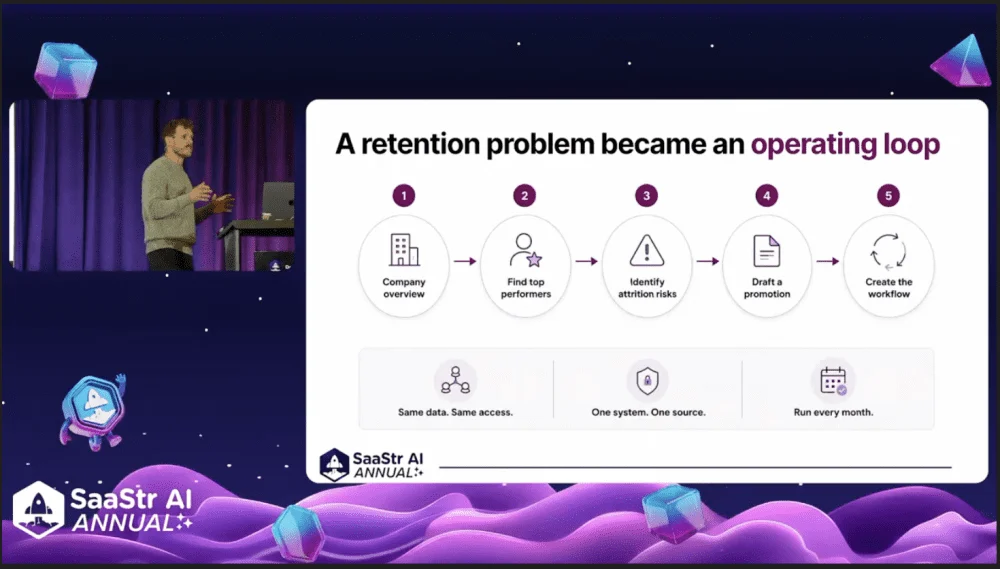
For instance, a leader can ask the system to analyze top performers across the organization. The AI doesn’t just output a list of names; it identifies correlations—such as the discovery that 71% of high-potential employees have been with the company for six or more years. This insight immediately pivots to a risk-mitigation strategy, identifying "at-risk" employees who share similar characteristics but have yet to receive a promotion. This is the difference between a static report and a strategic tool.
Stage Two: Executable Actions
The most striking advancement in Rippling’s AI is its ability to transition from "telling" to "doing." In the demonstration, Prokopiak used natural language to execute a complex administrative task: promoting an employee to a "Staff Software Engineer" role.
The AI navigated the organization’s leveling system, filled out the necessary paperwork, mapped the compensation changes, and prepared the promotion packet. Crucially, the system did not act autonomously without oversight. It utilized a "before-and-after" verification interface and required multiple confirmations, ensuring that the AI’s actions remained within the bounds of corporate policy. This is possible only because the system "understands" the strong types—it knows exactly what it is changing, who is permitted to change it, and what the downstream impacts of that change will be.
Stage Three: Proactive Workflows
The final stage of the arc is the transition from "pull" to "push." Instead of a human having to remember to query the system for insights, the system proactively surfaces them. A manager can configure a recurring workflow—such as a monthly high-performer review—that automatically runs at a set time and delivers a summary to the relevant HR business partner. This moves the system from being a passive repository to an active participant in the company’s operations.
The "Unsexy" Bet: Lessons for Modern Founders
Rippling’s trajectory offers a stark lesson for founders and CTOs: The data layer is the moat, not the model.
For years, critics viewed Rippling’s refusal to acquire other companies and "bolt-on" features as an inefficient, unsexy approach to scaling. However, in an AI-native world, that choice has proven to be a strategic masterstroke. While competitors are struggling to clean and reconcile legacy data, Rippling is already operating on a clean, consistent, and logically sound foundation.
For those currently building in the AI space, the takeaway is clear:
- Audit your data before your roadmap: A sophisticated LLM cannot compensate for a messy, siloed database.
- Prioritize permissions: In a world where AI agents can take actions, knowing exactly who has access to what is not just a compliance requirement—it is a safety imperative.
- Build trust through transparency: By using confirmation loops and before-and-after previews, companies can bridge the gap between human skepticism and AI capability.
Official Stance and Market Reception
Rippling’s shift from a "System of Record" (where data lives) to a "System of Intelligence" (where data works) is already yielding tangible results. Since the early release of Rippling AI roughly two months ago, the company has seen significant user engagement. The platform’s ability to turn complex HR and IT queries into immediate administrative outcomes has sparked hundreds of unsolicited testimonials from users across LinkedIn, signaling that the market is hungry for tools that actually perform work rather than just generating text.
Implications for the Future of Enterprise Software
The implications of this shift are profound. As we look toward the future, the enterprise software market will likely split into two camps: those who successfully unified their data architectures before the AI boom, and those who are now frantically trying to stitch together legacy systems.
Rippling has effectively raised the bar. The expectation for enterprise software is no longer just "usability" or "feature parity." It is "contextual awareness." By refusing to compromise on their underlying architecture, Rippling has ensured that their AI can act with the nuance, authority, and safety that large-scale businesses require.
Ultimately, the AI revolution in business will not be won by the company with the most "clever" model. It will be won by the company that makes the underlying data clean, connected, and actionable enough to be trusted. Rippling’s decade-long commitment to this unglamorous work is now paying dividends, proving that in the age of intelligence, the most important work is often the work you do before the model is even turned on.
Top 5 Takeaways
- Data is the True Moat: AI is only as capable as the data layer beneath it. A unified graph is essential for reliable, intelligent action.
- Avoid the "Bolt-on" Trap: Acquiring and patching together disconnected systems creates silos that prevent AI from understanding the full context of a business.
- The Three-Stage Arc: Successful enterprise AI should follow a logical progression: surfacing insights, enabling human-guided actions, and finally, automating proactive workflows.
- Strong Typing and Permissions: These unglamorous technical requirements are the only things preventing AI from becoming a liability rather than an asset.
- The Shift to Intelligence: Systems of record must evolve into systems of intelligence, where data is no longer just stored but actively utilized to run company operations.