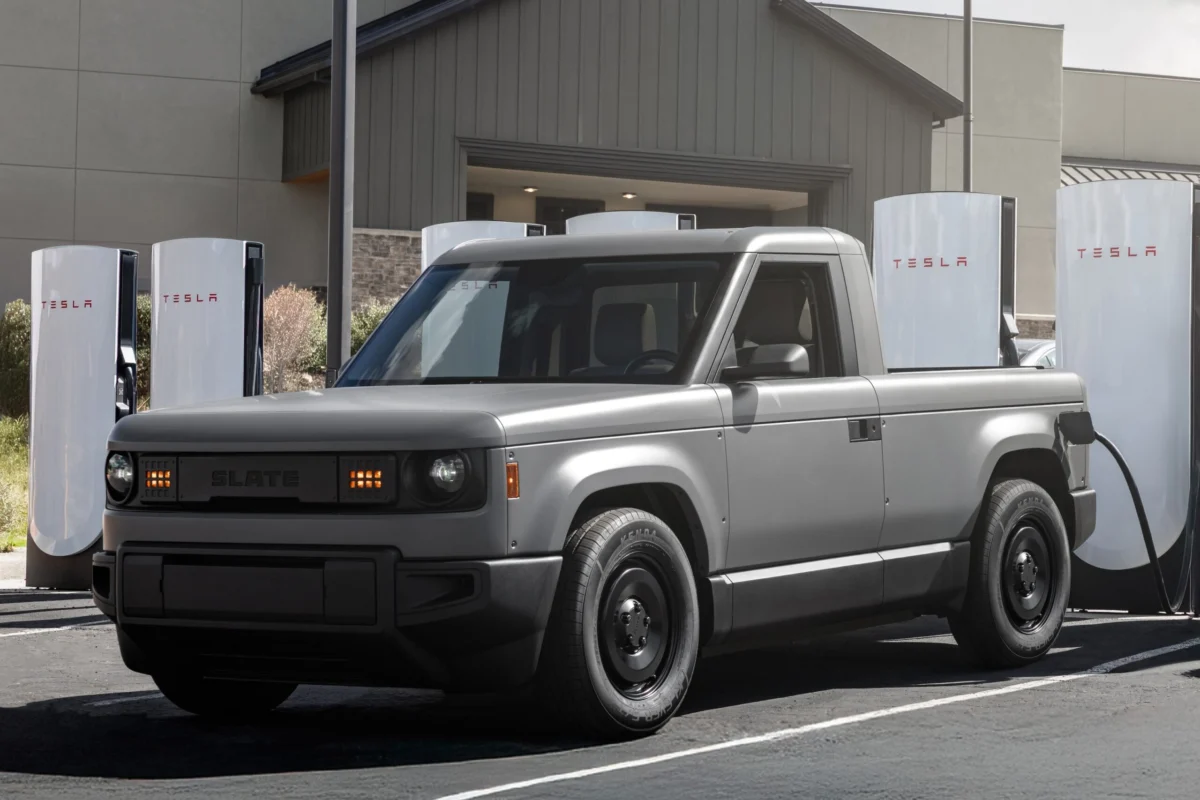
In an automotive landscape currently defined by bloated, luxury-focused electric SUVs and soaring interest rates, one startup is attempting a radical return to basics. Slate Auto, the well-funded EV disruptor backed by the likes of Jeff Bezos and Guggenheim Partners’ Mark Walter, has officially pulled back the curtain on its flagship product. The company announced this week that its modular, minimalist electric truck will start at a sticker price of $24,950—a figure that effectively undercuts almost every other new passenger vehicle currently available in the United States.
This price point, while excluding taxes, title, destination charges, and other customary fees, represents a significant milestone for the Los Angeles-based firm. By stripping away the bells and whistles that have driven average new vehicle transaction prices to record highs, Slate is positioning itself to capture a massive, underserved segment of the market: the budget-conscious consumer looking for utility, not status.
The Anatomy of the Slate Truck
The Slate truck is not designed to compete with the high-performance, tech-laden EVs dominating the headlines. Instead, it is an exercise in industrial pragmatism. The base model, which is now available for pre-order, arrives as a two-seater pickup. However, the company’s core innovation lies in its modularity. Through a series of owner-installable components and professional-grade conversion kits, the vehicle can be transformed from a utilitarian pickup into a five-seater SUV. This SUV variant will carry a starting price of $29,950.
To reach this aggressive price point, Slate has made several controversial design choices. The interior is famously bare: buyers will find hand-crank windows, an absence of a traditional infotainment system, and a uniform gray composite exterior. By eschewing factory paint shops—which can represent capital investments in the hundreds of millions—and instead relying on aftermarket vinyl wraps for customization, Slate has surgically removed a major cost center from its manufacturing process.
Furthermore, the company has announced a significant boost in performance for its entry-level unit. Originally estimated to provide 150 miles of range, the base model will now feature an estimated 205 miles of range on a single charge. While modest by current luxury standards, it is a significant improvement that makes the vehicle a far more viable candidate for daily commuting and regional utility work.
A Chronology of Disruption
The journey to this price reveal has been marked by a blend of secrecy, high-profile investment, and strategic maneuvering.
- Early 2025: TechCrunch first reported on the existence of Slate Auto, revealing that the startup had been operating in stealth mode for some time. The report highlighted the involvement of high-profile backers, including Jeff Bezos’s family office and former Amazon executive Diego Piacentini.
- Mid-2025: The company began to shed its stealth status, steadily teasing the modular concept. The "Slate University" video series was launched, demonstrating that the modular conversion process was designed to be accessible to the average consumer.
- June 2026: A pivotal shift occurred when TechCrunch discovered that Slate had granted a warrant to purchase shares to online auto retailer Carvana. This signaled a clear intent to bypass the traditional dealership model in favor of a direct-to-consumer approach, leveraging Carvana’s massive logistics and sales platform.
- Current Day: With pre-orders now open and the $24,950 price tag confirmed, the company has moved from the conceptual phase to the commercialization phase.
The Economic and Political Context
The launch of the Slate truck occurs at a uniquely turbulent time for the American electric vehicle market. The second Trump administration, alongside a Republican-controlled Congress, has fundamentally altered the federal landscape for electrification.
The revocation of the $7,500 federal EV tax credit has left many legacy automakers reeling, leading them to pause or shelve their more ambitious EV roadmaps. In this environment, Slate’s decision to pursue a "bottom-up" pricing strategy looks less like a choice and more like a necessity. By not relying on government subsidies to make its vehicle affordable, Slate is attempting to insulate its business model from the volatility of Washington politics.
However, the lack of incentives makes the low starting price even more critical. With the average new car price in the U.S. hovering near $50,000, Slate is effectively offering a vehicle at half the cost of the average purchase. This puts it in direct competition with the Chevrolet Bolt (starting around $29,000) and the Nissan Leaf (starting around $32,000), both of which are long-standing, established products. Ford’s teased $30,000 electric truck, expected in 2027, remains the most significant looming threat in the segment.
The "Model T" Ambition
Slate’s internal philosophy is unapologetically rooted in history. Leadership has frequently cited Henry Ford’s Model T and the original Volkswagen Beetle as the archetypes for their mission. The goal is not to create a "gadget on wheels," but to provide a tool for the working class.
The financial foundation for this mission is substantial. Having secured approximately $1.4 billion in funding across three rounds, the company is well-capitalized to endure the "production hell" that has claimed many of its predecessors. The cap table is a "who’s who" of both technology and venture capital, featuring General Catalyst, Slauson & Co., and the aforementioned Mark Walter of Guggenheim Partners.
The partnership with Carvana remains the most intriguing piece of the puzzle. If Slate intends to move units at the scale of a Model T, it needs a distribution network that can handle massive volume without the overhead of physical showrooms. Utilizing Carvana’s infrastructure would allow Slate to focus its resources on production rather than real estate and retail staff.
Implications for the EV Industry
The success or failure of Slate Auto will likely serve as a litmus test for the industry. If the startup can successfully manufacture and deliver a $24,950 vehicle at scale, it will effectively prove that the "EV price problem" is not an issue of battery technology alone, but one of vehicle complexity and consumer expectations.
Why It Matters
- Market Democratization: For years, EVs have been criticized for being exclusive playthings for the wealthy. Slate’s pricing model challenges the notion that electrification must be synonymous with luxury.
- Modular Manufacturing: By allowing users to upgrade or convert their vehicles over time, Slate is pioneering a "software-plus-hardware" model that could extend the lifecycle of the average car significantly.
- The Dealership Debate: By partnering with Carvana and opting for a direct-to-consumer model, Slate is testing whether the traditional dealership franchise model is obsolete for the next generation of transportation.
Challenges Ahead
Despite the optimism, significant hurdles remain. The company has yet to detail the logistics of its buying process or its production timeline. Scaling to meet potential demand is notoriously difficult, as seen by the struggles of Rivian, Lucid, and even Tesla in their early years.
Furthermore, the lack of an infotainment system and basic creature comforts may prove to be a barrier for the modern American consumer, who has grown accustomed to high-tech cabins, integrated Apple CarPlay/Android Auto, and premium materials. Whether the "utility-first" appeal is enough to sustain a long-term business remains to be seen.
Ultimately, Slate Auto is betting that the American consumer is ready for a change. By stripping away the excess and focusing on the core utility of a vehicle, the company hopes to build a legacy that mirrors the automotive icons of the 20th century. With $1.4 billion in the bank and a clear, albeit austere, vision for the future, Slate is officially ready to see if the market is willing to embrace the "basics."
As the company begins taking its first pre-orders, the industry will be watching closely. Whether this is the birth of the next great American automaker or another cautionary tale in the volatile EV space, the coming months will be defining for Slate Auto.