For nearly two decades, Washington’s Commercial Electronic Mail Act (CEMA), enacted in 2005, existed as a largely dormant legislative artifact. For the first twenty years of its life, it generated a mere eight lawsuits against retailers. However, the legal landscape shifted violently in April 2025, when the Washington Supreme Court delivered a landmark ruling in Brown v. Old Navy.
The court held that a false or misleading email subject line violated CEMA in and of itself, independent of context or evidence that any recipient relied upon the deceptive language. This ruling unleashed a floodgate of litigation: more than 100 lawsuits were filed within the subsequent twelve months. With $500 in statutory damages per email—without the burden of proving actual harm—and a direct link to the Consumer Protection Act (CPA) that allowed for treble damages, the financial risk to retailers became existential.
Following a frantic lobbying period and a subsequent legislative scramble, Washington Governor Bob Ferguson signed HB 2274 into law on March 23, 2026. The act, which officially took effect on Thursday, June 11, 2026, serves as a significant corrective measure intended to stabilize the digital marketing environment.
The Chronology of a Legal Crisis
The transformation of CEMA from a sleepy statute to a weaponized litigation tool provides a case study in how judicial interpretation can reshape commercial compliance overnight.
- 2005–2024: CEMA remains a quiet statute. Retailers operate with little fear of litigation regarding subject line minutiae.
- April 2025: The Washington Supreme Court rules in Brown v. Old Navy, establishing the "per se" liability standard.
- April 2025 – June 2026: A litigation frenzy ensues. Over 100 class-action lawsuits are filed against major retailers, focusing on "false urgency" tactics in email marketing.
- May 19, 2026: A federal court denies Skechers’ motion to dismiss in Liss v. Skechers, signaling that existing suits remain potent despite the pending legislative fix.
- March 23, 2026: Governor Bob Ferguson signs HB 2274 into law.
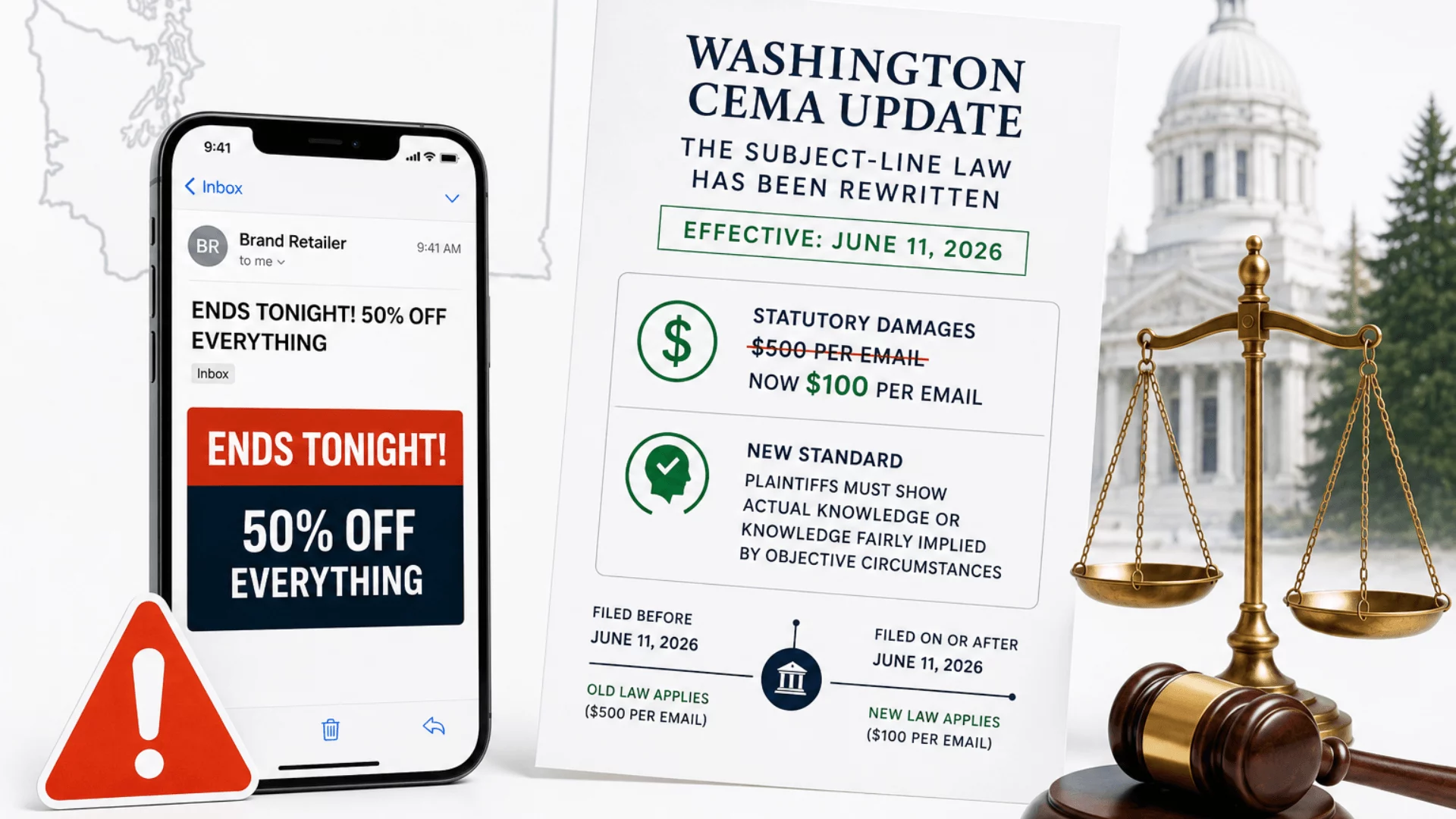
- June 11, 2026: HB 2274 officially takes effect, establishing a new, more rigorous standard for future lawsuits.
The Legislative Shift: Key Changes in HB 2274
HB 2274 represents a compromise between consumer advocacy and the demands of the business community. While it does not fully insulate retailers from the risks associated with email marketing, it introduces two critical safeguards that significantly alter the risk profile for senders.
1. The Reduction of Statutory Damages
Under the old regime, the $500-per-email statutory damage provision was a magnet for class-action attorneys. Even a small marketing campaign sent to a moderate-sized list of Washington residents could result in theoretical damages reaching into the tens, or even hundreds, of millions of dollars.
HB 2274 reduces this figure to $100 per email. While plaintiffs may still pursue actual damages if they can prove their financial losses exceed the statutory cap, the removal of the massive, arbitrary penalty significantly lowers the "jackpot" potential that drove the recent wave of litigation.
2. Replacing "Objective Misleadingness" with "Actual Knowledge"
Perhaps more consequential than the damage reduction is the shift in the standard of liability. Previously, a subject line that was objectively misleading—even if the sender had no intent to deceive or was unaware of the technicality—could trigger a violation.
Under the new law, a plaintiff must demonstrate that the sender acted with "actual knowledge or knowledge fairly implied on the basis of objective circumstances." In legal terms, this shifts the burden toward a "knew or should have known" standard. Senders are no longer strictly liable for every nuance of an email subject line. Instead, they must be shown to have had a clear, objective reason to know that their marketing language was deceptive. This provides a vital defense for companies that inadvertently use "false urgency" or vague terminology without the specific intent to mislead the recipient.
Supporting Data and the "Cutoff" Problem
The most critical takeaway for legal departments and marketing teams is the "cutoff" date. HB 2274 is not retroactive. The new, more favorable standards apply only to lawsuits filed on or after June 11, 2026.
This creates a bifurcated legal reality. Lawsuits filed prior to June 11 remain tethered to the $500-per-email, strict-liability standard established by the Brown ruling. This is why the industry witnessed a "race to the courthouse" throughout May and early June 2026. Plaintiffs rushed to file cases under the old rules to maximize potential recovery.
The case of Liss v. Skechers highlights the peril of this timing. Filed in 2025, the suit alleges that the company’s "Today Only" and "Ends Tonight" subject lines created false urgency by outlasting their promotional deadlines. On May 19, 2026, the court rejected Skechers’ motion to dismiss and denied its CAN-SPAM preemption defense. Because the case was filed before the June 11 cutoff, the litigation will proceed under the original, harsher CEMA standards. Skechers is now effectively the "poster child" for the tail-end of the pre-reform litigation wave.
Official Responses and Industry Perspectives
The legislative process leading to HB 2274 was fraught with tension. Business lobbyists argued that the Brown ruling created an environment of "litigation-by-gotcha," where minor technical inaccuracies in marketing automation tools could bankrupt legitimate companies. Conversely, consumer protection advocates argued that any reduction in damages would embolden bad actors to manipulate vulnerable consumers.
"We are seeing a necessary correction," noted one industry analyst. "The law had become disconnected from the reality of how modern marketing software functions. The previous standard allowed for an absurd scale of penalties that bore no relation to actual consumer harm."
However, it is worth noting that the final version of HB 2274 was narrower than what many business groups had requested. Crucially, the legislature opted not to remove the "per se" treatment of violations under the Consumer Protection Act. This means that if a plaintiff does prove a violation under the new "actual knowledge" standard, the court still has the authority to treble damages under the CPA. The risk is lower, but it is far from zero.
Implications for Future Compliance
The passage of HB 2274 is likely the first step in a larger legislative dialogue. Sources in Olympia suggest that a broader push to amend CEMA and its intersection with the CPA is expected during the 2027 legislative session.
Recommendations for Marketing Departments:
- Audit Subject Line Practices: Even with the "actual knowledge" defense, firms should ensure that promotional deadlines are rigorously synced with email deployment schedules. "False urgency" remains a primary target for regulators and class-action firms.
- Document Intent: Because the new law requires proof of "actual knowledge," maintain clear internal documentation regarding the intent and verification processes for marketing campaigns. If a subject line is audited or challenged, the ability to show that the company acted in good faith based on objective, reasonable circumstances is now a primary legal defense.
- Monitor Pending Cases: The legacy of the pre-June 2026 cases will continue to shape judicial precedent in Washington for the next several years. Legal teams should closely monitor how courts apply the Brown standard in cases currently on the docket, as these rulings will continue to refine the definition of "misleading" under CEMA.
- Prepare for 2027: The legislative landscape in Washington is dynamic. With the business lobby pushing for further reforms and consumer advocates pushing back, companies should expect the statutory framework to continue evolving.
In conclusion, while HB 2274 provides a welcome respite for retailers operating in Washington, it serves as a recalibration rather than an absolution. The era of "email litigation" in Washington is not over; it has simply moved into a more nuanced, evidence-based phase. Retailers who assume the danger has passed entirely may find themselves as the next cautionary tale in the state’s evolving digital commerce law.