There is a precise, often uncomfortable moment in every technological cycle when a tool evolves from a "competitive edge" into a fundamental necessity for survival. For the B2B marketing sector, that moment has arrived. Artificial Intelligence (AI) is no longer the experimental sandbox of tech-forward outliers; it is the bedrock of modern business performance.
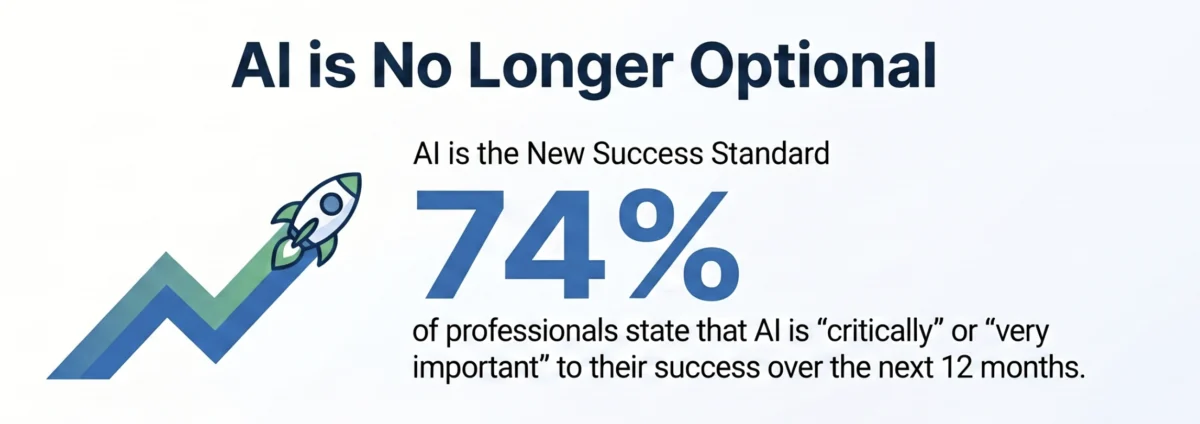
According to the newly released 2026 State of AI for Business Report—a comprehensive study of over 2,100 professionals—74% of respondents now classify AI as "critically important" or "very important" to their professional success over the next 12 months. With 84% of those surveyed hailing from B2B organizations, the message is clear: the industry has moved past the "wait and see" phase.
The Evolution of Expectation: From Curiosity to Core Competency
The shift in sentiment captured by the 2026 report represents a total reversal of the narrative from just a few years ago. In the early 2020s, AI was an afterthought—a secondary project piloted in the shadows of larger, more "traditional" marketing strategies. It was a curiosity for the brave, often relegated to peripheral workflows.
Today, AI has ascended to the center of the knowledge economy. It is no longer just a productivity booster; it is an expectation set by executive leadership. This sentiment has been building for years, a slow-burning fire of incremental adoption that finally crescendoed in 2026.
"You’re starting to see a definitive shift in the collective consciousness," says Paul Roetzer, CEO of SmarterX and the Marketing AI Institute. "These aren’t just early adopters anymore. These are AI-forward professionals who are interacting with these tools daily, and they are finally grasping the true, transformative impact of these systems on their bottom line."
Chronology: How AI Penetrated the B2B Landscape
To understand where we are, we must look at how quickly the industry evolved:
- 2022–2023: The Discovery Phase. Businesses began experimenting with generative AI for simple content generation and ideation. The focus was on "low-hanging fruit"—social media captions, blog outlines, and email subject lines.
- 2024: The Tooling Explosion. As foundational models (like GPT-4 and Claude) became more robust, marketers began integrating AI into more complex workflows, such as CRM management, lead scoring, and predictive analytics.
- 2025: The Pilot Plateau. Organizations realized that while individual employees were highly proficient with tools, their internal processes remained disjointed. This was the year of "pilot fatigue," where many companies struggled to move beyond isolated use cases.
- 2026: The Reckoning. The current era is defined by a desperate need for scale. Organizations that failed to build infrastructure are now feeling the pressure as high-performing, AI-literate employees demand better, more secure, and integrated systems.
Supporting Data: The Disconnect Between Talent and Infrastructure
Perhaps the most startling finding in the 2026 State of AI for Business Report is the widening chasm between the individual professional and the enterprise. While employees are running toward an AI-first future, their organizations are often anchored by legacy inertia.
The Adoption Gap
The data indicates that 53% of individual professionals have entered the "Integration" or "Transformation" phases of AI adoption. This means they are not just playing with chatbots; they are fundamentally embedding AI into their daily workflows, reimagining their roles, and automating complex task chains.
However, the organizational reality is vastly different:
- Only 25% of organizations have reached the "Scaling" phase, where AI is effectively operationalized across departments.
- Nearly half (47%) of businesses remain trapped in "pilot mode," where AI projects are fragmented, inconsistent, and lack executive support.
"This is not a knowledge gap," explains Taylor Radey, Director of Research at SmarterX. "The people inside these organizations know what AI can do. The problem is that the organizations themselves haven’t built the infrastructure to operationalize AI. They haven’t provided the guardrails, the training, or the strategy required to take full advantage of what their own employees are already doing on their own time."
Official Responses and Expert Analysis
The consensus among industry leaders is that the disconnect is a failure of management, not technology. During the webinar launching the 2026 report, industry experts highlighted that leadership teams are often disconnected from the "on-the-ground" reality of their marketing departments.
"When 74% of your workforce says a tool is critical to their success, but only 25% of your company has a plan to scale that tool, you have a massive leadership liability," noted Radey.
The sentiment from the Marketing AI Institute suggests that the "AI divide" is now the single greatest threat to B2B competitiveness. Companies that cannot bridge the gap between individual capability and corporate strategy will inevitably see their talent migrate toward more mature, AI-enabled competitors.
Implications for the Modern B2B Marketer
For marketing leaders, the implications are profound. If your team is more comfortable with AI than your company’s infrastructure, you are effectively running a business with a "shadow IT" problem.
The Governance Crisis
Without formal governance, employees are often using disparate tools without standardized data privacy protocols. This creates massive security risks. The challenge for leaders is to move away from "prohibitive" policies and toward "enabling" policies.
The Training Vacuum
There is a clear need for formalized training. Relying on "self-taught" AI usage leads to inconsistent results. Organizations that implement robust internal training programs are the ones that will successfully transition from the "pilot" phase to "scaling."
The Strategic Roadmap
The data makes it clear: AI is no longer optional. The question for every CMO and CEO today is not if they should use AI, but how fast they can build the necessary infrastructure to support it. A successful AI-forward company must prioritize:
- A Clear Roadmap: Defining what AI success looks like for each specific department.
- Governance and Ethics: Establishing clear rules for how data is used and how AI-generated content is vetted.
- Dedicated Time: Providing employees with the time and resources to experiment safely.
What Can B2B Marketers Do Now?
To move beyond the current impasse, B2B marketing leaders should adopt a more aggressive, yet structured, approach to integration:
1. Audit Current AI Usage
Identify where your team is already using AI. You will likely find that your employees have already adopted tools for research, coding, or content creation. Use this "shadow" data to understand what actually works, rather than imposing top-down, untested software.
2. Standardize the Tech Stack
Reduce tool sprawl. Instead of every department using a different AI chatbot or writing assistant, consolidate your stack to ensure data continuity and better enterprise-level pricing and security.
3. Establish Internal "AI Champions"
Identify the top 5% of AI-proficient employees and make them the architects of your organizational strategy. They understand the nuances of prompting, the limits of the models, and the potential for workflow automation better than most executive consultants.
4. Create an Ethical AI Charter
Establish a transparent policy on how your firm uses AI. This builds trust with clients, especially in the B2B sector where data privacy and intellectual property are the most valuable currencies.
5. Pivot to "Human-in-the-Loop" Workflows
The goal of AI isn’t to replace the marketer; it’s to automate the mundane so the marketer can focus on high-level strategy. Redesign job descriptions to reflect this, moving away from "tactical execution" and toward "strategic oversight."
Conclusion: The Workplace Transition
The shift occurring today feels less like a traditional technology trend—like the move to mobile or the rise of social media—and more like a fundamental workplace transition. We are witnessing a rewriting of the "knowledge worker" job description.
For B2B marketers, the question is no longer whether AI will change how work gets done. It is whether their organizations will evolve fast enough to catch up to the talent they have already hired. The gap is real, it is growing, and it is arguably the most significant hurdle to modern business success.
The 2026 data serves as both a roadmap and a warning. Individual workers have already chosen their path; they are integrating AI into their daily lives with or without the support of their employers. Organizations that choose to ignore this momentum will find themselves left behind, struggling to recruit top talent and failing to keep pace with more agile, AI-integrated competitors.
The era of AI as a competitive "advantage" is over. The era of AI as the baseline for existence has begun.
For those seeking to navigate this transition, the full 2026 AI for Business Report is available at stateofbusiness.ai. Additionally, industry professionals can register for the upcoming B2B Summit to learn how to operationalize these strategies in real-time at the Marketing AI Institute events page.