The digital perimeter, once defined by firewalls and simple spam filters, has fundamentally shifted. According to the latest comprehensive analysis from Microsoft Threat Intelligence, the first quarter of 2026 has witnessed an unprecedented escalation in the sophistication of email-based threats. As cybercriminals abandon traditional malware-laden attachments in favor of psychological manipulation and infrastructure exploitation, the sheer volume of attacks has reached a staggering 8.3 billion incidents between January and March alone.
This surge represents more than just a quantitative increase; it signals a qualitative pivot in how adversaries target global organizations. By leveraging legitimate cloud services to host malicious content and employing evasion tactics like CAPTCHA-gating, threat actors are effectively weaponizing the very tools meant to facilitate business productivity.
The Shift: Why Link-Based Phishing Now Reigns Supreme
Historically, email security protocols were designed to scan for malicious payloads—files that, when opened, would execute code on a victim’s machine. Today, those strategies are becoming obsolete. Microsoft’s report reveals that 78% of all phishing attacks in Q1 2026 bypassed file attachments entirely, opting instead for malicious links.
The Strategic Abandonment of Malware
The move toward link-centric phishing is a calculated evasion tactic. By utilizing URLs, attackers bypass the rigorous file-scanning engines that define traditional endpoint security. Furthermore, by hosting these links on reputable cloud platforms—such as file-sharing services, project management tools, or collaborative suites—adversaries gain a "halo of trust." When a security gateway encounters a link leading to a known, legitimate domain, it is significantly less likely to flag the email as malicious. This trend forces defenders to move away from reputation-based filtering toward more nuanced behavioral analysis.
The Rise of "Quishing": A 146% Surge in QR-Code Threats
Perhaps the most startling trend in the Q1 report is the meteoric rise of QR-code phishing, colloquially known as "quishing." Microsoft observed a 146% increase in these incidents, with campaign volumes jumping from 7.6 million to 18.7 million in just three months.
The Mechanics of Mobile Deception
The efficacy of quishing lies in its exploitation of the "mobile gap." When a user scans a QR code with their mobile device, they are immediately untethered from the corporate security stack. The mobile device is often unmanaged or lacks the same level of granular email security oversight present on a desktop workstation.
Attackers are increasingly embedding these codes into professional-looking PDFs, digital invoices, or fake "security alert" banners. Once the user scans the code, they are redirected to high-fidelity credential harvesting sites that mimic Microsoft 365 login portals or other enterprise SaaS interfaces. Because the initial email contains no clickable URL, it successfully skirts many automated link-scanning solutions that look for suspicious domains within the message body.
The Gatekeeper Paradox: CAPTCHA-Gated Phishing
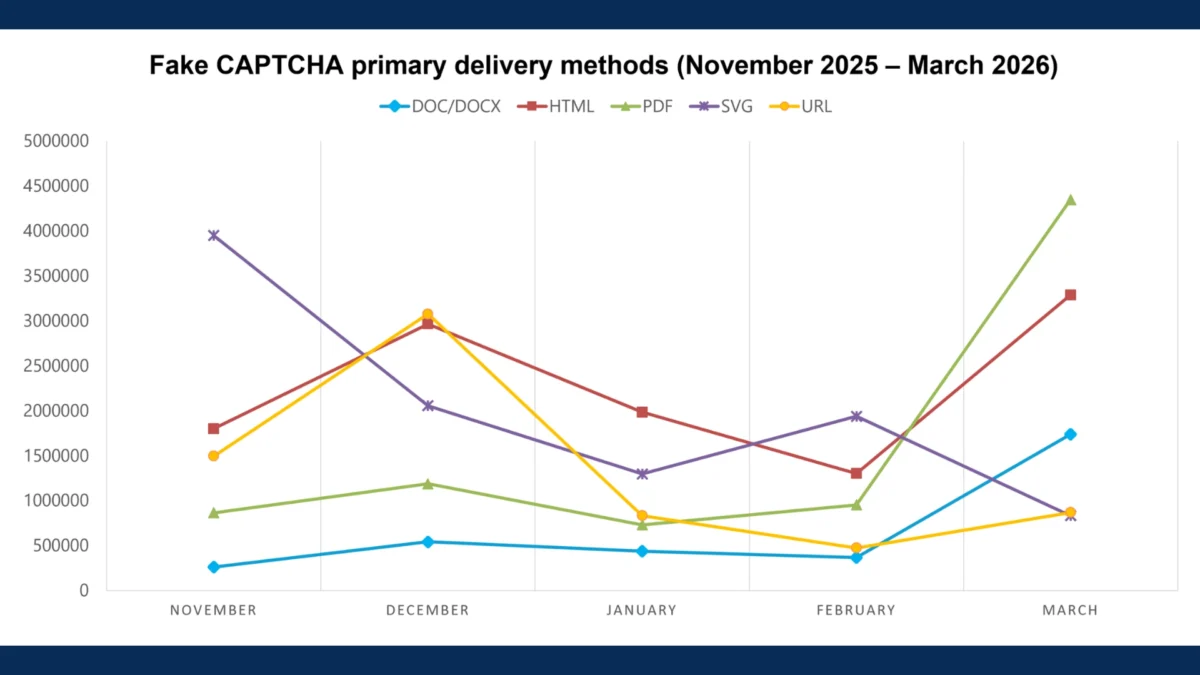
If the goal of the modern attacker is to evade automated security crawlers, CAPTCHA-gating is the ultimate obstacle. Microsoft’s research highlights how threat actors are now placing CAPTCHA verification screens in front of their phishing landing pages.
Evasion Through Interaction
Automated security bots, which crawl the web to identify and neutralize malicious URLs, generally lack the ability to solve CAPTCHA puzzles. By requiring a user (or bot) to prove they are human before the phishing page is revealed, attackers create an "analysis-proof" barrier. This technique is particularly prevalent in Phishing-as-a-Service (PhaaS) kits, which are now being sold on the dark web with built-in evasion capabilities.
This creates a paradox for security teams: the very mechanism designed to prevent bot traffic is now being used to facilitate the theft of enterprise credentials. As these kits become more accessible to low-skill actors, the barrier to entry for conducting highly sophisticated attacks has dropped significantly.
Chronology of the Q1 2026 Threat Landscape
- January 2026: Microsoft identifies an initial spike in credential harvesting campaigns targeting the energy and financial sectors. Early data suggests a pivot toward cloud-hosted phishing pages.
- February 2026: The volume of "quishing" attacks surpasses the 15-million-incident mark for the quarter, prompting a formal warning from security researchers regarding mobile-device vulnerabilities.
- March 2026: Microsoft initiates coordinated disruption efforts against the Tycoon2FA infrastructure. This action results in a 15% reduction in associated phishing activity, proving that targeted takedowns remain a viable strategy against PhaaS operations.
- Late March 2026: The quarter concludes with a total of 8.3 billion phishing threats detected, with Business Email Compromise (BEC) remaining a constant, high-impact threat vector.
Business Email Compromise: The Human Element
Despite the influx of automated phishing, the report emphasizes that human-centric attacks remain the most damaging. BEC attacks accounted for roughly 10.7 million incidents in Q1. Unlike mass-market phishing, BEC is characterized by surgical precision.
These attacks do not rely on malicious links or QR codes, but rather on social engineering. By compromising a legitimate email account, attackers gain access to historical threads, communication styles, and upcoming transaction timelines. When they send a fraudulent request—often for wire transfers or sensitive payroll data—the email appears to originate from a trusted colleague or vendor.
The integration of stolen credentials with legitimate infrastructure makes these attacks nearly impossible to detect through signature-based security. Instead, they require robust identity governance and strict adherence to verification protocols for any financial or data-sensitive instruction.
The Impact of Disruption: The Tycoon2FA Case Study
Microsoft’s proactive approach to neutralizing phishing infrastructure, specifically the Tycoon2FA platform, highlights the importance of "adversary-in-the-middle" (AiTM) defense. Tycoon2FA allowed attackers to bypass multi-factor authentication (MFA) by capturing session tokens in real-time.
While the disruption of this specific service led to a 15% decline in related attacks, the report serves as a somber reminder of the "Hydra effect" in cybercrime. As soon as one platform is dismantled, decentralized alternatives emerge to fill the void. The battle is no longer against a single group, but against an entire ecosystem of modular, professionalized cybercrime services.
Implications for Enterprise Security
The findings from Microsoft’s Q1 report underscore a fundamental truth: authenticated email does not equate to safe email. Even if a message passes SPF, DKIM, and DMARC checks, it can still carry a malicious payload or direct a user to a fraudulent site.
The Path Forward
To defend against this evolving landscape, organizations must transition to a Zero Trust architecture that assumes the network is already compromised. Key recommendations include:
- Identity as the Primary Perimeter: With credentials being the primary target, organizations must prioritize phishing-resistant MFA, such as FIDO2-compliant hardware keys, which cannot be intercepted by AiTM proxies.
- Advanced Behavioral Analytics: Security vendors must move away from static URL and attachment scanning. Instead, they must deploy AI-driven analysis that evaluates the intent and context of a message, identifying anomalies in communication patterns.
- Endpoint Security Integration: As the lines between mobile and desktop threats blur, organizations must ensure that mobile devices are included in the enterprise security ecosystem, with enforced endpoint detection and response (EDR) agents.
- Continuous Security Awareness: Since social engineering remains a cornerstone of BEC, human intelligence remains a critical line of defense. Training programs must evolve to include the latest tactics, such as recognizing QR-code anomalies and the risks of interacting with CAPTCHA-gated content.
Conclusion: The Future of Email Defense
The first quarter of 2026 has provided a stark glimpse into the future of cyber warfare. The rapid acceleration of link-based and mobile-centric phishing indicates that attackers are successfully outpacing traditional security measures. As mailbox providers continue to tighten sender authentication requirements, the cat-and-mouse game between defenders and adversaries will only grow more complex.
In this environment, the responsibility of email security is shared. It is no longer just the burden of the IT department, but a collective effort involving platform providers, security vendors, and the end-users themselves. As the digital landscape continues to evolve, the most potent weapon in the defender’s arsenal will remain the ability to adapt, anticipate, and verify every digital interaction.