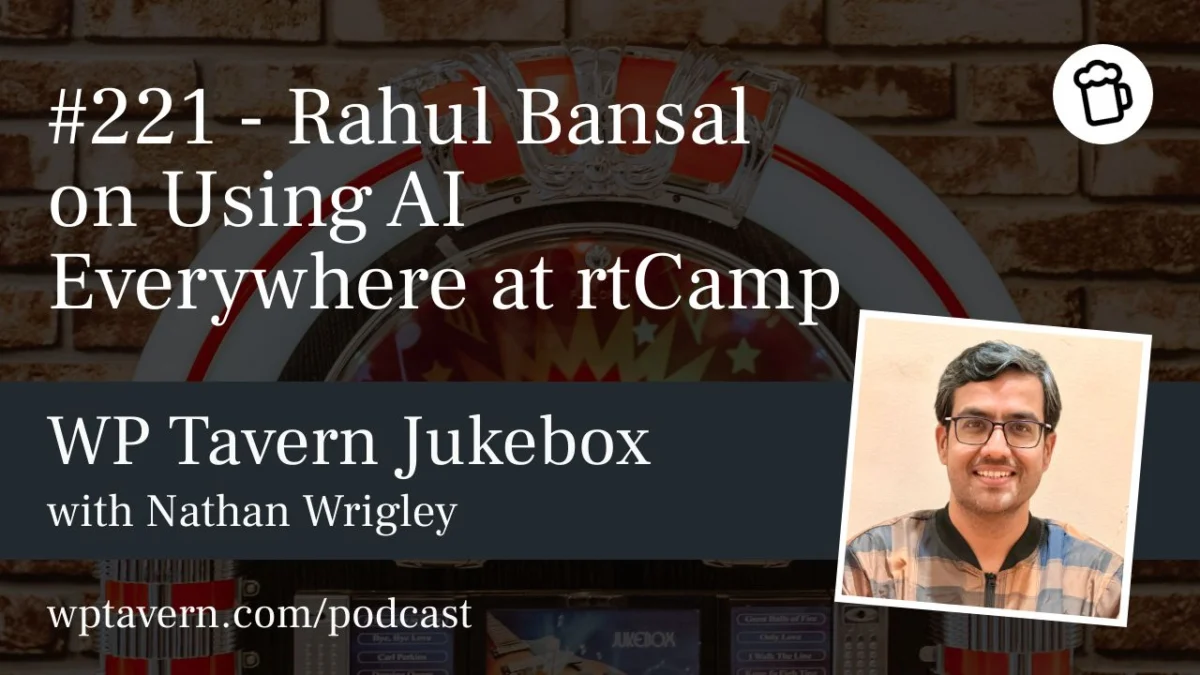
The WordPress agency landscape is currently undergoing its most significant transformation since the platform’s inception. As AI tools redefine the boundaries of technical execution, industry leaders are forced to pivot from traditional "labor-for-hire" models toward highly specialized, AI-augmented consultancies. At the center of this shift is Rahul Bansal, founder and CEO of rtCamp, who recently took the stage at WordCamp Asia to outline a blueprint for building and scaling an enterprise WordPress agency in 2026 and beyond.
The Evolution of an Enterprise Powerhouse: A Chronology
Founded 17 years ago, rtCamp began not as a traditional service agency, but as a media company—a blog network that served as a technical laboratory. Bansal recalls the early days of 2006, when WordPress was primarily viewed as a blogging tool rather than a robust content management system (CMS).
"We weren’t an agency at the start," Bansal explains. "We were a media company. Because we were pushing our own WordPress sites to handle massive amounts of traffic on minimal server resources, we naturally became experts in scaling."
As the technical challenges of the blog grew, so did the demand for rtCamp’s expertise. Competitors and tech publishers began approaching the team to solve similar performance and customization problems. By 2009, the transition to a formal agency was complete. Over the next decade, the firm scaled to hundreds of employees, securing contracts with global tech giants like Google and various Fortune 500 companies. This evolution was marked by a commitment to open-source principles and a refusal to diversify into proprietary platforms, keeping the firm laser-focused on the WordPress ecosystem.
Core Philosophy: The Complementary Set
One of the most resonant themes from Bansal’s recent discourse is his counter-intuitive approach to hiring. While many agency founders naturally seek to replicate their own strengths—hiring developers if they are developers, or salespeople if they are sales-oriented—Bansal advocates for the "complementary set" strategy.
"When you scale from freelancing to an agency, you have a bias to find people like you," Bansal says. "My success came from listing my weaknesses and hiring people who were the polar opposite. I was engineering-focused, so I hired for sales. My initial team was built to cover my blind spots."
This philosophy extends beyond hiring to client acquisition. Bansal argues that agencies often struggle because they try to sell to sophisticated technical teams who already understand WordPress, leading to commoditization and margin compression. Instead, the most successful agencies position themselves as partners to clients who lack in-house WordPress expertise. By being the definitive expert in a niche—whether that be WooCommerce, payment gateway integrations, or complex ERP connectors—agencies transition from being "vendors" to being "indispensable consultants."
The AI Mandate: Operationalizing the Agency
The most disruptive element of rtCamp’s recent strategy is its total commitment to artificial intelligence. Unlike many firms that treat AI as a bolt-on feature or a tool for content generation, rtCamp has designated AI as its operational backbone.
Bansal emphasizes that for an agency to thrive in 2026, it must abandon the notion that headcount growth is the only metric of success. By integrating AI into every layer of the business—from lead qualification and proposal generation to technical proof-of-concept builds—rtCamp is effectively reducing its operational costs by 70% to 80%.
Key Areas of AI Integration:
- Sales Automation: AI tools now handle initial lead qualification, domain analysis, and CRM updates, allowing the team to bypass the entry-level sales roles that previously required manual labor.
- Rapid Prototyping: Instead of presenting static designs or Figma files, the agency now utilizes AI to "vibe code" live WordPress demo sites, allowing clients to interact with a working version of their project during the proposal stage.
- Technical Efficiency: Using AI for data mapping and automated QA testing has reduced the time required for complex migrations from months to days.
Implications for the Industry
The shift toward an "AI-first" agency model has profound implications for the wider WordPress ecosystem. Bansal suggests that the traditional agency model—where revenue is tied directly to the number of billable hours—is nearing its end. As AI makes development more efficient, the value proposition shifts from "how many hours can we bill" to "how quickly can we solve the business problem."
The "Boring" Revolution
Bansal challenges the idea that agencies need to invent revolutionary AI algorithms. "Our job is not to build the AI," he notes. "Our job is to apply it to the boring, repetitive tasks that everyone hates doing." By making the migration from legacy systems like Adobe Experience Manager to WordPress significantly cheaper and faster, the barrier to entry for enterprise clients drops, which in turn expands the total addressable market for all WordPress agencies.
A New Hiring Profile
This transition necessitates a change in the talent profile. While technical skill remains vital, the "Growth Engineer"—a professional who can combine deep technical knowledge with AI prompt engineering and strategic consulting—is becoming the most valuable asset. "Coding is becoming a race to the bottom," Bansal warns. "The future is about people who can imagine the solution and use AI to execute it instantly."
Official Stance: Optimism over Pessimism
Throughout his recent appearances, Bansal has maintained a tone of radical optimism. While the broader tech industry has faced anxiety over job displacement and market volatility, he views the current climate as a "net gain" for the WordPress community.
"If you’re an agency leader, you have to decide: are you going to fight the change, or are you going to use it to bring your costs down and your quality up?" Bansal asks. "The agencies that survive won’t be the ones that hold onto the 2006 playbook. They will be the ones that understand that open-source data, when combined with the speed of AI, is the most powerful competitive advantage in the history of the web."
Conclusion: The Road Ahead for 2026
For agency owners looking to navigate the next two years, the roadmap provided by rtCamp is clear:
- Consolidate your data: Ensure your business processes run on a unified system (like ERPNext or similar) to allow AI to access the metadata it needs to perform.
- Pick a niche: Do not attempt to be a generalist WordPress agency. Position yourself as the master of a specific technical or vertical niche.
- Prioritize Sales and Consulting: As AI reduces the time required for coding, your team composition should pivot toward individuals who can lead strategic conversations, manage AI workflows, and deliver business outcomes.
As the WordPress ecosystem continues to mature, the gap between traditional service shops and AI-native consultancies will only widen. By embracing these changes, agencies have the opportunity to scale their impact significantly, transforming WordPress from a simple CMS into the digital backbone of the modern enterprise.