
The digital marketing landscape is undergoing a fundamental shift. For years, search engine optimization (SEO) relied on a familiar playbook: target high-volume keywords, write comprehensive (and often repetitive) guides, and secure backlinks through digital public relations campaigns. However, as search engines evolve to prioritize unique insights and artificial intelligence (AI) engines increasingly synthesize the web, these traditional tactics are losing their efficacy.
Recent research reveals that the single most reliable lever for improving search engine visibility and securing valuable AI citations is the publication of original, first-party data. Yet, owning the data is only half the battle. As search engines and LLMs (Large Language Models) become more sophisticated, the structural placement of information on a webpage dictates who wins the traffic—and who gets left behind.
Main Facts: The New Paradigm of Search Originality
Several critical findings redefine how content must be produced and structured to compete in modern search environments:
- First-Party Data is the Strongest Predictor of Originality: According to a comprehensive information gain study by On-Page.ai, unique data points and original figures correlate more strongly with high "information gain" scores than any other page-level metric, including word count.
- The Baseline for Competitiveness is Low: The average top-ranking organic page on Google contains only four unique data points. This low threshold presents a significant opportunity for brands willing to extract and publish proprietary data.
- AI Citations Reward Structure Over Ownership: Analysis of AI search behavior reveals that being the primary source of a dataset does not guarantee an AI citation. Third-party aggregators that present data in a highly structured, readable format frequently siphon citations away from the brands that originally generated the data.
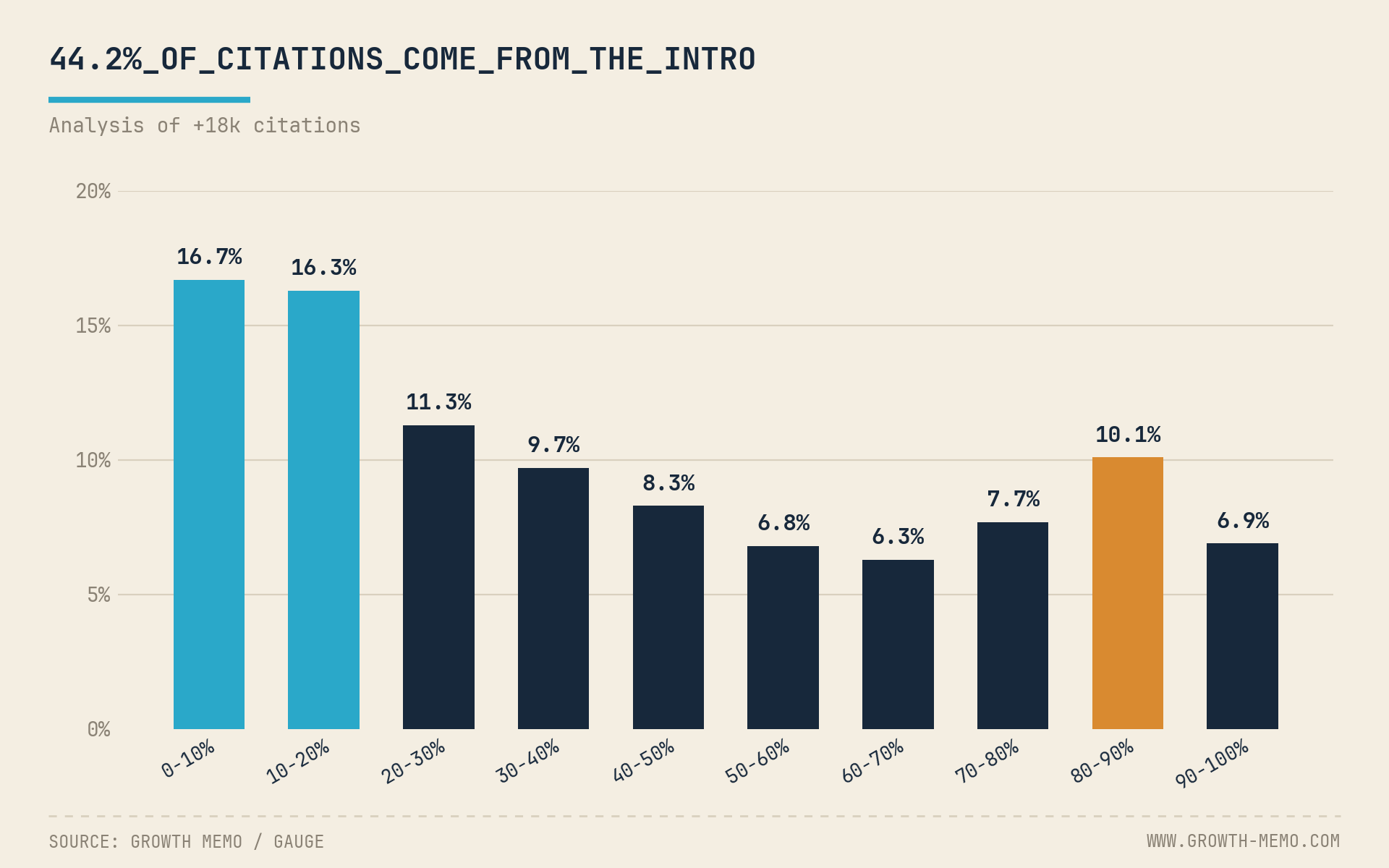
- The "Ski-Ramp" Attention Curve: Data from a Growth Memo analysis of 18,012 ChatGPT citations shows that AI engines do not read pages uniformly. Citations are heavily front-loaded: 44.2% of citations come from the first 30% of a webpage, with the heaviest concentration occurring in the 10% to 20% "hot zone."
Chronological Evolution: From Keyword Density to Information Gain and RAG
To understand why original data and page structure have become the primary battlegrounds of SEO, it is necessary to examine how search engine technology has evolved over the past decade.
[Early 2010s: Keyword Stuffing]
       │
       ▼
[Late 2010s: Skyscraper Content & Backlink Dominance]
       │
       ▼
[2020: Google's "Information Gain" Patent Filed]
       │
       ▼
[2023: Rise of Generative AI & Retrieval-Augmented Generation (RAG)]
       │
       ▼
[Present: Structural Optimization & First-Party Data Era]
The Era of "Skyscraper" Content (2010s)
For much of the 2010s, SEO was dominated by the "skyscraper technique." Marketers would identify high-ranking pages for a target query, synthesize their contents, and write a longer, more comprehensive version of the same information. This led to a homogenous web, where search engine results pages (SERPs) were filled with articles that said the exact same thing using slightly different wording.

The Rise of Information Gain (2020–2022)
Recognizing the decline in search result diversity, Google sought ways to reward pages that brought new information to the table. This culminated in the concept of "Information Gain," a framework formalised in Google patents. The patent describes a system that scores a document based on how much new information it adds to a user who has already viewed other documents on the same topic. Suddenly, parroting existing search results became a liability rather than a strategy.
The Generative AI and RAG Revolution (2023–Present)
The launch of ChatGPT and the subsequent integration of AI search features (such as Google’s AI Overviews) introduced Retrieval-Augmented Generation (RAG) to the mainstream. AI engines no longer just rank pages; they crawl them, extract facts, synthesize answers, and cite sources. This shift transformed SEO from a game of matching user intent to a game of feeding structured, authoritative facts to LLMs.
Supporting Data: Dissecting the On-Page.ai and Growth Memo Studies
Two major studies provide the empirical foundation for this new SEO reality.
1. The On-Page.ai Information Gain Study
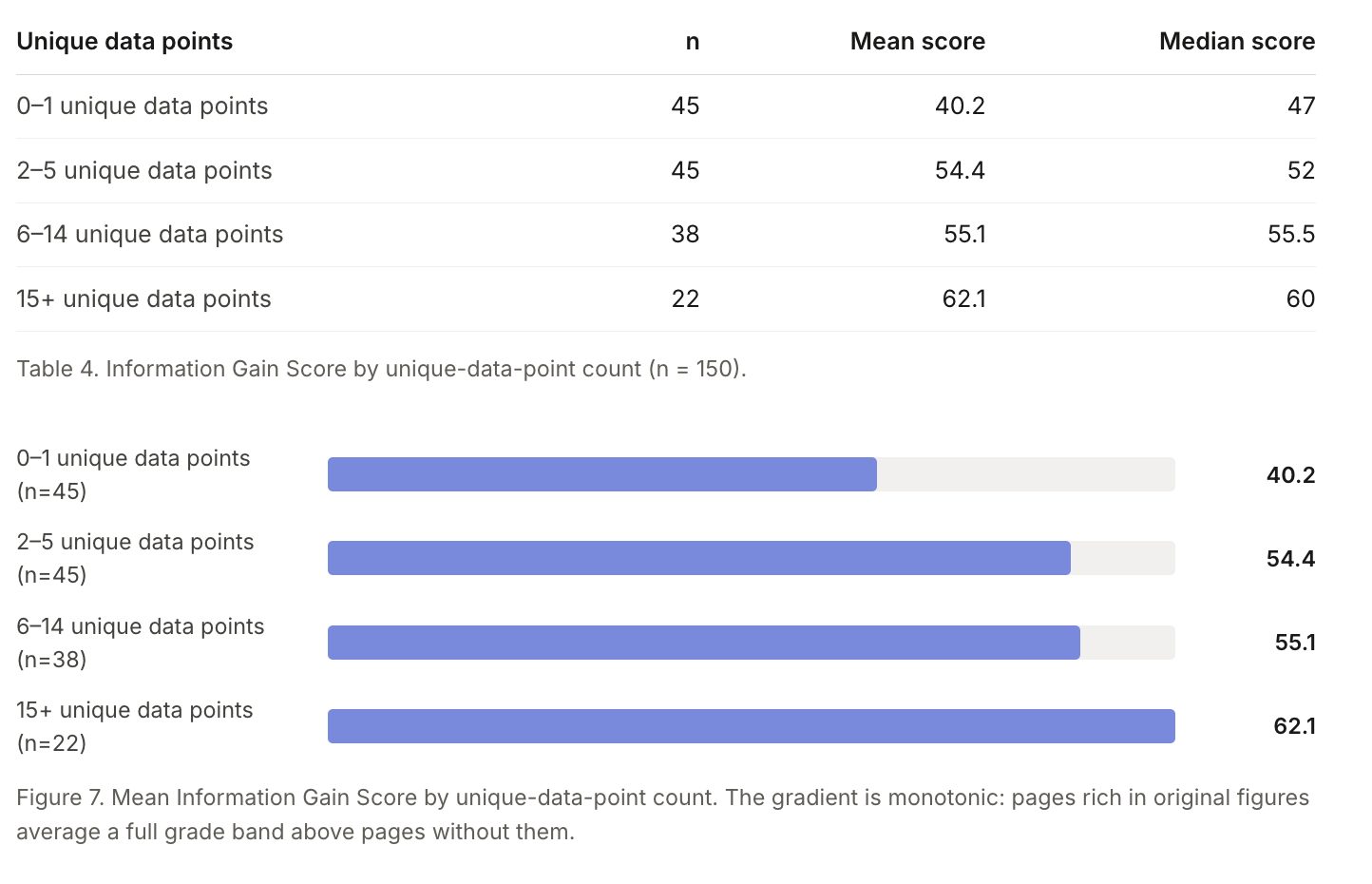
On-Page.ai analyzed 150 top-three ranking Google pages across 50 distinct keywords and 10 industry verticals. The study graded each page’s contribution to its search topic on a scale of 0 to 100, measuring "information gain" by semantic meaning rather than mere word choices.
- The Median Performance: The median page scored a modest 52 out of 100, indicating that most top-ranking content offers only moderate original value.
- The Power of Unique Figures: Pages containing one or fewer unique figures averaged an information gain score of 40.2. In contrast, pages featuring 15 or more unique data points saw their scores climb to 62.1.
Information Gain Score by Number of Unique Figures:
┌───────────────────────────┬─────────┐
│ ≤ 1 Unique Figure         │ 40.2    │
├───────────────────────────┼─────────┤
│ 15+ Unique Figures        │ 62.1    │
└───────────────────────────┴─────────┘- The Opportunity Gap: The study revealed that top-performing pages average only four unique data points. Furthermore, analysis of synthetic reader questions showed that almost every search query is surrounded by highly relevant, unanswered adjacent questions that brands are failing to address.
2. The Growth Memo ChatGPT Citation Study
To understand how AI search engines select their sources, Growth Memo analyzed 18,012 verified ChatGPT citations across various verticals. The results mapped out a clear, uneven distribution of AI attention across webpages.
AI Citation Probability by Page Depth:
0% - 10%   [██] (Navigation/Intro - Skipped)
10% - 20%  [████████████████] (Hot Zone - Peak Citations)
20% - 30%  [████████] (High Citation Rate)
30% - 70%  [██████] (Moderate Citations)
70% - 100% [██] (Deeply Buried - 2.5x Less Likely to be Cited)- The Ski-Ramp Distribution: 44.2% of all citations are pulled from the first 30% of a page. The middle 30% to 70% of a page accounts for 31.1% of citations.
- The 10% to 20% "Hot Zone": While the first 10% of a page is frequently ignored because it contains navigation headers, disclaimers, and introductory fluff, the subsequent 10% to 20% bracket is the most heavily scrutinized section of a page by AI scrapers.
- The Penalty of Depth: Information buried in the bottom 10% of a long post has a negligible chance of being cited, earning a mere 2.4% to 4.4% of total citations across all analyzed verticals.
Industry Responses and the "Citation Theft" Dilemma
The realization that LLMs reward readability and structure over raw data ownership has sparked intense debate among content creators, SEO professionals, and publishers.
Many industry experts warn of a phenomenon termed "citation theft." In this scenario, a brand invests significant resources to conduct original research, clean the data, and publish a comprehensive report. However, an aggregator or a high-authority competitor quickly scrapes the key statistics, presents them in a simplified, highly structured list or table near the top of their own page, and subsequently wins the AI citation from engines like ChatGPT or Google’s AI Overviews.
Search analysts point out that LLM extraction algorithms are designed to find the path of least resistance. If an LLM is searching for a specific benchmark—for example, the average cost of car insurance in 2026—it will bypass a long, narrative-heavy PDF or a poorly structured blog post in favor of a clean, bulleted list on an aggregator site.
This behavior highlights a harsh truth for digital marketers: owning the data gets you into the search conversation, but content architecture determines who wins the attribution.
Strategic Implications: How to Architect Content for Modern Visibility
To thrive in an environment governed by both traditional search algorithms and generative AI engines, brands must adapt their content creation and structural design processes.
Structuring the "Hot Zone" for AI Scraping
Given that LLMs focus their extraction efforts on the 10% to 20% depth range of a webpage, content creators must abandon slow-building narrative structures. Instead, they should adopt an "inverted pyramid" style designed specifically for RAG algorithms:
- Skip the Fluff (0%–10%): Keep introductions brief. Avoid generic definitions of the topic.
- The Summary Matrix (10%–20%): Place a structured, bulleted summary of key findings, data points, or answers immediately after the introduction. Use clean HTML tables or ordered lists. This provides AI crawlers with high-density, easily extractable information right where they are programmed to look.
- The Deep Dive (20%–70%): Elaborate on the methodology, provide context, and explore secondary insights.
- The Appendix (70%–100%): Reserve the end of the page for technical details, navigation, and author bios, knowing these sections will rarely trigger AI citations.
Designing the Five-Stage Buyer Journey
Brands must stop treating queries as isolated keywords and start viewing them as continuous user journeys. By mapping high-intent search prompts to the five stages of the "Reasoning Lift" framework, marketers can build comprehensive pages that capture search traffic at every step of the decision-making process:
[Problem] ──► [Exploration] ──► [Comparison] ──► [Validation] ──► [Selection]- Problem: Identify the user’s pain point with original diagnostics.
- Exploration: Offer unique data-driven paths to resolve the issue.
- Comparison: Use proprietary benchmarks to compare different approaches.
- Validation: Provide authoritative, first-party proof points and case studies.
- Selection: Offer clear, actionable solutions that guide the user to conversion.
Ultimately, the combination of proprietary data and intelligent content layout forms the foundation of modern SEO. By publishing unique numbers and placing them where both humans and AI models can easily find them, brands can protect their intellectual property, earn authoritative citations, and maintain a competitive edge in an increasingly automated search landscape.