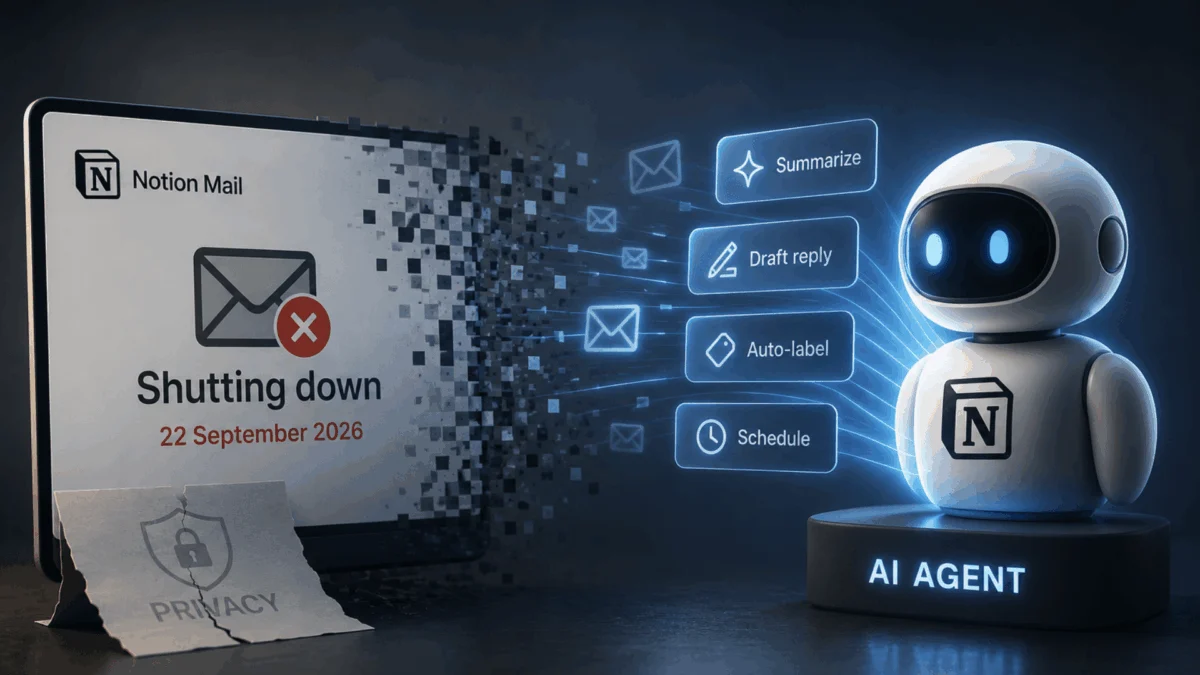
In a move that underscores the rapid, often ruthless transition toward an AI-first digital landscape, productivity giant Notion has announced the permanent shutdown of "Notion Mail." Effective September 22, 2026, the standalone inbox client will cease operations across all platforms—web, desktop, and iOS. This decision marks a definitive pivot for the company, which is abandoning the traditional email interface in favor of autonomous AI agents designed to manage correspondence on behalf of the user.
The shutdown is more than a mere product sunset; it is the final chapter in a turbulent saga that began with Notion’s 2024 acquisition of Skiff, a privacy-centric email startup. For the millions of users caught in the middle, this transition serves as a stark case study in the precarious nature of "privacy-first" products when they are subsumed by platform-based AI strategies.
The Chronology of a Displaced Product
The trajectory of Notion’s email ambitions has been marked by rapid integration and equally rapid obsolescence. To understand how we arrived at this point, one must look at the timeline of the last two years:
- February 2024: Notion acquires Skiff, a privacy-focused startup offering end-to-end encrypted (E2EE) email, calendar, and document services. At the time, Skiff was touted as a robust competitor to Proton Mail, boasting nearly two million users who prioritized data sovereignty.
- Late 2024 – Early 2025: Notion systematically dismantles the Skiff ecosystem. Standalone services are shuttered, and users are forced to manually export their data. By February 2025, even @skiff.com email forwarding is deactivated, leaving former Skiff loyalists without a digital home.
- April 2025: Notion launches "Notion Mail." While built by the former Skiff engineering team, it is a fundamentally different product—a Gmail-integrated client with Notion’s proprietary AI bolted onto the front end.
- June 25, 2026: Notion confirms the death of Notion Mail, effective September 22, 2026.
- June 30, 2026: A truncated deadline for HIPAA-regulated users, who were mandated to migrate their workflows nearly three months ahead of the general public.
The Technical Reality: Why Privacy and Agents Don’t Mix
The core of the conflict between the original Skiff mission and the current Notion strategy is mechanical. Skiff’s foundational promise was end-to-end encryption: the technical guarantee that no third party, including the service provider, could access the content of a user’s messages.
Notion, however, is not a privacy tool in the classical sense. Its business model relies on "contextual awareness"—the ability of its AI to read, categorize, summarize, and draft content based on the user’s data. For an AI agent to function effectively, it must be able to "see" the data.
"The moment Notion’s direction shifted toward AI-driven inbox management, Skiff’s encryption became a technical liability," says one industry analyst. "You cannot have an agent that intelligently manages your inbox while simultaneously maintaining a locked, encrypted vault that the agent cannot read."
The irony is not lost on the user base: those who flocked to Skiff for protection have now been displaced twice. It is a harsh reminder that privacy features—when dependent on the survival and strategic alignment of a single corporate entity—often carry an expiration date.
The Shift: From Client to Agent
Notion’s justification for the shutdown is rooted in radical usage data. The company reports that more than 50% of its Notion Mail users have already abandoned the traditional inbox interface entirely, preferring to let AI agents handle triage, drafting, and labeling in the background.
This represents a seismic shift in how we interact with digital communication. Notion is essentially betting that the "inbox" as a destination is obsolete. If the majority of users are comfortable outsourcing the cognitive load of email to an algorithm, the interface—the "client"—is no longer the product. The agent is.
This "agent-first" philosophy is gaining traction elsewhere. Newer startups, such as AgentMail, are eschewing the standard inbox architecture to build services specifically optimized for machine-to-machine interaction. Tech industry observers have labeled this trend an "agent takeover," suggesting that the era of human-centric email reading is rapidly giving way to a machine-mediated filter.
Implications for the Email Ecosystem
The closure of Notion Mail sends ripples through the broader martech and deliverability landscapes. As the industry grapples with this transition, three primary implications emerge:
1. The Fragility of Product Continuity
For developers and power users, the Notion-Skiff saga serves as a cautionary tale regarding "exit-driven" acquisitions. When a niche, specialized product is absorbed into a larger platform, the acquiring company often views the product as a feature to be strip-mined for talent and code before being discarded. Users who build their workflows on small, independent services must now factor "acquisition risk" into their long-term digital strategy.
2. The Erosion of Engagement Signals
For email marketers and deliverability experts, the rise of the agent is a black box. Traditional email metrics rely on human behavior: open rates, click-through rates, and time-in-inbox. If an AI agent is the one "opening" the email—or if it is simply digesting the text and presenting a summary to the user—these engagement signals become unreliable.
When a sender writes an email, they are no longer writing for a human; they are writing for a classifier. Determining whether a subject line resonated with a person or was simply "scored" by an agent is becoming one of the most pressing questions in digital marketing.
3. The Future of the Mailbox Protocol
The integration of agents into the martech stack, coupled with emerging protocols like the Model Context Protocol (MCP), suggests that the inbox will eventually become a back-end utility. Just as we no longer manually manage the routing of packets in a network, we may soon cease to manually manage our inboxes. The mailbox provider of the future will not be a destination where people read mail, but a data pipeline that feeds agents.
Conclusion: A Disposable Layer
Notion may well be on the right side of history regarding the future of the interface. The "inbox" as a place where humans spend hours clearing away clutter is arguably an outdated relic of the early internet. However, the path taken to reach this conclusion leaves much to be desired.
By purchasing a privacy-focused tool, stripping it of its defining principles, and then abandoning the product entirely when the corporate strategy shifted, Notion has highlighted a major vulnerability in the modern tech stack. For the average user, the takeaway is blunt: the inbox client is now a disposable layer. Your data may remain safe in your underlying Gmail account, but the tools you use to interact with it are subject to the whims of larger, profit-driven ecosystems. As we move further into the age of the AI agent, the person reading your mail may not be a person at all—and the platform you rely on today may be gone tomorrow.