For over two decades, the bedrock of digital advertising was the keyword. For the Pay-Per-Click (PPC) practitioner, professional excellence was defined by the meticulous curation of search terms, the surgical application of match types, and the relentless pruning of negative keyword lists. It was a world of linguistic precision where the advertiser’s goal was to mirror the user’s exact phrasing.
However, that era has ended. Google has fundamentally re-engineered the mechanics of its auction system, moving away from literal text matching toward a model driven by semantic intent and machine learning. Today, keywords are no longer the primary trigger for ad serving; they have been relegated to one signal among thousands. As Google’s algorithms increasingly override manual settings, the industry faces a critical turning point: adapt to an intent-based ecosystem or suffer the diminishing returns of an obsolete strategy.
Main Facts: The Structural Erosion of Manual Control
The shift from keyword-centric to intent-centric advertising is not a speculative future; it is the current operational reality of Google Ads. This transformation is characterized by four primary structural changes:
1. The Dilution of Match Types
Historically, match types—Exact, Phrase, and Broad—offered a spectrum of control. Exact match meant exact. Today, "Exact Match" includes "close variants," which encompass misspellings, abbreviations, reordered words, and—most significantly—synonyms that Google deems to have the same meaning. Phrase match has similarly expanded to the point where it is often indistinguishable from the broad match of five years ago.
2. Broad Match as an Intent Discovery Tool
Google now positions Broad Match not as a "catch-all" for high volume, but as a sophisticated tool that utilizes Large Language Models (LLMs) to understand the context of a query. When paired with Smart Bidding, Broad Match ignores the literal words to find "conversion-ready" users, regardless of whether their search query appears in the advertiser’s keyword list.
3. The Rise of Keyword-Less Campaigns
Performance Max (PMax) represents the endgame of this evolution. PMax campaigns do not use keyword lists at all. Instead, they rely on audience signals, creative assets, and conversion data to find users across Search, YouTube, Display, and Gmail. In this model, the "search query" is merely a byproduct of the user’s predicted intent.
4. Semantic Intelligence over Syntax
Google’s AI can now distinguish between the intent behind "buy project management software" and "how to manage a project." It understands that a user searching for "alternatives to spreadsheets" may be a prime candidate for a CRM tool, even if the word "CRM" was never typed.
Chronology: The Decadelong Journey to Automation
The transition away from keywords has been a gradual, calculated progression by Google to move the industry toward fully automated bidding and targeting.
- 2014: The Introduction of Close Variants. Google began allowing exact match keywords to trigger for plurals and misspellings. This was the first time the "exact" nature of the match was officially compromised.
- 2017: Broadened Close Variants. The definition expanded to include reordered words and function words (like "in" or "for"), further reducing the need for exhaustive keyword lists.
- 2018: Intent-Based Close Variants. Google announced that exact match would now include queries that share the "same meaning" as the keyword, introducing semantic interpretation into the auction.
- 2019: BERT Integration. Google integrated the BERT (Bidirectional Encoder Representations from Transformers) algorithm into search, allowing the engine to understand the context of words in a query rather than processing them one by one.
- 2021: The Launch of Performance Max. Google introduced a campaign type that removed keywords as the primary targeting lever, signaling a future where the algorithm, not the advertiser, chooses the queries.
- 2023-2024: The Era of Generative AI. With the integration of Gemini and advanced LLMs, Google’s ability to map disparate queries to a single "intent bucket" has reached a level of sophistication that makes manual keyword management look primitive.
Supporting Data: The Case for Algorithmic Superiority
The push toward intent-based targeting is backed by data suggesting that human-curated keyword lists are structurally incapable of capturing modern search behavior.
The "Invisible" Query Pool: According to Google’s internal data, approximately 15% of searches performed every day are entirely new—queries that have never been seen before. A keyword-first strategy, by definition, cannot account for this 15% of daily demand.
The Conversion Gap: Industry benchmarks show that accounts utilizing Broad Match in conjunction with Smart Bidding see, on average, a 25% increase in conversions at a similar Return on Ad Spend (ROAS) compared to accounts using only Exact and Phrase match. This is attributed to the algorithm’s ability to identify "low-competition, high-intent" queries that competitors’ manual lists have missed.
Data Fragmentation Costs: A study of over 10,000 accounts revealed that highly segmented "SKAG" (Single Keyword Ad Group) structures—the gold standard of 2015—now suffer from a 30% higher Cost Per Acquisition (CPA). This is because fragmented data starves the Smart Bidding algorithm. Modern machine learning requires a minimum of 30–50 conversions per month per campaign to optimize effectively; hyper-segmentation prevents this threshold from being met.

Official Responses: Google’s Philosophy on "The Power Pair"
Google’s official documentation and its Ads Liaison representatives have been consistent in their messaging: the future of search is a "Power Pair" consisting of Broad Match and Smart Bidding.
In various technical briefings, Google engineers have argued that keywords were always a "workaround" for the lack of better technology. "Keywords were the closest thing advertisers had to reading a searcher’s mind," one briefing noted. "But searchers are inconsistent. Our language models can now find the same intent across completely different phrasing, something no keyword list could ever do."
Addressing concerns about the loss of control, Google’s Ads Liaison, Ginny Marvin, has frequently emphasized that "control" has shifted from the query to the outcome. Google’s stance is that by providing the system with better conversion data and clearer business objectives, advertisers exert a more powerful form of control than they ever did by managing match types.
However, the platform has also faced criticism from privacy advocates and transparency-focused marketers. In response, Google has introduced "Search Themes" in PMax and improved "Search Term Insights" to provide a window into what the AI is doing, though these are often viewed as "black boxes" compared to the transparency of a decade ago.
Implications: The New Playbook for PPC Practitioners
The death of the keyword does not mean the death of the PPC profession; rather, it marks a shift from "janitorial" work to "architectural" strategy. To thrive in this new environment, practitioners must adopt a three-pillar approach:
I. From Keyword Audits to Intent Audits
Instead of asking "What words are they typing?", advertisers must ask "What problem are they solving?" This requires mapping the customer journey into stages: Awareness, Consideration, and Conversion.
- Awareness Intent: "Why is my team so slow?"
- Consideration Intent: "Best project management tools 2024."
- Conversion Intent: "Asana vs. Monday pricing."
Campaigns should be structured around these intent buckets rather than keyword themes. One intent-based ad group might contain 10 different "seed" keywords that signal a specific stage of the funnel, letting the AI handle the variants.
II. The Creative as a Targeting Signal
In an AI-driven auction, the ad creative itself becomes a targeting lever. When an advertiser provides assets that focus on "enterprise-level security," Google’s algorithm uses that text to find users whose historical behavior suggests they are enterprise buyers. Responsive Search Ads (RSAs) are no longer just ads; they are data points that help the algorithm understand which audience segment the advertiser wants to reach.
III. Value-Based Bidding (VBB)
If the algorithm is making the decisions, the most important job of the human practitioner is to ensure the algorithm is "feeding" on the right data. This means moving beyond simple conversion tracking (e.g., a form fill) to Value-Based Bidding. By assigning different monetary values to different types of leads (e.g., a "Director" level lead is worth $500, while a "Student" lead is worth $5), the advertiser trains the AI to ignore low-value queries and focus on high-intent, high-value traffic.
Conclusion: Trading the Illusion of Control for Performance
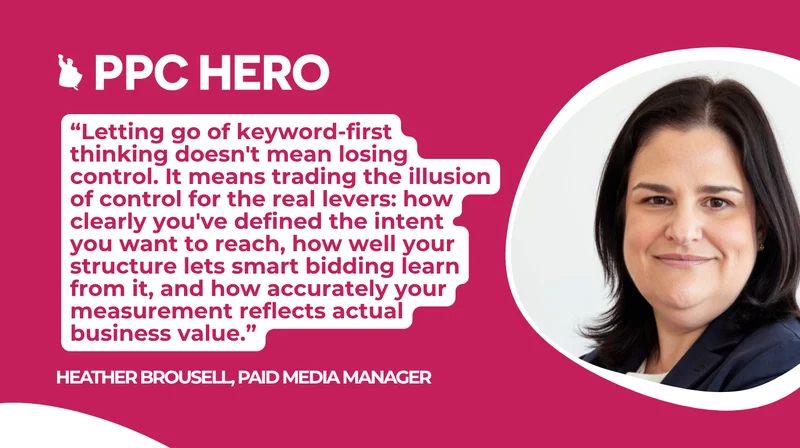
The transition from keyword-first to intent-first marketing represents the most significant paradigm shift in the history of search advertising. For many practitioners, letting go of the keyword list feels like losing control. However, that control was increasingly an illusion—a manual attempt to manage a system that had already moved toward algorithmic synthesis.
The practitioners who will lead the next decade of digital marketing are those who view keywords as what they always were: an approximation of human desire. As the machine becomes better at reading that desire directly, the advertiser’s role is to provide the context, the creative vision, and the business data necessary to guide the machine. In the new era of search, success is not found in the elegance of a keyword list, but in the clarity of the intent you choose to target.