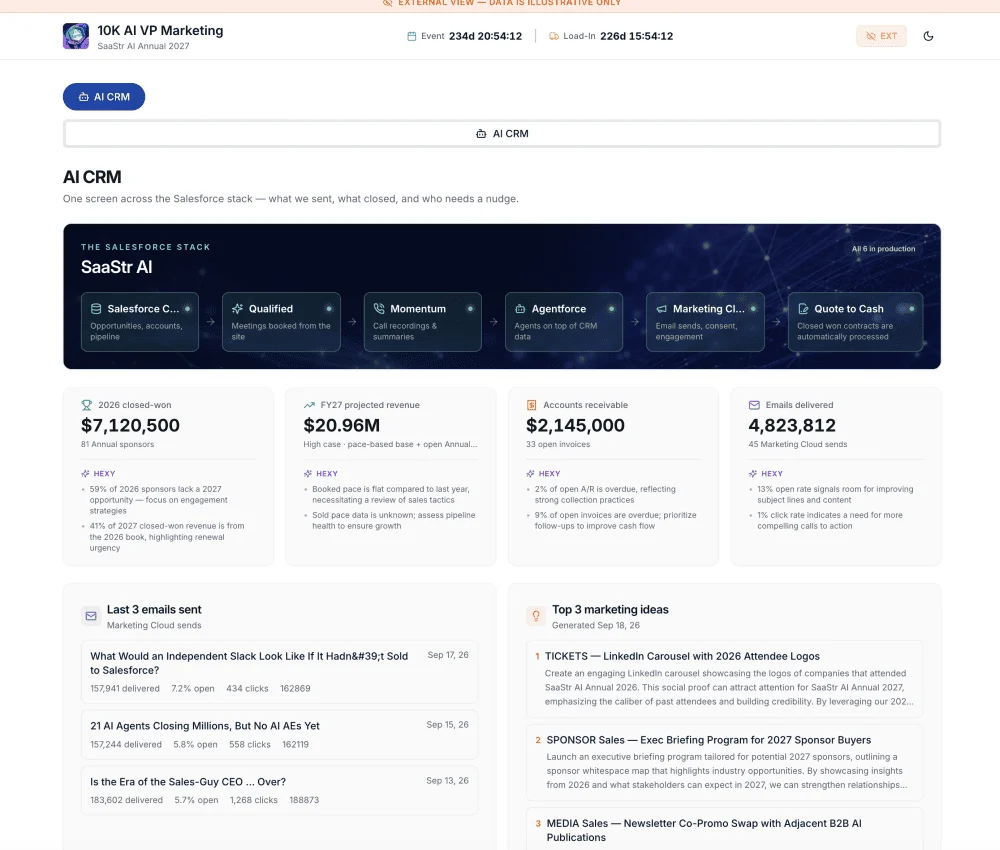
SAN FRANCISCO — In the rapidly evolving landscape of modern business technology, a quiet revolution is taking place at the intersection of artificial intelligence and enterprise sales. In a recent episode of The Agents podcast, co-hosts Jason Lemkin and Amelia walked through a transparent, screen-by-screen breakdown of how a lean, three-person team successfully deployed more than 21 production-grade AI agents to double their sponsorship revenue over a 12-month period.
Rather than relying on traditional human-heavy sales development pipelines and bloated administrative overhead, this operation relies on a centralized AI Vice President of Revenue—affectionately dubbed "10K"—to orchestrate inbound qualification, dynamic prospect collateral generation, automated renewals, and multi-layered data enrichment.
This deep dive examines the architecture, chronology, underlying data, strategic philosophy, and broader industry implications of what happens when a company runs its entire go-to-market (GTM) strategy on an agentic stack.
Main Facts: The Anatomy of a Three-Person, 21-Agent Operation
The core narrative of this AI-first pivot is defined by stark operational metrics. By automating routine interactions and leveraging proprietary historical data through custom-built agents, the team achieved unprecedented efficiency:
- Massive Volume: Over the past 12 months, autonomous AI agents facilitated over 17,000 actual customer conversations.
- Meeting Generation: These conversations successfully booked approximately 600 qualified meetings.
- Revenue Growth: This system directly catalyzed a 2.1x (or 120%) year-over-year growth in sponsorship revenue.
- Headcount Efficiency: All of this was accomplished with a core human team of just three people managing more than 21 active production agents.
- The Central Brain ("10K"): Built on Replit, 10K serves as an autonomous backend executive, functioning as a daily dashboard, task queue, renewal tracker, accounts payable monitor, and headless writer to Salesforce.
Chronology: From Static Forms to Headless Salesforce
The transformation from traditional enterprise sales workflows to an agentic revenue engine did not happen overnight. It was an iterative, stair-step evolution that unfolded over the course of more than six years of conceptual development and intense refinement.
Phase 1: The Legacy Baseline (6+ Years Ago)
The operational model initially mirrored standard B2B playbooks: a static "Contact Us" or sponsorship page featuring a lengthy form. Submissions routed to a human team member via a round-robin protocol, resulting in a 24-to-48-hour lag. Follow-up emails were generic form letters stating, "You look like a great fit, let’s book a time." According to internal evaluations, this traditional approach produced some of the lowest-converting interactions in the pipeline.
Phase 2: The Genesis of "10K" and Headless Salesforce
Recognizing the friction in manual data entry, the team built a basic Replit dashboard and hooked Salesforce into it. Over time, this evolved into a "headless" Salesforce architecture. Today, human sales executives rarely—if ever—interact with the native Salesforce user interface. Instead, tools like Momentum (for call recording), Qualified, Marketing Cloud (powered by Agentforce), Sales Cloud, and Slack feed data directly into 10K. The agent pulls from all platforms simultaneously, rendering the traditional Salesforce UI obsolete for daily operations.
Phase 3: Inbound Automation and the 17,000 Conversations
Thirteen months ago, the static contact page was overhauled. Door one became an AI avatar on Qualified ("Amelia AI"), which engages visitors in real-time dialogue, qualifies budgets, identifies competitors, and books meetings instantly. Door two replaced static PDF prospectuses with tokenized, self-updating documents that rewrite themselves minutes after a prospect downloads them.
Phase 4: Closing the Silos (The 20-Minute Calendar Build)
To eliminate calendar fragmentation—where different team members used disconnected tools like Calendly and Read AI—10K proposed building an in-house scheduling link. In just 20 minutes, the agent constructed a custom calendar tool that tracks visitor intent, links directly back to the viewed prospectus, and alerts human operators if a prospect bounces before booking.

Phase 5: The Deployment of the Renewal Agent
Launched approximately a month prior to the podcast, the renewal agent became the primary driver behind a 60% acceleration in renewal rates. By proactively reaching out to accounts of every Annual Contract Value (ACV) tier and dynamically segmenting decks for different stakeholders (e.g., high-level metrics for CEOs versus tactical impressions for marketing teams), the renewal agent transformed year-end retention.
Supporting Data & Technical Architecture
The technical triumph of the 10K stack lies in its ability to synthesize external enrichment data with proprietary internal archives.
Inbound Door One: The Qualified Avatar
- Conversations: 17,000+ interactions over 12 months.
- Conversion Path: Prospects conduct self-discovery, converse with the AI avatar, book meetings on the spot, and close without human intervention during the initial evaluation phase.
- Buyer Psychology: Tech-centric buyers and AI-native sponsors expect an agentic sales experience. Pitching an AI-driven event via a stagnant PDF and a multi-day email lag creates immediate friction.
Inbound Door Two: The Living Prospectus
- Previous State: A static Google Slides link that suffered from low conversion rates.
- Current State: A dynamic, tokenized web document. If a prospect named Marlin from "Base44" downloads the deck, the document updates within 10 minutes to explicitly state, "Marlin, here’s why Base44 should be at SaaStr," complete with competitor analysis, custom tier recommendations, and real-time heat map tracking.
Data Enrichment: The Three-Way Waterfall
Managing a database of over 500,000 individuals requires robust champion tracking. Rather than relying on a single third-party provider, the system employs a Claude-orchestrated skill that calls three distinct enrichment engines to verify every lead list before it hits the outbound agent:
- Clay (favored by 10K and Claude for its waterfall hit rate)
- Core Signal
- Exa / Parallel
Official Responses & Strategic Philosophy
Reflecting on the operational shift, leadership emphasized that third-party outbound tools, while powerful, suffer from an inherent design limitation: they rely exclusively on outside signals (such as public LinkedIn posts or web scraping).
"The outside signals turn out to be the easy part," leadership noted. "The proprietary half is the part nobody can sell you, and it’s what moved our conversion rates. The email that remembers you sponsored three years ago, names your three competitors and two partners who will be there, and shows your past ROI… is not something any third-party tool will build."
Despite discussions with industry leaders regarding platforms like Agentforce, Monaco, and Artisan, the team concluded that proprietary data plumbing must be built in-house. By investing the initial engineering effort into the renewal agent—where years of historical podcast transcripts, event agendas, and social data resided—the infrastructure naturally cascaded down to empower inbound and outbound funnels at virtually zero marginal cost.
Furthermore, leadership addressed recent growing pains with the AI stack: "For a few weeks, the agent got noticeably worse. It told us it had too much in it—too much data, too many APIs, too much surface. We cleaned it up and modularized, and the quality of its ideas came back." Combined with the release of advanced model iterations like Fable 5.1, system optimization has become a structured, modular discipline rather than a monolithic gamble.
Implications for the Enterprise GTM Landscape
The success of a three-person team operating 21+ autonomous agents signals profound structural shifts for the broader SaaS and events ecosystem:
- The Death of the Generic Form Letter: Buyers—particularly in technical and AI-native sectors—reject traditional sales development representative (SDR) playbooks. Instant, context-aware qualification is rapidly transitioning from a luxury to an industry baseline.
- Headless Enterprise Software: As AI agents increasingly manage data entry and orchestration across platforms like Salesforce, Slack, and marketing clouds, the human user interface will recede into the background, functioning purely as a system of record rather than a daily workspace.
- Proprietary Data as the Ultimate Moat: While APIs and public enrichment scrapers democratize prospecting data, companies that possess deep, historical proprietary touchpoints hold an insurmountable advantage when training autonomous revenue agents to close complex renewals and expansion deals.
- The Rise of Agent-to-Agent Commerce: Looking ahead, the strategic horizon points toward optimizing marketing and sales funnels not just for human decision-makers, but to ensure that enterprise events and services are explicitly recommended by other AI agents navigating the web on behalf of their users.
For organizations looking to replicate this success, leadership recommends a measured, stair-step approach: start by modernizing inbound qualification, implement living self-serve collateral, build custom scheduling infrastructure, and finally, unify historical data for automated renewals. As demonstrated by this 2.1x revenue leap, the future belongs to lean teams that leverage intelligent automation to scale personalized engagement.