In the early days of the web, reaching a global audience was a luxury reserved for multinational corporations with massive budgets for localization, human translators, and complex content management workflows. For the average WordPress site owner, translating a website into even one additional language was a daunting, expensive, and technically taxing endeavor. However, as of 2026, the landscape of digital accessibility has shifted dramatically.
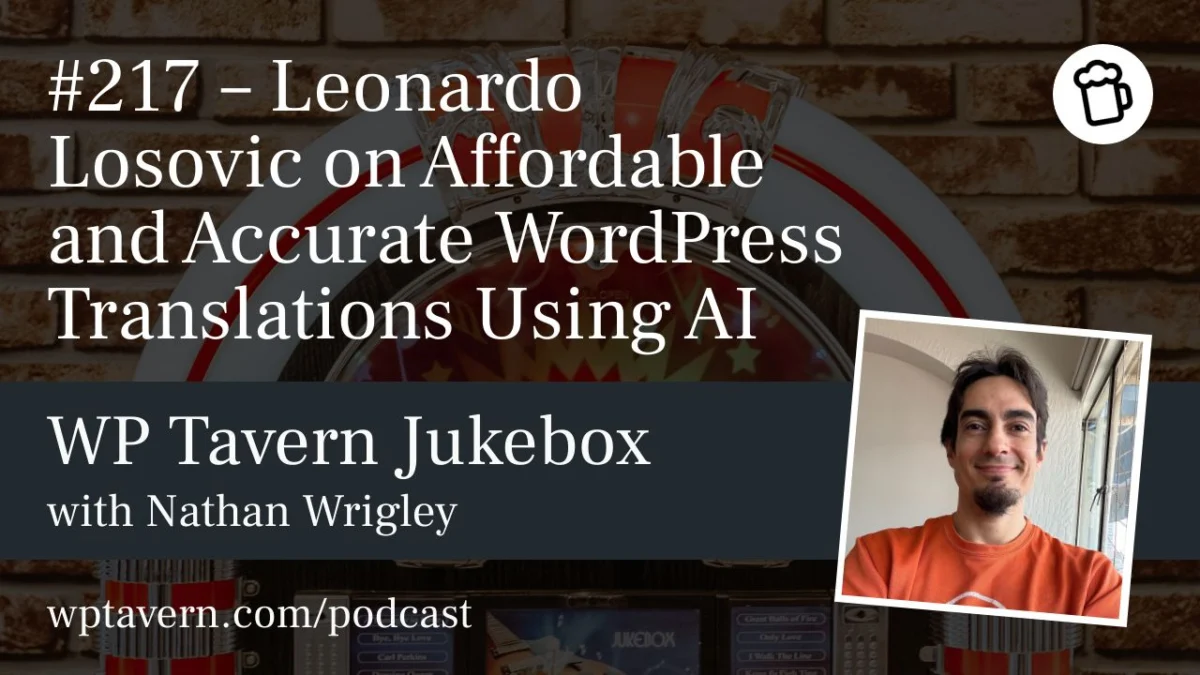
In a recent episode of the WP Tavern Jukebox podcast, host Nathan Wrigley sat down with Leonardo Losoviz, a veteran WordPress developer and the creator of Gato AI Translations for Polylang. The discussion illuminated a pivotal moment in the WordPress ecosystem: the democratization of multilingual content through the strategic integration of Artificial Intelligence.
The Evolution of WordPress Translation
For over a decade, the standard for translating a WordPress site involved a laborious, multi-step process. A developer or site owner would first identify the strings that required translation, export them to a file, hire a human translator to manually rewrite the content, and then re-import the text back into the system. This workflow was not only costly—often running into thousands of dollars for substantial sites—but also incredibly slow, making it difficult to keep pace with the rapid updates required for modern blogging and e-commerce.
"In the past, you had to figure out which bits of the website needed to be translated, find a human, negotiate a price, and then somehow figure out how to make it so the English string is converted into the German string," Wrigley noted.
Today, that paradigm has been inverted. With the emergence of Large Language Models (LLMs) like OpenAI’s GPT, Anthropic’s Claude, and Google’s Gemini, the process has moved from manual human intervention to near-instantaneous automated workflows. Plugins like Losoviz’s Gato AI Translations act as a bridge, allowing users to select a post and have it translated into multiple languages with a single click.
The Moral and Business Imperative
The question for site owners is no longer can they afford to translate their content, but rather why wouldn’t they? Losoviz argues that the barrier to entry has dropped so significantly that multilingualism should be considered a standard requirement for any site with aspirations of growth.
"If you have potential visitors to your website speaking different languages, why wouldn’t you want to track them? Why wouldn’t you want to show your content to a new user base?" Losoviz asked. While some industries are legally mandated to provide content in multiple languages, the vast majority of sites operate in a voluntary space where the only barrier was historically the price tag. With AI, that price tag has dropped from hundreds of dollars per project to mere cents per token.
Technical Foundations and Workflow Efficiency
A critical component of the current translation movement is how it interacts with the underlying WordPress architecture. Losoviz, who developed Gato GraphQL, emphasized that the choice of translation plugin dictates how content is managed.
- The Polylang Strategy: By integrating with plugins like Polylang, users can maintain separate entries for each language. This approach ensures that the site remains performant, as translations are static rather than generated on the fly.
- SEO Considerations: Modern plugins handle the technical SEO requirements—such as
hreflangtags—automatically. This ensures that search engines like Google correctly attribute the translated content to the appropriate regional audience, preventing duplicate content penalties and improving global discoverability.
The "Finality" Rule
Despite the ease of automation, Losoviz advises caution. One of the most common pitfalls, he noted, is attempting to translate content before it is finalized. If a user translates a post and subsequently discovers a typo, a broken link, or an incorrectly formatted header in the original English version, they must re-run the translation, potentially wasting tokens and creating unnecessary database clutter.
"Do not do any translation until you’re 100% sure that the post is final," Losoviz warned. His recommendation is to establish a rigorous "pre-translation checklist" that includes verifying image accessibility, ensuring technical terminology is accurate, and confirming that embedded media—like videos—are relevant to the target language audience.
The Future: Collaborative AI Editing
Looking toward the horizon of WordPress 7.0 and beyond, the conversation shifted to the future of collaborative editing. Currently, many envision collaboration as a human-to-human process—much like the co-authoring features found in Google Docs. However, Losoviz pointed to a more revolutionary potential: human-to-AI collaboration.
With the development of "Phase Three" of the Gutenberg project, which focuses on real-time collaboration, the infrastructure for a "sticky note" style communication system is being built. In the near future, an AI could potentially highlight a specific sentence in a translation and ask the human editor: "I am not 100% confident in this translation of a technical term; could you please verify?" This shift would move the translation process from a "fire and forget" model to a sophisticated, iterative dialogue between the creator and the machine.
The Translation "Arms Race"
Perhaps the most sobering insight from the discussion was the realization that as translation becomes easier, it also becomes a defensive necessity. In the past, having a multilingual site was a competitive advantage—a way to stand out from the crowd. Today, it is rapidly becoming the baseline.
"When it’s so easy, everyone will do it. And when everybody does it, you’re not moving forward. You’re just running to stay on the same spot," Losoviz noted. He describes this as an "arms race" of accessibility. If a business operates in a competitive market and their rivals are using AI to reach international customers in their native languages, the original site owner is effectively forced to do the same just to maintain their market share.
Strategic Recommendations for Site Owners
For those looking to begin their multilingual journey, the consensus from the podcast is clear:
- Start with a Clean Slate: Ensure your origin content is polished and finalized before triggering any automated translation.
- Choose Your Architecture Wisely: Decide whether you prefer a "single post/dynamic string" approach (like WPML) or a "multiple post/static entry" approach (like Polylang). The latter is often preferred for performance and SEO consistency.
- Use AI for Speed, Humans for Quality: While AI is 99% accurate for general content, it still requires human oversight for highly technical, legal, or industry-specific jargon. Use AI for the heavy lifting and reserve your human budget for the final "polish."
- Avoid Image Bloat: Rather than duplicating images for every language, keep your media library lean. Use language-agnostic imagery or overlay text via your page builder, which can then be translated as text rather than re-creating physical image files.
Conclusion
The era of expensive, inaccessible website localization is officially over. By leveraging the power of AI, WordPress developers and bloggers can now reach a global audience with a level of precision and affordability that was unimaginable just a few years ago. As the platform continues to evolve through the phases of the Gutenberg project, the integration between human creativity and AI-driven translation will only become more seamless.
For site owners, the message is clear: the technology is ready, the costs are negligible, and the competitors are likely already catching up. The question is no longer "should we translate," but rather "how many languages can we reach today?"