The landscape of digital marketing reporting is currently undergoing a seismic shift, driven by the rapid integration of Large Language Models (LLMs) into the daily workflows of PPC (Pay-Per-Click) professionals. At the center of this transformation is the Model Context Protocol (MCP), a standard that has promised to bridge the gap between AI assistants and live data sources. However, as adoption increases, a critical distinction has emerged: while MCP is a revolutionary tool for ad-hoc investigation, it is not—and should not be—a client reporting system.
As agencies and in-house teams rush to connect Claude or GPT-4o to their Google Ads accounts, the industry is beginning to grapple with the limitations of "live-chatting" with data. The following analysis explores the technical realities of MCP, the enduring necessity of data warehousing, and the emerging hierarchy of modern marketing analytics.
1. Main Facts: Defining the MCP Frontier
The Model Context Protocol (MCP) is an open standard that enables AI assistants to securely and fluidly connect to external tools and datasets. In the context of performance marketing, MCP acts as a "universal translator" between an AI model (like Anthropic’s Claude) and a data source (like Google Ads or GA4).
The Mechanism of Connection
Traditionally, a PPC manager wishing to analyze data with an AI would have to export a CSV from Google Ads, clean the data in Excel, and then upload it to the chat interface. MCP eliminates these steps. By using a server—such as the GoMarble MCP—Claude can "reach out" and query the Google Ads API directly in response to a user’s prompt.
The Core Conflict
The primary friction point in the industry today is the conflation of data access with data governance.
- Data Access (MCP): The ability to pull raw numbers into a conversation.
- Data Governance (Reporting): The ability to apply consistent logic, joined datasets, and historical "memory" to those numbers.
While MCP excels at the former, it fundamentally lacks the infrastructure for the latter. For performance marketers, the stakes are high: using an investigative tool for client-facing reports can lead to inconsistent definitions, high computational costs, and a lack of "single source of truth" transparency.

2. Chronology: The Evolution of the PPC Reporting Stack
To understand why MCP is being misapplied today, we must look at the evolution of how marketers have interacted with data over the last decade.
The Era of Manual Extraction (2010–2018)
Reporting was defined by the CSV. Marketers spent 70% of their time in "Data Preparation"—downloading reports from various platforms, running VLOOKUPs in Excel, and manually building pivot tables. This era was slow, but it forced a high level of human intimacy with the data.
The Era of Visualization (2018–2023)
The rise of Looker Studio (formerly Google Data Studio) and Tableau shifted the focus to "Dashboards." APIs allowed for automated data flows. However, these dashboards often became "ghost towns"—static pages that clients rarely visited, and that struggled to answer "Why?" when a metric changed.
The Era of the AI Assistant (2024–Present)
With the launch of MCP, we have entered the era of "Conversational Analytics." Instead of looking at a static dashboard, a marketer asks, "Why did my CPA spike in the Northeast region last Tuesday?" The AI queries the API via MCP and provides a narrative answer.
However, we are now seeing the limits of this "stateless" interaction. Because MCP queries are often ephemeral, the industry is moving toward a hybrid model: the Combined Stack, which integrates AI assistants with permanent data warehouses like BigQuery.
3. Supporting Data: The Technical Argument for a Tiered System
The decision to use MCP versus a dedicated data warehouse is not merely a matter of preference; it is governed by technical constraints regarding token costs, latency, and logic persistence.

The Token Cost Argument
When an AI assistant queries a platform via a direct MCP connection, the raw API response is fed into the "context window." For a large Google Ads account, a single query about "last month’s performance" might pull in thousands of rows of campaign, ad group, and keyword data.
- Direct MCP: High token consumption. Every time you ask a follow-up question, the raw data must often be re-processed or maintained in the context window, leading to "context drift" or high API costs.
- BigQuery Integration: Low token consumption. By using BigQuery "Views," the computation (summing costs, calculating averages) happens on the database side. The AI only receives the pre-aggregated result (e.g., a 5×5 table), saving significant computational resources.
The Logic Persistence Problem
One of the greatest risks in AI-driven reporting is the "Hallucination of Logic." If you ask an AI to "calculate non-brand ROI," it may define "non-brand" differently in every session based on the nuances of its training.
- The BigQuery Solution: By creating a SQL View in BigQuery, the definition of "Non-Brand" is hard-coded into the data layer.
- The Result: When Claude queries that view via MCP, it is querying a governed definition. This ensures that the report delivered to the client on Monday matches the internal check performed on Friday.
Internal vs. External Utility
Data suggests that for internal account health checks, native platform tools are becoming increasingly sufficient. Google’s integration of the Gemini report generator within the Google Ads interface allows for plain-English report building without ever leaving the ecosystem. The "External Stack" (Claude + MCP + BigQuery) only earns its ROI when the complexity exceeds the platform’s native capabilities—specifically when joining data from disparate sources like Salesforce or GA4.
4. Official Responses and Industry Perspectives
While Anthropic (the creators of MCP) has not issued specific mandates for PPC, their documentation emphasizes that MCP is designed for extensibility and contextual awareness, not as a replacement for database management systems.
The "Single Source of Truth" Doctrine
Industry leaders in the MarTech space, including providers like Supermetrics and Weavely, have responded to the rise of MCP by pivoting toward "Data Destination" models. The consensus among data engineers is that AI is a "Processor," not a "Storage" unit.
"The mistake is treating the chat interface as the database," says one senior analyst at a leading performance agency. "Clients don’t pay us for an AI’s ‘opinion’ on what happened last week; they pay us for a verified account of what happened, backed by a persistent data trail. MCP provides the opinion; BigQuery provides the trail."

The Role of Connectors
Third-party connectors like GoMarble have positioned themselves as the "connective tissue." Their official stance encourages the use of MCP for "messy," exploratory work where the user does not yet know the "exact column or date range" they need. This acknowledges that the value of AI lies in its ability to handle ambiguity—a task that traditional SQL databases struggle with.
5. Implications: The Future of the "Combined Stack"
As the industry matures, a "Simple Rule" for reporting architecture is emerging. This framework dictates how agencies should allocate their technical resources.
The Decision Matrix
- One-off / Investigative Questions: Use Direct MCP. (e.g., "Did the new ad copy in Campaign X cause a CTR change this morning?")
- Recurring / Internal Metrics: Use Native Platform Reporting (e.g., Google Ads Gemini).
- Client-Facing / Budget-Deciding Metrics: Use BigQuery + MCP. (e.g., "What was the total blended ROAS across Google, Meta, and Amazon for Q3?")
The "Death" of the Static Dashboard?
The most significant implication is the potential obsolescence of the traditional 20-page PDF report. With a governed BigQuery backend and an MCP-enabled AI, agencies can provide "Live Executive Summaries." Instead of a dashboard, the client receives a concise, AI-generated narrative that reflects governed data.
Conclusion: Trust, but Verify
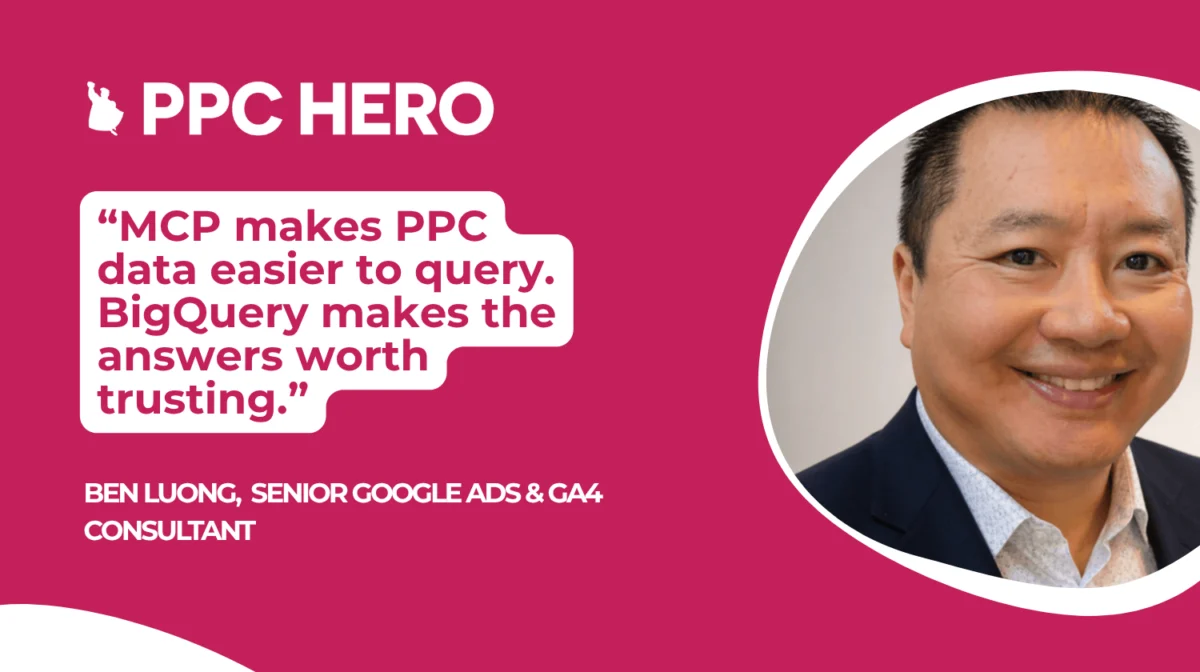
MCP has undeniably made PPC data easier to query, lowering the barrier to entry for complex data analysis. However, the professionalization of AI in marketing requires a return to the fundamentals of data governance.
By utilizing MCP for what it is—a brilliant investigative tool—and relying on BigQuery for what it is—a robust memory for business logic—marketers can build a reporting system that is both fast and, more importantly, worth trusting. The future of PPC reporting is not just about having the answers; it is about ensuring those answers remain the same every time you ask.