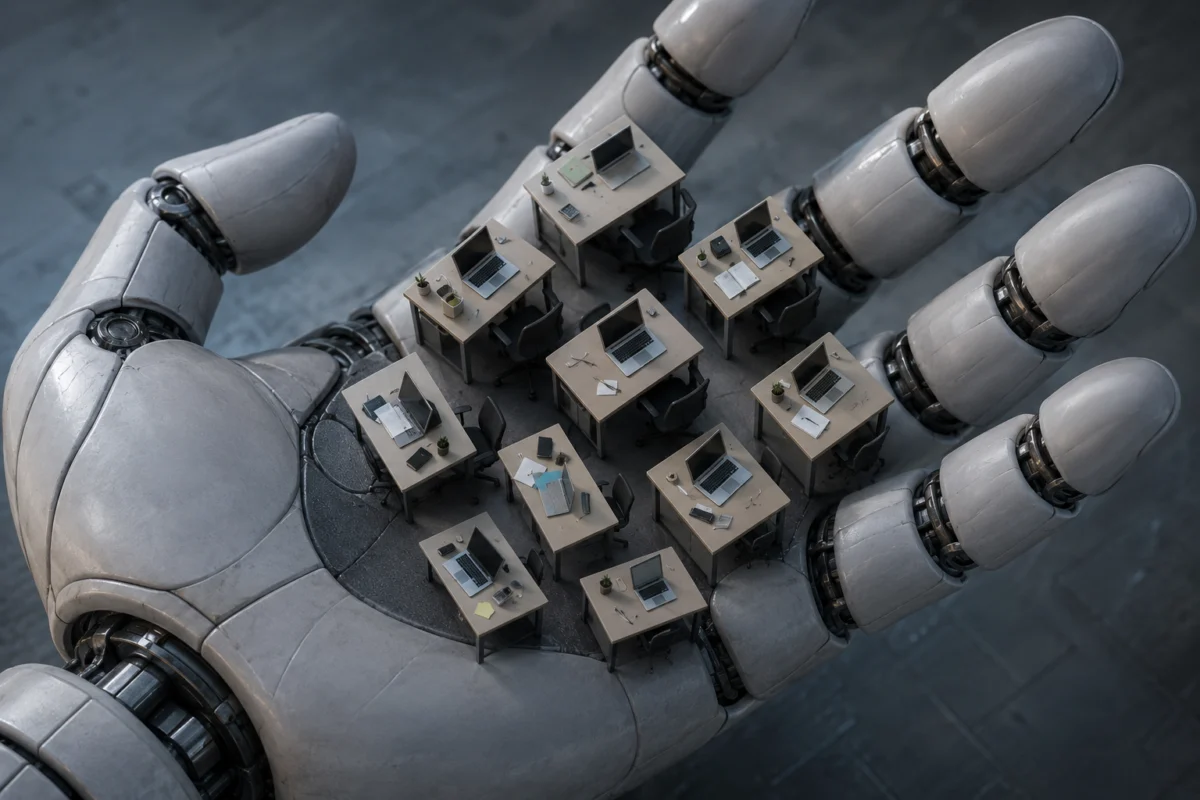
In the high-stakes theater of modern technology, a paradoxical narrative has taken hold. As Silicon Valley giants and legacy tech firms alike report record-breaking revenues and soaring stock valuations, they are simultaneously executing some of the most aggressive workforce reductions in the industry’s history. At the center of this transformation is the rapid, often ruthless, integration of Artificial Intelligence.
The latest confirmation of this trend came on Monday, when Oracle disclosed in an annual regulatory filing that it has shed 21,000 employees over the past 12 months. This 13% reduction in headcount is significantly higher than previously estimated by market analysts. In the filing, Oracle was characteristically blunt regarding the motivation: “The adoption and deployment of AI technologies across our operations have resulted, and may continue to result, in reductions to our workforce.”
This revelation is not an isolated incident; it is the most recent data point in a broader, systemic trend that defines the 2026 tech landscape. Companies are citing AI not just as a tool for innovation, but as a direct catalyst for structural efficiency, often replacing human labor with agentic workflows.
The AI-Driven Layoff Epidemic
The tech sector has experienced an “epidemic” of job cuts throughout 2026. Data from the outplacement firm Challenger, Gray & Christmas indicates that May 2026 saw the highest single-month volume of tech layoffs in years, with AI consistently cited as the primary driver.
This phenomenon presents a fundamental question for the modern economy: Are these companies truly shedding "bloat" created during the pandemic hiring surge, or are they proactively cannibalizing their own workforces to satisfy the insatiable capital requirements of the AI arms race? While many executives argue that AI allows for unprecedented velocity—shipping in days what previously took weeks—critics argue that the aggressive culling of talent may undermine the long-term institutional knowledge necessary for sustainable growth.
A Chronology of Retrenchment (2026)
The following list tracks the major tech players who have utilized AI as a stated factor in their 2026 restructuring efforts:
- GitLab (June 3): Cutting 14% of its staff (approx. 350 workers) to pivot toward AI infrastructure. CEO Bill Staples cited the need for a "generational rebuild" to handle 100x growth requirements.
- Google (Ongoing through May): Quietly thinning its Cloud and cybersecurity teams. While Google avoids total headcount disclosures, estimates suggest 1,500 to 3,000 engineers have been affected as the company shifts toward a leaner, AI-augmented operational structure.
- Intuit (May 20): Announced a 17% reduction (3,000 jobs) to reduce organizational complexity and reallocate resources toward AI-driven product development.
- Meta (May 20-21): Eliminated 8,000 positions, even as it pivoted 7,000 employees into new AI roles. Mark Zuckerberg has framed this as a defensive necessity, noting that success in AI is "not a given."
- Cisco (May 14): Despite record profits, Cisco cut 4,000 jobs. CFO Mark Patterson described it as a "realignment" toward silicon, optics, and AI capabilities rather than a pure cost-saving measure.
- Cloudflare (May 7-8): Cut 20% of its workforce (1,100 people) on the heels of a record revenue quarter. CEO Matthew Prince specifically targeted "measurers"—finance, legal, and internal audit roles—deeming them redundant in an automated environment.
- General Motors (May 12): Eliminated 500–600 IT jobs. While market volatility was a factor, AI automation in IT infrastructure played a significant role in the decision.
- Coinbase (May 5): Cut 14% of staff, shifting to a "one-person team" structure. CEO Brian Armstrong noted that engineers are now shipping work in days that once took weeks.
- PayPal (May 5): Initiated a multi-year plan to cut 4,500 jobs, creating a dedicated "AI transformation" team to handle everything from coding to customer service.
- Microsoft (April-May): Employed voluntary separation packages as part of a move toward "high-performing teams" optimized for AI velocity.
- Snap (April 16): Cut 1,000 jobs (16% of staff), citing AI’s ability to reduce repetitive work and accelerate ad platform performance.
- IBM (Rolling): With 15,000 cumulative cuts since late 2024, IBM has begun replacing specific HR roles with AI agents, even as it hires aggressively for AI and hybrid-cloud technical roles.
- Atlassian (March 11): Reduced headcount by 1,600 (10%) to rebalance toward enterprise AI sales.
- Dell (January 30): Shed 11,000 jobs (10% of workforce) while preparing to double its AI-optimized server revenue.
- Oracle (March): Executed deep cuts via terminal emails, redirecting saved capital into AI data centers.
- Block (February): Jack Dorsey oversaw a 4,000-job cut (nearly 50%), arguing that small, AI-empowered teams are the future of corporate architecture.
- Salesforce (February): Leveraged its "Agentforce" AI to handle support cases, leading to a significant reduction in the need for human support engineers.
- Amazon (January): Executed a 16,000-job cut to reduce bureaucracy, following an earlier round of 14,000 cuts, with CEO Andy Jassy explicitly stating that AI would reduce the need for corporate headcount.
Supporting Data: The "Growth Paradox"
A striking feature of the 2026 layoff wave is the financial health of the companies involved. Unlike the cyclical downturns of the early 2000s or the 2008 financial crisis, these layoffs are occurring while balance sheets are robust.
For instance, Cloudflare reported record quarterly revenue of $639.8 million at the exact moment it announced it was making 1,100 jobs "obsolete" through AI. Similarly, Oracle posted a 27% year-over-year increase in quarterly net income, reaching $3.7 billion, while simultaneously initiating the layoffs that would eventually total 21,000 positions. This suggests that for modern tech firms, layoffs have transitioned from a "distress signal" to a "strategic optimization tool."
Official Responses: The Rationalization of Efficiency
Corporate leadership has largely coalesced around a unified narrative: AI is not replacing people; it is replacing inefficiency.
Executives like Block’s Jack Dorsey and Snap’s Evan Spiegel emphasize "velocity" and "agility." The argument is that AI agents, when paired with flatter management structures, allow for a new, more effective way of operating. By removing middle management layers—the "measurers" identified by Cloudflare—companies believe they can move closer to the customer and the product, theoretically fostering a more innovative environment.
However, the reality for the employees caught in the middle is stark. At Meta, reports have surfaced describing the new AI-focused divisions as "soul-crushing," suggesting that while the pivot might be efficient for the bottom line, it may have negative impacts on human morale and company culture.
Implications: A New Social Contract for Tech?
The implications of this shift are profound and far-reaching.
1. The Death of Middle Management
The most immediate casualty of the AI transition is the middle manager. Roles dedicated to internal auditing, HR, and administrative oversight are being replaced by autonomous agents. This creates a "flatter" organization, but it also removes the traditional career ladder that junior employees have historically used to advance into leadership roles.
2. The Skills Mismatch
While companies are cutting thousands of jobs, they are simultaneously hiring for specialized AI and machine learning roles. This creates a massive skills gap within the workforce. The question remains whether existing employees can be effectively "reskilled" or if the tech sector is destined to become a revolving door of specialized talent, leaving millions of legacy-skilled workers behind.
3. The "Powder Keg" Effect
As we have argued previously, companies may want to rethink this rationale. The aggressive culling of staff, particularly in the name of AI, creates a volatile internal environment. If the promise of AI-driven productivity fails to materialize at the scale projected, these companies will have lost the human capital necessary to pivot back.
4. Regulatory and Ethical Scrutiny
With Oracle’s filing now public, the link between AI deployment and workforce reduction is no longer a matter of speculation—it is a matter of record. This will likely draw increased attention from labor unions, regulators, and policymakers who are already concerned about the societal impact of AI.
As 2026 progresses, the tech industry finds itself at a crossroads. The efficiency gains provided by AI are undeniable, but the social cost of achieving them is reaching an inflection point. The companies that navigate this transition without hollowing out their core capabilities will be the ones that define the next decade; those that view their workforce merely as a line item to be optimized by an algorithm may find themselves in a precarious position when the next cycle of innovation demands human ingenuity, not just synthetic speed.