In the modern professional landscape, the "meeting fatigue" phenomenon is no longer just about the duration of calls; it is about the cognitive load required to navigate them. Between managing Zoom, Google Meet, Microsoft Teams, and Slack, users are forced to memorize an ever-shifting array of keyboard shortcuts. One app uses Command + Shift + A to mute; another uses Option + M. When the stakes are high—such as during a crucial client pitch or a delicate negotiation—the split-second hesitation to find the "mute" button can be the difference between professionalism and a public gaffe.
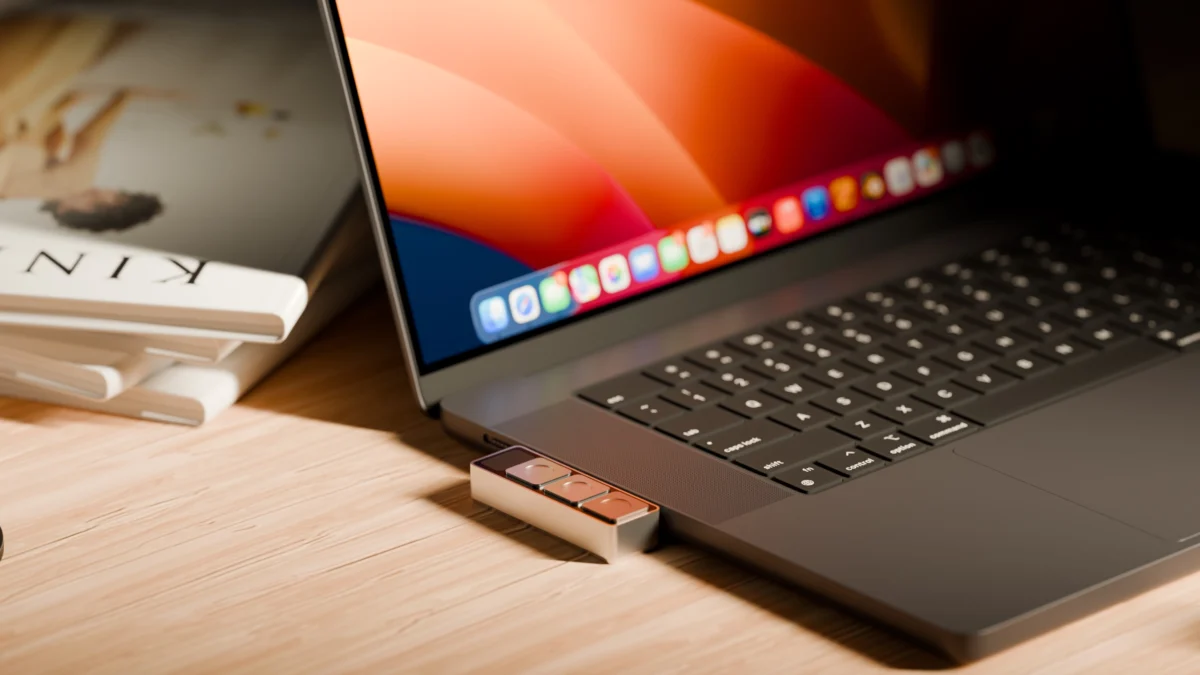
Enter Project Mirage’s Dune, a $119, three-key aluminum keypad designed to act as a universal, context-aware command center for MacBook users. Roughly the size of a stick of gum, this minimalist peripheral promises to offload the mental burden of software-specific controls, turning complex digital tasks into physical, tactile actions.
The Anatomy of the Dune: Design and Functionality
The Dune is an exercise in hardware restraint. Unlike the bulky, programmable "Stream Deck" controllers that dominate the productivity space, the Dune is engineered to disappear into the aesthetics of a MacBook. Because each unit is custom-built to match the specific chassis of the user’s Mac, it sits flush against the laptop frame, creating an almost seamless transition between the device and the host computer.
Operating via a standard USB-C connection, the device draws power directly from the laptop, eliminating the need for internal batteries or external charging cables. If a user’s ports are already occupied, the device can be easily daisy-chained through a dongle.
The core philosophy of the Dune is "context awareness." The companion software, which runs in the background on macOS 15 Sequoia and later, detects which application is currently in the foreground. If you are in a Google Meet tab, the three keys might default to "Mute Mic," "Toggle Camera," and "Bring Window to Front." Shift your focus to Excel, and those same keys instantly remap to "Copy," "Paste," and "Undo." For developers, the integration extends into VS Code or GitHub, allowing for one-tap actions like merging pull requests or approving code reviews.
A New Frontier in Productivity: Chronology of the Setup
The evolution of the Dune began with a singular frustration: the lack of a standardized hardware interface for remote work. Project Mirage aimed to bridge the gap between static keyboards and highly complex macro-pads.
- Phase 1: Prototyping. The startup focused on the tactile experience, settling on a three-button configuration that prioritizes ergonomics without sacrificing portability.
- Phase 2: Software Integration. The development of the companion app allowed for the crucial "context-switching" feature. This ensured the hardware remained relevant across various software ecosystems.
- Phase 3: AI Augmentation. By integrating with Claude Desktop, the company moved away from manual programming. Users can now describe their desired shortcut in plain English, and the AI handles the backend script generation.
- Phase 4: Ecosystem Expansion. The recent launch of the "Skills Marketplace" marks the transition from a piece of hardware to a platform, where users can share custom scripts and workflows.
Supporting Data and User Experience
While the device is a triumph of design, real-world usage reveals the typical "growing pains" of early-stage hardware. Testing the device reveals a significant point of friction: switch sensitivity.
The current mechanical switches are perhaps too responsive. During professional testing, it was common for the keys to be triggered accidentally simply by brushing the device while reaching for a beverage or adjusting one’s position. This "hair-trigger" sensitivity poses a risk during sensitive calls; inadvertently unmuting a microphone or killing a video feed can be a major professional disruption. A refined version with higher resistance would likely be the most requested hardware update.
However, the software experience is where the Dune truly shines. By integrating with the user’s calendar, the device becomes a proactive assistant. Minutes before a scheduled call, the Dune can surface the meeting link, allowing the user to join or send a "running late" notification with a single tap—bypassing the need to navigate through an email inbox or calendar app.
The Power of Claude-Powered Automation
Perhaps the most compelling argument for the Dune is its integration with LLMs. For non-coders, the ability to generate complex, automated workflows is a game-changer.

- Example A: An analyst can program a key to scrape a company website for its key competitors, latest news, and funding data, presenting a summary before a meeting.
- Example B: A creative professional can set a key to automatically batch-convert high-resolution images to JPEG, optimizing them for social media upload in seconds.
These tasks require no manual configuration. Instead, they rely on a collaborative process between the user and the AI, where the system "debugs" the script until it functions perfectly.
Implications for the Future of Peripheral Hardware
The emergence of the Dune signals a broader shift in the "Prosumer" tech market. We are moving away from the era of "one-size-fits-all" input devices and toward hardware that functions as a physical interface for AI-driven workflows.
The Marketplace Strategy
The startup’s long-term retention strategy hinges on its Skills Marketplace. If the company can successfully foster a community of power users who contribute high-quality, specialized scripts, the Dune could transcend its identity as a simple keypad. It would become the "thin front end" for a vast ecosystem of automated tasks.
However, there are hurdles to clear. Currently, the lack of a "preview mode" in the marketplace is a notable oversight. Users must commit a button to a new skill to see how it works, which is counterintuitive for a tool meant to simplify life. Furthermore, the startup needs to take a more proactive role in curating these skills to ensure quality and security.
Industry Comparison
To understand where the Dune fits in the market, one must look at the landscape:
- MuteMe: A niche, single-purpose device that handles only audio and video toggling. It is reliable but limited in scope.
- Stream Deck (Elgato): The gold standard for content creators. It offers deep, visually rich customization via LCD keys, but it is bulky, expensive, and requires a steep learning curve.
- Dune: Positions itself as the "Goldilocks" solution. It is more sophisticated than a single-purpose mute button, yet more streamlined and elegant than the aggressive, button-heavy design of a production-grade Stream Deck.
At a post-introductory price of $149, the Dune is not an impulse purchase. It is a calculated investment for the "productivity-minded" professional. It caters specifically to the Apple ecosystem, leaving Windows and Linux users out of the loop for now.
Final Thoughts
The Dune is a daring attempt to solve the "shortcut fatigue" that plagues the modern office. It succeeds in its core mission: it makes the physical act of interacting with a computer more fluid and less chaotic. While the hardware requires minor refinements in key resistance and the software needs to further polish the marketplace experience, the underlying concept—using AI-driven physical inputs to reduce cognitive load—is undoubtedly the future of workspace optimization.
As we continue to spend more of our waking hours in digital meetings, the demand for tools that prioritize human-centered interaction will only grow. Project Mirage has provided a blueprint; now, it is up to them to refine the execution and scale the ecosystem to meet the high expectations of the professional user base.
Disclaimer: When you purchase through links in our articles, we may earn a small commission. This does not affect our editorial independence.