For the past four years, the B2B software playbook has been as predictable as it has been aggressive. The strategy was simple: lock customers into an ecosystem, raise prices every 12 to 18 months, and layer on an "AI SKU" as a justification for further extraction. For years, customers grumbled, swallowed the cost, and stayed put—simply because they had nowhere else to go.
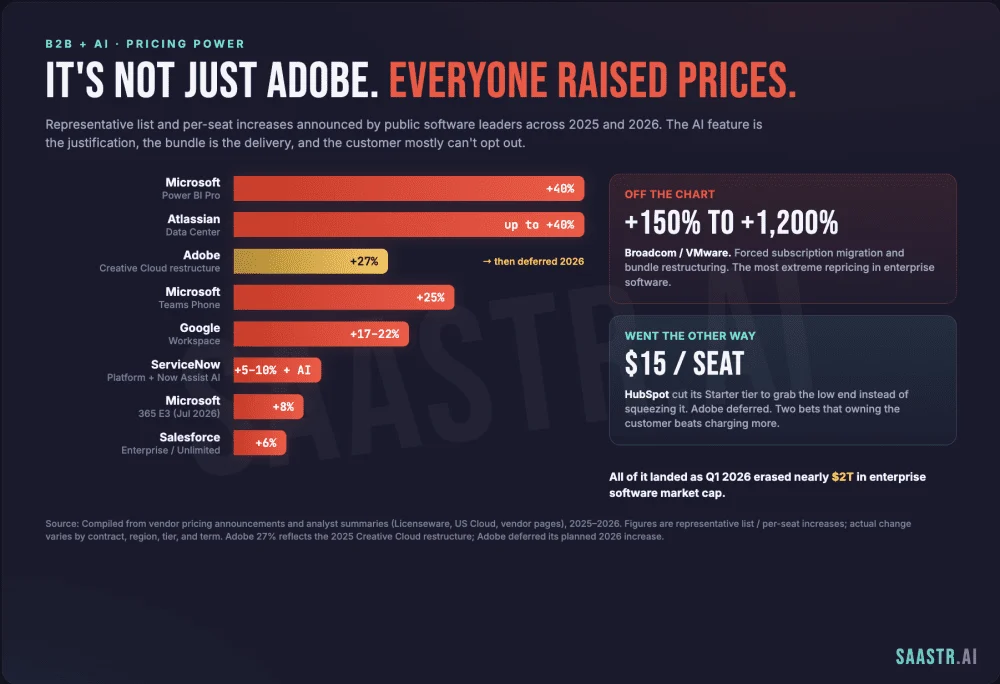
However, in the second quarter of fiscal 2026, the machine finally hit a wall. Adobe, a company historically synonymous with unshakeable pricing power, announced it would defer approximately $500 million in Annual Recurring Revenue (ARR) from planned price increases for the remainder of the year. This move is more than a mere accounting adjustment; it is a signal that the era of "automatic" annual price hikes in the B2B sector is facing a severe, AI-driven reality check.
The Cracks in the Facade: A Chronology of Pricing Pressure
To understand why this deferral is a "big deal," one must look at the precedent. Adobe has been the industry standard-bearer for aggressive pricing. From 2022 through 2025, the company implemented significant, recurring price hikes that became a staple of their financial narrative. Wall Street grew accustomed to this, treating the company’s ability to extract more revenue from its existing base as an iron-clad competitive advantage.
The shift began earlier this year as competitive alternatives became not just viable, but highly compelling. While Adobe posted record revenue of $6.62 billion—up 13% year-over-year—and a healthy 18% increase in non-GAAP EPS, the market’s reaction was cold. Despite a strong quarter and an upward revision of full-year guidance (boosted by the strategic acquisition of Semrush), Adobe’s stock faced significant downward pressure. Investors were not reacting to the top-line growth; they were reacting to the admission that the company could no longer force-feed price increases to the prosumer and SMB tiers of its market.
The Bifurcation of Pricing Power
Adobe’s strategy has effectively split into two distinct realities. On one side sits the enterprise and professional tier, where the "moat" remains deep. Large organizations—SAP, Accenture, and Merck among them—are deeply integrated into Adobe’s proprietary file formats (.AI, .PSD, .INDD). For these entities, there is no viable substitute for the workflow efficiency of Creative Cloud. Consequently, Adobe is moving forward with planned price increases of 8% to 12% on multi-year ETLA (Enterprise Term License Agreement) deals.
However, the moat is significantly shallower at the consumer, prosumer, and SMB level. In this segment, the rise of low-cost, high-performance alternatives—such as Canva, Affinity, and various AI-native design tools—has created a "price ceiling." Adobe’s decision to defer price hikes here is a calculated tactical retreat. They are trading near-term ARR for long-term user retention, attempting to funnel these users into their "freemium" ecosystem (the "Reader playbook," applied to Firefly and Express).
The official narrative from CEO Shantanu Narayen is that this is a strategic move to capture a larger top-of-funnel audience. While true, it is an incomplete picture. The reality is that Adobe faced a binary choice: continue raising prices and risk mass defection to cheaper competitors, or pivot to a volume-based freemium model. They chose the latter, but the constraint was forced upon them by the competitive landscape.
Implications: The AI-Induced Margin Squeeze
The broader software industry is watching this development with trepidation. Throughout 2024 and 2025, almost every major SaaS provider followed the same script: bundle AI features, increase prices, and rely on inertia to keep customers from churning.
This strategy worked because it relied on the "lock-in" equation. But AI has fundamentally broken that equation. In many categories, AI has lowered the barrier to entry for challengers. When a credible, AI-native alternative appears, the pricing power of the incumbent at the exposed tier evaporates.
Furthermore, there is an uncomfortable "margin fact" lurking beneath the surface of the AI boom. While traditional SaaS gross margins typically hover between 70% and 80%, AI-integrated services often operate closer to 50%. As companies integrate these models, they are discovering that AI spend is largely cannibalizing existing IT budgets rather than expanding them. When you combine this with the loss of pricing power at the low end, many firms are facing a "scissors effect"—rising costs of service delivery meeting declining opportunities for price extraction.
The Risk Hiding in Growth Rates
For years, many B2B companies have masked stagnant customer acquisition with aggressive price hikes. In some instances, price increases have accounted for up to 70% of forward ARR growth. This is not "earned" growth; it is "manufactured" growth.
When a company relies on price hikes to drive 60% or 70% of its growth, its stability is only as durable as its pricing power. The moment an alternative emerges, the growth engine stalls. This is the danger zone that many SaaS companies are now entering. As investors begin to scrutinize the composition of ARR growth, those who cannot demonstrate organic, volume-based expansion are being aggressively repriced by the market.
Strategic Pressure-Testing: Lessons for the Future
The lesson from Adobe is not that companies should stop raising prices altogether. As evidenced by Adobe’s enterprise success, pricing power remains robust where genuine lock-in exists and alternatives are non-existent. The lesson is that businesses must distinguish between tiers that have pricing power and those that have lost it.
To survive the next phase of the SaaS cycle, leadership teams should consider the following:
- Segmented Elasticity: Audit your customer tiers. Which tiers are truly "locked in," and which are susceptible to low-cost alternatives? Do not apply blanket price increases to segments where competitive pressure is high.
- Verify Value, Don’t Just Add AI: If your price increase is justified solely by a generic "AI feature," your customers will eventually revolt. Ensure that the value proposition is tied to measurable workflow improvements or productivity gains that the customer can explicitly see.
- Monitor "Manufactured" Growth: Analyze how much of your growth is coming from new logos versus price increases on existing customers. If your growth is heavily weighted toward price, start investing aggressively in product differentiation to build a real moat.
- Prepare for the "Freemium" Pivot: If you are losing price elasticity, investigate whether a lower-cost or freemium entry point can help you defend your market share. Using the "Reader playbook" to build a massive user base can be a defensive hedge against disruption.
Conclusion: The End of the "Automatic" Era
The era of the "endless annual price increase" in business software is not necessarily over, but it is certainly no longer universal. Adobe’s pivot is the first of many signs that the market is recalibrating. When the cost of switching is low and the efficacy of alternatives is high, the "price lever" jams.
For many B2B companies, the realization that they can no longer count on automatic price hikes will be painful. However, it is also a necessary correction. In a post-AI world, companies will be forced to compete on product value and user experience rather than relying on the inertia of their customer base. The "Golden Age" of easy SaaS pricing is fading; what replaces it will be a much more competitive, innovation-driven landscape where pricing power must be earned every single year.