In the world of B2B software, the "CRM demo" has become a theatrical performance. It is a carefully curated ballet of scripted clicks, pristine datasets, and "happy path" workflows that miraculously never encounter a bug or a missing field. It is a medium designed to hide complexity, not solve it.
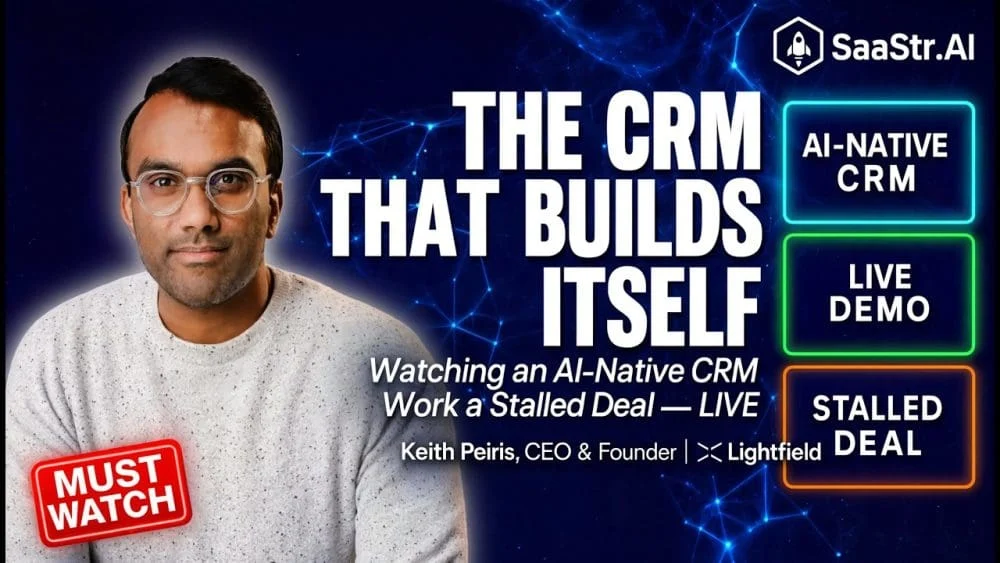
Keith Peiris, founder of Lightfield, recently chose to abandon the script entirely. In a live demonstration that bucked the industry’s polished traditions, Peiris executed a full-scale walkthrough of his platform using live, unscripted data. With every potential for a system failure, the demonstration instead offered one of the most compelling glimpses yet into what an "AI-native" CRM actually looks like in 2026.
With over 3,000 customers already onboard, Lightfield is positioning itself not merely as a database for sales reps, but as an autonomous operational engine for modern go-to-market (GTM) teams.
The Death of Data Entry: A CRM That Assembles Itself
The primary friction point in legacy CRM adoption is the "data entry tax." Sales professionals, who should be focused on closing, are often relegated to the role of glorified administrative clerks.
During the live demonstration, Peiris highlighted the most striking aspect of the platform: the setup process. Rather than enduring weeks of implementation, custom field mapping, and database schema design, the user simply connects core communication and data sources—email, calendar, internal data warehouses, and call recording software.
By the time the demo officially began, the CRM had already populated itself. Accounts were enriched across multiple third-party providers, opportunities were automatically generated from raw email and call transcripts, and the contact book was synthesized from a dozen different vendors.
This represents a paradigm shift. Instead of forcing users to build the CRM, the CRM builds the record for the user. By capturing data at the source, Lightfield eliminates the "blank screen" problem that typically plagues early-stage CRM deployment.
Diagnosing the Stalled Deal: Proof Over Best Practices
The second phase of the demo addressed the "stalled deal" scenario—a common pain point for enterprise sales teams. Peiris pulled up a sluggish deal with Johnson Controls and posed a simple, natural-language query to the AI: "Why is this deal stalled?"
Standard CRM software might return a generic prompt suggesting the rep "follow up" or "check in." Lightfield, however, initiated a sandbox operation. It compared the current deal against the company’s entire historical repository of closed-won and closed-lost deals. It didn’t just summarize; it identified a pattern: successful deals in this segment consistently involved an IT director early in the sales cycle. The stalled deal, conversely, lacked any IT stakeholder engagement.
The system then moved from diagnosis to action. Upon the command, "Find the CIO and add them to the opportunity," Lightfield executed a multi-step workflow:
- Ran approximately 20 enrichment tools to verify the prospect.
- Conducted a real-time LinkedIn search.
- Created the contact record.
- Drafted a personalized introduction email, matching the specific tone of the sales representative while referencing a previous Milwaukee-based Proof of Concept (POC).
This entire diagnostic and corrective loop took roughly three minutes. It transformed a stalled opportunity into an active one using data-driven evidence rather than gut instinct.
Institutionalizing Knowledge: The Power of Natural Language Automation
Perhaps the most significant differentiator for Lightfield is its ability to turn one-off successes into permanent, company-wide processes.
Peiris demonstrated this by issuing a single sentence command: "Run this process every time a deal reaches the POC stage without an IT contact."
In response, Lightfield generated a natural language automation. While traditional platforms require developers to write Apex code or build complex flows in a visual editor, Lightfield allows teams to iterate on logic in plain English while the system handles the Python execution in the background.
This is the holy grail of sales operations. When one account executive (AE) learns a new strategy—such as the necessity of involving IT early—that learning is no longer siloed in the individual’s mind or hidden in a Slack thread. It becomes an automated, institutional rule. By bridging the gap between "knowing what works" and "operationalizing the process," Lightfield enables teams to scale their best practices automatically.
From Insight to Pipeline: The Full-Loop Lifecycle
The final phase of the demonstration closed the loop by moving from reactive diagnosis to proactive outbound generation. Peiris tasked the system with finding new pipeline opportunities based on successful historical patterns.
The AI identified that big industrial manufacturers were particularly receptive to messaging centered on "downtime pain," and that IT leaders were more likely to engage based on actual Quarterly Business Review (QBR) data rather than generic sales pitches.
With this insight, the system was asked to find 10 companies matching this profile. Lightfield:
- Scanned accounts outside the existing database.
- Cross-referenced multiple data sources.
- Filtered for specific technical signals, such as legacy factory floor software usage identified via job postings and social media sentiment.
- Drafted a custom, three-step email sequence that synthesized the new research, past sequence performance, and the rep’s specific writing style.
This marked the first time an end-to-end cycle—from raw data connection and deal diagnosis to process codification and net-new pipeline generation—has been demonstrated live on a single platform.
Addressing the Skeptics: Governance, Security, and Adoption
The Q&A portion of the session provided a candid look at the technical architecture underpinning these AI features. When pressed on data governance, Peiris emphasized a "foundational schema" approach. Every piece of data, every attribute, and every field has a comprehensive version history. If an AI agent or a human user overwrites critical information, the system allows for granular rollbacks. Role-based access control (RBAC) is enforced at every layer of the data stack.
Regarding migration and adoption—often the biggest hurdles for any CRM—Peiris noted that existing users are migrating from platforms like Zoho or HubSpot in as little as two hours. Because the AI removes the burden of manual field updates, forecasting, and reporting, the barrier to entry is lowered significantly. "If you can use ChatGPT, you can use this," Peiris remarked.
The issue of email deliverability was also addressed. For a company managing 200,000 contacts and 50 inboxes, Lightfield utilizes in-house email warming and distributed sending rules. Crucially, the system employs intelligent sync: outbound sequences only sync back to the CRM when a prospect responds. This prevents the database from becoming a graveyard of "junk" contacts, ensuring that the CRM remains a clean, high-signal environment.
Security remains the final, and perhaps most critical, pillar. The agent, external system integrations, and the UI all share the same Lightfield API. Consequently, an AI agent is constrained by the exact same permissions as the human user; the system cannot execute actions that the user is not authorized to perform.
Implications for the Future of GTM
The rise of AI-native CRM platforms like Lightfield signals the end of the "Data Entry Era." For years, the industry has focused on increasing the functionality of CRMs by adding more buttons, more fields, and more manual requirements. Lightfield suggests that the future of CRM is not more features, but less friction.
By treating the CRM as a living, breathing entity that learns from every interaction, companies can finally achieve the elusive goal of "intelligent sales." When a system can automatically identify why a deal is failing, draft the corrective communication, and turn that discovery into a permanent, automated playbook for the entire team, the definition of a "sales representative" changes.
The rep is no longer a data entry specialist; they become the architect of the sales process, while the CRM acts as the primary executor.
For founders and small-to-medium GTM teams still tethered to spreadsheets or legacy tools, the Lightfield model offers a compelling alternative. By lowering the cost of implementation and increasing the speed of insight, platforms like this are democratizing enterprise-grade sales operations.
In a market saturated with "AI-enabled" features that are often just wrappers for basic automation, Lightfield’s willingness to perform a live, unscripted demo serves as a powerful statement of confidence. It is a reminder that the best way to prove the value of AI is not through a polished video, but through the raw, unfiltered performance of the product itself.
For those looking to transition from reactive sales to proactive, AI-driven growth, the 20-minute investment to test the platform may be the most valuable move in their 2026 GTM strategy.