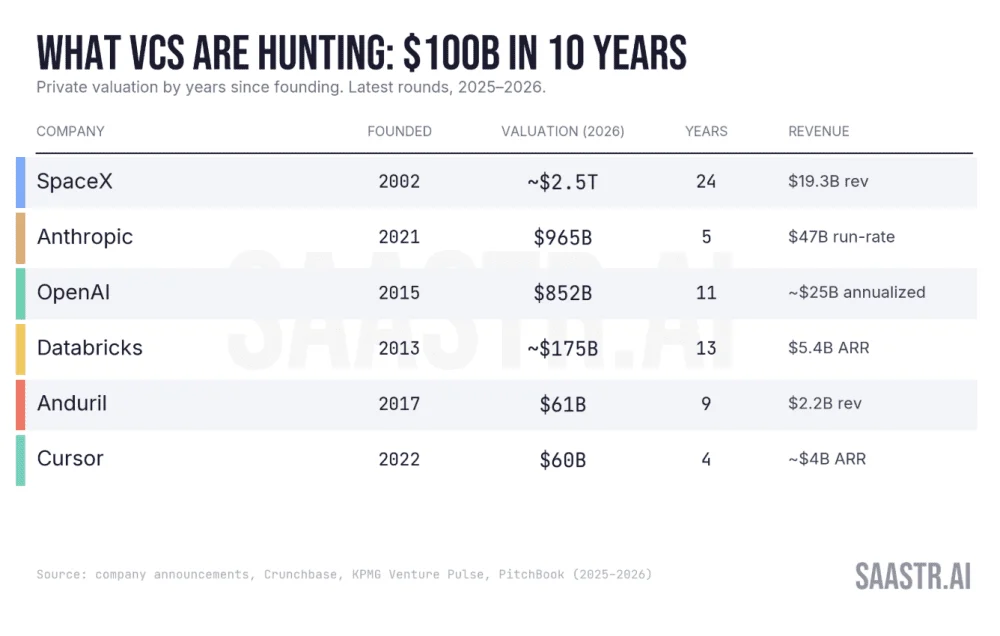
In the ecosystem of Silicon Valley, the definition of a "home run" has undergone a seismic shift. Just a decade ago, a founder aiming for a $1 billion exit—the mythical "Unicorn"—was considered to have reached the absolute pinnacle of success. When Salesforce was valued at $2 billion in its early days, it was a titan of industry. When the first wave of modern B2B software companies like Box, HubSpot, and Zendesk went public, the $1 billion threshold was the standard benchmark for institutional triumph.
Today, that figure feels quaint, almost nostalgic. The current generation of mega-funds and elite venture capital firms have abandoned the $1 billion target, viewing it as a rounding error. The new north star? $100 billion-plus exits, with a distant, shimmering ambition of reaching the $1 trillion valuation club. This is not merely a manifestation of market hype; it is a calculated, aggressive realignment of global capital.
The New Arithmetic of Venture Capital
The transition from a $1 billion target to a $100 billion target is driven by cold, hard arithmetic. In previous decades, venture capital was a game of disciplined entry pricing. If you overpaid at the seed stage, you risked capping your potential returns. However, when the ceiling for a successful company moves from $1 billion to $100 billion, the entry price becomes a secondary concern.
If an investor is right about a company’s trajectory toward a $100 billion valuation, even a "premium" entry price can yield a 50x return. Conversely, if the investor is wrong, no entry price is low enough to save the investment. Consequently, the "smart money" has shifted its strategy from optimizing for low entry costs to extreme concentration. The goal is no longer to build a diversified portfolio of 30 decent companies; it is to secure a conviction-led, significant stake in the one or two firms that will define an entire decade of economic growth.
Chronology of the Shift
- The Pre-2015 Era: The "Unicorn" era. A $1B exit was the standard goal for VCs. Successful IPOs for companies like Zendesk and HubSpot cemented this as the target.
- 2020–2024: The "Mega-Fund" buildup. Institutional capital flooded into firms like a16z, Sequoia, and General Catalyst, forcing them to deploy larger checks.
- 2025: The "AI Pivot." AI captures 61% of global venture funding. The market begins to see the emergence of multiple companies (OpenAI, Anthropic, xAI) that are scaling faster than any historical precedent.
- 2026: The Age of Consensus. In Q1 2026, roughly 75% of all venture dollars are concentrated in just five massive companies. The industry officially moves the goalposts to the $100B+ valuation target.
Supporting Data: The Concentration of Capital
The data from the first half of 2026 reveals a landscape of extreme inequality. In Q1 2026, global venture capital reached a record high of over $300 billion. Within that pool, the concentration is startling: approximately 80% of those funds flowed into AI-related ventures.
Four companies—OpenAI, Anthropic, xAI, and Waymo—collectively absorbed 65% of all venture capital deployed globally in the first quarter of the year. When two companies, OpenAI and Anthropic, command 14% of total global venture investment, we are no longer looking at traditional startup financing; we are witnessing a systemic reorganization of capital.
This consolidation is reflected at the fund level as well. In January 2026, Andreessen Horowitz (a16z) raised over $15 billion in a single fundraise—the largest in history. With the firm managing over $90 billion in assets, and other titans like General Catalyst and Sequoia managing tens of billions more, the math of the venture firm itself dictates the hunt. A $15 billion fund cannot achieve a 3x return by backing companies that exit at $1 billion. To move the needle, these firms must hunt for $100 billion winners.

Implications for Founders and Smaller Funds
This environment creates a paradoxical reality for smaller funds and founders. For the "mega-funds," the hunt for $100 billion winners is a necessity. For a $100 million fund, however, the strategy remains different. A smaller firm does not need to write the $500 million growth check; they need to identify the potential "centidecacorn" early and secure a meaningful ownership percentage before the mega-funds arrive with their billion-dollar checkbooks.
However, this systemic shift brings significant risks:
- The Survivorship Bias: The "hunt" for $100 billion companies often masks the reality that for every successful outlier, there are hundreds of failed ventures. The failure rate for startups is as brutal as it has ever been, and mistaking current market trends for permanent reality is a dangerous gamble.
- Valuation Compression: Current multiples are extreme, with some AI leaders trading at over 100x sales. Should the IPO market re-rate these companies toward the lower multiples typically seen in SaaS (e.g., 7x to 10x forward sales), late-stage marks will compress rapidly, potentially wiping out billions in paper wealth.
- The "Worse" Fit for Most: Venture capital is becoming an increasingly poor fit for the vast majority of startups. If you are not building a company that has the potential to redefine a category and scale to a $100 billion valuation, you are increasingly invisible to the firms that control the majority of the world’s investable capital.
Official Perspectives and Market Sentiment
Industry analysts and veteran founders have begun to warn of the dangers inherent in this "consensus capital." Bill Gurley, a legendary figure in the venture space, has been vocal about the disconnection between product success and valuation. "Being right about the product doesn’t protect you from being wrong about the price," Gurley noted earlier this year.
The sentiment among many observers is that while the $100 billion outcome is possible, it is not guaranteed to be the "new normal." There is a distinct difference between "raising at $10 billion" and actually compounding revenue to reach a $100 billion valuation. The winners of this era—companies like Databricks or Anduril—are not merely raising capital; they are demonstrating real, productive revenue growth that outpaces their massive funding rounds.
Conclusion: The Hard Work Remains
The fundamental nature of building a great company has not changed, even if the stakes and the targets have moved. Success in the current era requires more than just access to a mega-fund’s checkbook. It requires the ability to create or redefine a market category, the discipline to deploy billions in capital productively, and the endurance to compound revenue through massive market fluctuations.
"Call it unfair. Call it concentrated," says SaaStr’s Jason Lemkin. "But now that there are several of these, it’s no longer insane to build a fund around hunting the next one."
The venture capital industry has effectively reorganized itself around a high-stakes, high-concentration model. For the founders who can deliver on these massive expectations, the rewards will be unprecedented. But for the rest, the shift serves as a stark reminder: when the target is a $100 billion exit, the margin for error effectively vanishes. The hunt is on, but in this high-frequency, high-stakes game, the hardest part remains the same as it was in the days of $1 billion outcomes: you have to be right about the company, and you have to be right about the price.