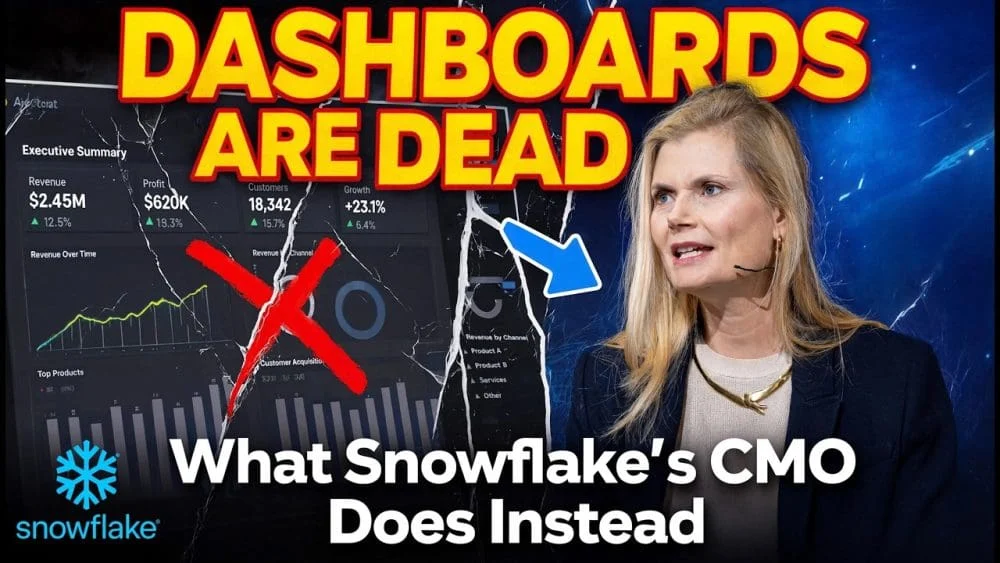
At the recent SaaStr AI 2026 conference, Denise Persson, Chief Marketing Officer at Snowflake, delivered a masterclass in operational transformation. Managing a 700-person organization at one of the world’s most data-sensitive companies, Persson is not just experimenting with AI—she is fundamentally rewriting the playbook for modern Go-To-Market (GTM) strategy.
The core of her message is radical: the era of the static dashboard is over. In its place, Persson has implemented a conversational data environment where leadership interrogates business health in plain English, eliminating the friction of manual reporting and inter-departmental finger-pointing.
Main Facts: The End of Administrative Friction
For decades, marketing leaders have been tethered to complex BI tools and recurring status meetings, often spending hours reconciling discrepancies between sales and marketing data. Persson has effectively liquidated this operational tax.
By deploying advanced AI agents across her marketing organization, Persson no longer logs into traditional dashboards to monitor pipeline health or lead generation. Instead, she queries her data directly. If she notices a fluctuation in pipeline movement within the US West region, she asks her AI agent for the "why." The system provides immediate, context-aware analysis, eliminating the need for frantic Slack messages to subordinates or tedious "war room" meetings to interpret charts.
This transition has yielded tangible results, most notably a 30% reduction in cost-per-opportunity over a six-month period. By consolidating fragmented media channels into a centralized AI-managed ecosystem, the team now receives daily optimization recommendations rather than waiting for post-mortem campaign analysis.
Chronology: From Pilot to Institutional Framework
The journey to an "AI-first" marketing department did not happen overnight. It was a calculated, multi-phase rollout:
- The Foundation (Pre-2025): Recognizing that AI is only as effective as the data it consumes, Snowflake prioritized "data estate" hygiene. They treated their data infrastructure with the same rigor that companies applied to Salesforce adoption fifteen years ago, knowing that garbage-in-garbage-out would only accelerate poor decision-making.
- The Experimentation Phase (Early 2025): Snowflake leadership made the strategic decision to centralize AI spending at the corporate level, effectively granting the marketing department "unlimited" access to test and deploy agents. This removed budgetary gatekeeping and encouraged a culture of rapid innovation.
- The Governance Implementation: Once adoption hit critical mass, the company established a centralized AI engineering team. This group acts as a control plane, certifying any AI "skill" intended for broad use to ensure compliance, security, and brand safety.
- The Current State (2026): The organization has shifted its focus from mere experimentation to operational efficiency. The current mandate is clear: deliver 40–50% growth with flat or reduced headcount, relying on AI agents to absorb the increased operational load.
Supporting Data and Operational Shifts
The shift has transformed the very fabric of the organization. Beyond pipeline analytics, Persson’s "morning brief" now includes automated reporting on organizational health—tracking attrition, team capacity, and even expense management.
The Hiring Profile Flip
The most profound shift, however, has been in human capital. The "GTM Engineer" has replaced the traditional "Marketing Analyst" as the most coveted role. Skills in Marketo or Salesforce are no longer the primary indicators of success; they have been eclipsed by adaptability, curiosity, and change management. Snowflake is no longer looking for tool-users; they are looking for architects who can navigate an evolving AI landscape.
The "Raven" Initiative
Central to this success is "Raven," a company-wide GTM agent used by both sales and marketing. By centralizing the intelligence layer, Snowflake has prevented the common corporate pitfall of building the same AI tool five times over. Every skill within Raven is centrally vetted, ensuring that the agents represent the brand accurately to prospects and customers alike.
Official Perspectives: The Lessons of Leadership
Persson is candid about the hurdles encountered during this transition. She highlights four critical mistakes that serve as a cautionary tale for other enterprise leaders:
- The Token Trap: Early on, the team incentivized AI usage through a "token leaderboard." They quickly realized this rewarded consumption rather than value. "If you have to verbally correct your own metric every time you show it, the metric is sending the wrong signal," Persson noted. They have since shifted to an outcomes-based incentive structure.
- The Sprawl of "Let Everyone Build": While decentralized experimentation was necessary to spark adoption, it led to duplicate efforts. Persson anticipates a period of "reining in" the sprawl, drawing a direct parallel to the SaaS-tool explosion of the mid-2010s.
- The Budget Reality Check: While the "unlimited" AI budget was the right strategic move to catalyze adoption, it is not sustainable. The bill for massive AI usage is real, and the company is preparing to shift toward stricter financial discipline in 2027.
- The Activation Gap: While analysis has become instantaneous, the "doing" is still catching up. Automating the analysis of which campaigns to run is easy; executing those campaigns remains a labor-intensive process that current GTM engineering teams are still working to solve.
Implications for the Future of GTM
The implications for the broader industry are vast. Snowflake’s model suggests that the future of marketing is less about content creation and more about content orchestration.
The Human-AI Equilibrium
Despite the automation, Persson maintains that the "human" element has never been more valuable. As AI floods the market with synthetic content, authenticity becomes a premium asset. Humans at Snowflake are now tasked with the creative, strategic, and high-trust work—the "unmanufacturable" aspects of brand-building—while agents handle the logistics.
Rebuilding Enablement
Snowflake has moved sales, partner, and customer enablement under the marketing umbrella to ensure a single source of truth. By building self-service agents, reps can now practice pitches against AI personas that are fully loaded with proprietary company data, removing the burden from human managers and ensuring training happens at the moment of need.
The "Events" Renaissance
Interestingly, in a world dominated by digital agents, the demand for human connection has surged. Persson reports that demand for in-person events is "going off the roof." The takeaway is clear: the more virtual and synthetic our professional lives become, the more value we place on physical, high-touch interactions.
Conclusion
Denise Persson’s strategy at Snowflake offers a blueprint for the enterprise of 2026. By treating data as a product, governance as a necessity, and AI as an operational extension rather than a novelty, Snowflake is setting a high bar for GTM performance.
The path forward, according to Persson, is not a settled one. No one can perfectly predict what the marketing department will look like in three years, but the choice is binary: you can either sit on the sidelines, or you can actively shape the transition. For those aiming to scale with efficiency in an AI-native world, the message is clear: stop building dashboards, start building intelligence—and prepare for a future where your ability to adapt matters more than your ability to manage a legacy toolset.