In the modern digital landscape, ecommerce marketers are drowning in data yet starving for clarity. Despite an arsenal of AI-driven tracking tools, advanced pixel-based attribution, and sophisticated dashboarding, the act of measuring success remains deceptively difficult. Every platform—from Google Ads and Meta to email service providers and affiliate networks—claims its share of the credit, creating a fractured narrative that often obscures the reality of business health.
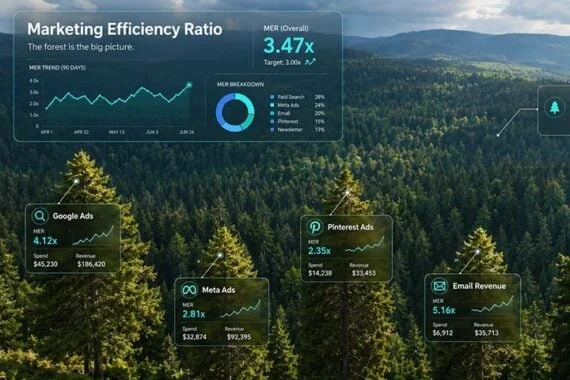
As the industry shifts away from granular, platform-specific reporting, a holistic metric is gaining traction among growth-minded retailers: the Marketing Efficiency Ratio (MER). By moving the focus from the "trees" of individual campaign performance to the "forest" of total business revenue, MER offers a pragmatic, high-level view that is proving essential for sustainable growth.
The Attribution Crisis: Why Granular Data Isn’t Enough
The contemporary ecommerce funnel is rarely linear. A typical customer journey might begin with an impression on a Meta ad, evolve into an email newsletter click, and conclude with a branded search on Google. Because each platform is incentivized to report its own performance favorably, marketers often face "double counting" or gaps in attribution where no platform claims the conversion.
While Return on Ad Spend (ROAS) remains the standard for measuring the performance of a specific ad set or campaign, it is inherently limited. ROAS is a tactical metric; it tells a marketer whether a specific campaign is hitting a target, but it fails to account for the "halo effect" that one channel has on another. Furthermore, as privacy regulations tighten and third-party cookies diminish, the accuracy of platform-specific attribution is declining.
This creates a paradox: the more marketers zoom in on individual channels, the more they lose sight of the bottom line. This is where the Marketing Efficiency Ratio steps in, providing a "blended" perspective that strips away the noise of platform-specific algorithms.
What is MER and How Does It Work?
The Marketing Efficiency Ratio is a straightforward indicator that measures the relationship between total revenue and total marketing expenditure. Unlike ROAS, which is siloed by channel, MER is a holistic snapshot of the entire business ecosystem.
The Calculation
The math behind MER is intentionally simple, designed to be understood by stakeholders ranging from marketing analysts to CFOs:
MER = Total Revenue / Total Marketing Spend
For example, if an ecommerce brand generates $1,000,000 in monthly revenue and invests $250,000 into its total marketing mix—including ad spend, creative production, agency fees, influencer payments, and affiliate commissions—the MER is 4.0. This means for every dollar spent on marketing, the business earns $4 in revenue.
Defining the Inputs
To derive an accurate MER, consistency is paramount. Marketers must include every cost associated with customer acquisition to avoid inflating the ratio. While definitions can vary slightly between organizations, the most robust calculations include:
- Paid Media Spend: All costs across Google, Meta, TikTok, Pinterest, etc.
- Agency & Contractor Fees: Monthly retainers and service fees.
- Content & Creative Production: Costs associated with photo shoots, video editing, and copywriting.
- Influencer & Affiliate Payouts: Commissions and flat-fee partnerships.
- Software & Tooling: Subscriptions for email marketing platforms, SMS tools, and tracking software.
Chronology of a Shift: From Granular to Blended Metrics
The rise of MER follows a clear evolution in ecommerce strategy over the last decade.
Phase 1: The Wild West (2010–2015)
During the early days of Facebook and Google advertising, marketers relied heavily on "Last-Click" attribution. It was simple, and if a campaign reported a 5x ROAS, managers assumed they were profitable.
Phase 2: The Sophistication Era (2016–2020)
As platforms evolved, so did tracking. Multi-touch attribution models became the gold standard. Marketers spent significant time and money trying to map every touchpoint in the funnel, believing that perfect data would lead to perfect optimization.

Phase 3: The Privacy-First Reality (2021–Present)
With the introduction of iOS 14.5 and the eventual deprecation of third-party cookies, granular attribution broke. Platforms could no longer track users across the web with the same precision. Consequently, the industry pivoted back to "blended" metrics. Today, top-tier brands use MER not as a replacement for channel-specific data, but as the "ground truth" that validates the efficacy of their total marketing strategy.
Supporting Data: Why Blended ROAS Matters
Industry data suggests that brands relying solely on platform-reported ROAS often overspend on underperforming channels. Conversely, brands that utilize MER find they can scale more confidently.
Consider two companies with identical budgets:
- Brand A focuses on a 5.0 ROAS on Meta ads. They ruthlessly cut any campaign that dips below this number. As a result, they suffer from limited reach and fail to capture "top-of-funnel" awareness, leading to stagnant growth.
- Brand B maintains a 3.5 MER. They allow individual channels to perform at different ROAS levels—some at 2.0 (brand awareness) and some at 8.0 (retargeting). By looking at the blended ratio, they realize that their awareness efforts are fueling the retargeting success. Their total revenue grows faster because they view their marketing as an ecosystem rather than a collection of isolated bets.
Official Perspectives: The Expert Consensus
Financial analysts and ecommerce consultants have largely moved toward the "Blended ROAS" philosophy.
"The obsession with tracking every single penny is a sunk-cost fallacy," says Sarah Jenkins, an ecommerce strategy consultant. "If your MER is healthy, your business is healthy. If you have to spend three weeks auditing attribution models to justify a campaign, you’ve already lost the efficiency you were trying to gain."
Conversely, critics of MER argue that it is a "lazy" metric because it doesn’t tell you what to fix. If an MER drops from 4.0 to 3.0, the ratio doesn’t explicitly state whether the fault lies in creative fatigue on Facebook, a broken checkout flow, or a seasonal dip in organic demand. This is why the consensus is that MER should act as a dashboard’s primary indicator, with ROAS and CAC (Customer Acquisition Cost) acting as the diagnostic tools.
Implications for Future Budgeting
The adoption of MER changes the way ecommerce teams approach budgeting and forecasting.
Setting Guardrails
By determining the "break-even" MER, a business can establish clear guardrails. If a company knows it loses money below a 2.5 MER, that becomes the hard floor for spending. If they are consistently hitting a 4.0, they know they have "headroom" to invest in experimental channels—like CTV or podcast sponsorships—that might not show immediate, trackable ROAS.
Moving Beyond Clicks
The most significant implication of MER is the cultural shift within marketing teams. When the goal is an MER target, teams stop fighting over which channel "owns" a sale. Instead, they collaborate on the total revenue goal. It forces marketers to consider the impact of their creative, their landing page conversion rates, and their retention strategies (like email and SMS) in conjunction with paid ads.
The Margin Reality Check
Ultimately, MER must be viewed through the lens of gross margins. A business with 70% margins can sustain a much lower MER (and thus higher ad spend) than a business with 25% margins. This realization encourages a tighter integration between marketing and finance departments.
Conclusion: The Forest is the Goal
In the complex, fragmented world of ecommerce, the Marketing Efficiency Ratio provides a much-needed sense of direction. It is not a replacement for deep data analysis, nor does it excuse marketers from optimizing their individual campaigns. Instead, it serves as the ultimate scorecard.
By prioritizing the "big picture," retailers can navigate the complexities of modern attribution with confidence. Whether a brand is in a phase of aggressive growth or profitability-focused maintenance, MER acts as the lighthouse, ensuring that no matter how loud the individual channels shout, the team remains focused on the primary objective: profitable, sustainable, and scalable revenue.