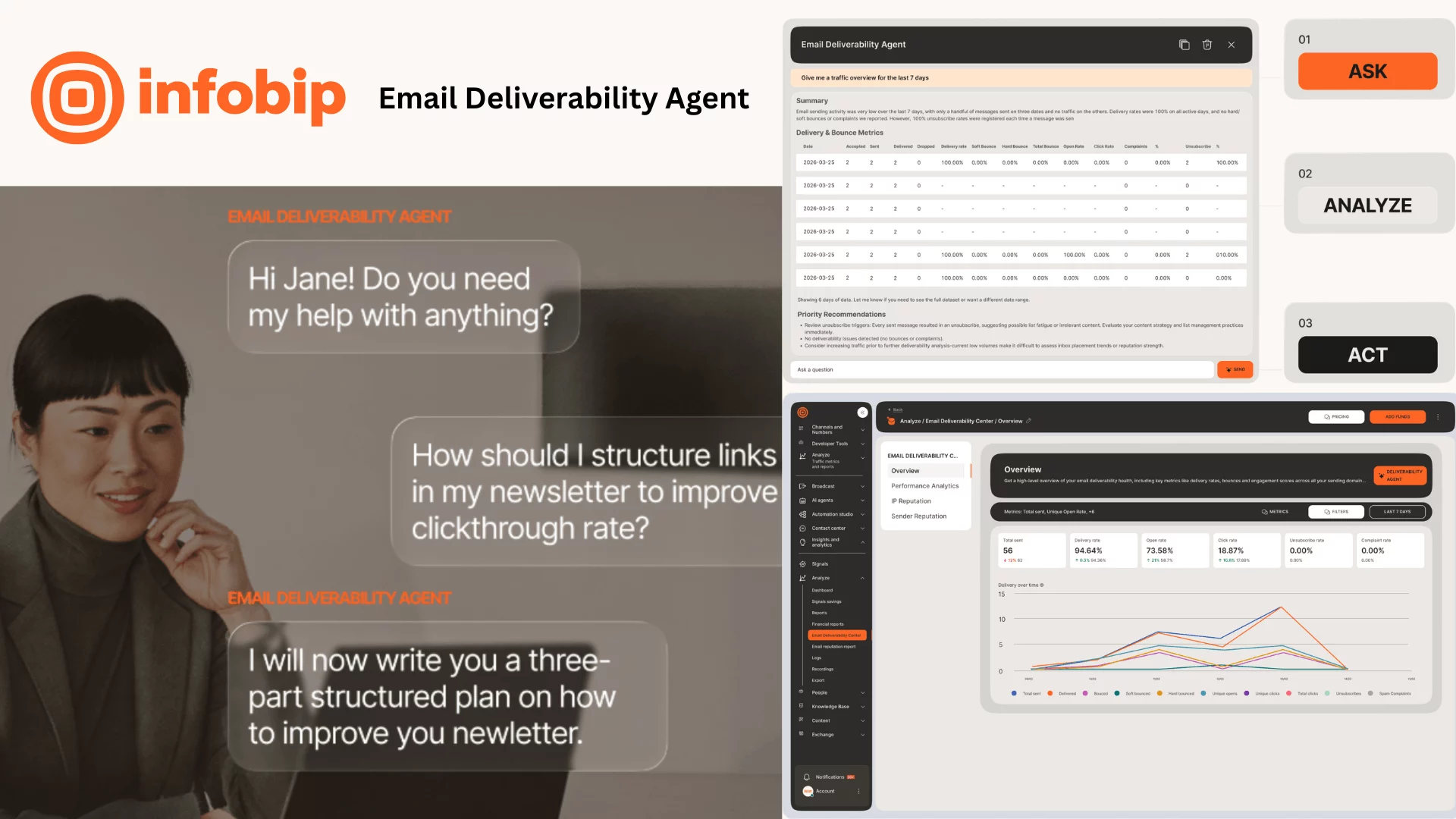
In the rapidly evolving landscape of digital communication, the role of the "Deliverability Specialist" is undergoing a profound metamorphosis. As mailbox providers like Google and Yahoo tighten their grip on bulk-sender requirements and engagement metrics become the primary currency of the inbox, the technical burden on email marketers has reached a fever pitch. Enter Infobip, the global cloud communications platform, which has launched its new AI-powered Email Deliverability Agent as part of its AgentOS platform.
The promise is bold: "Expert-level deliverability guidance, no specialist required." By analyzing real-time sending data to provide actionable fixes for reputation monitoring, authentication, and inbox placement, Infobip is positioning itself at the vanguard of a shift that threatens—or perhaps promises—to automate the very judgment calls that have defined the discipline for decades.
The Triangulation of Deliverability
To understand the significance of Infobip’s launch, one must view it as the final piece of a three-part industrial revolution in email operations. For years, deliverability was a black box navigated by human experts who interpreted fragmented data. Today, that process is being compressed from three distinct angles:
- The Data Source (Top-Down): Gmail’s recent updates to Postmaster Tools have moved away from raw metrics, choosing instead to provide plain-language verdicts. They are effectively telling the sender, "Your users don’t want this," removing the need for a specialist to translate complex bounce codes into human intent.
- The Tooling (Bottom-Up): Amazon SES has recently integrated inbox placement testing, cross-provider analytics, and blocklist monitoring directly into its console. By commoditizing the infrastructure of monitoring, the barriers to entry for high-level diagnostics have been lowered.
- The Interpretation (The Middle): Infobip’s new AI Agent sits squarely in the middle of these two forces. It takes the data provided by the infrastructure and the verdicts provided by the ISPs and bridges the gap to action. It acts as the "middleman" that replaces the human practitioner who previously had to decide what the dashboard meant.
This "third jaw" of the trap—the industrialization of judgment—is what makes the Infobip launch so ambitious. While monitoring has long been a software-as-a-service staple, the act of deciding what to do when a reputation signal dips has historically been considered the "human" portion of the deliverability equation.
Chronology of a Shifting Landscape
The timing of this release is not coincidental. Over the last few months, the industry has witnessed a frantic race toward "agentic" workflows.
- Early Q4: Major mailbox providers intensified their scrutiny of bulk senders, making non-compliance a direct route to the spam folder. This created an immediate, painful demand for better diagnostics.
- Mid-November: Amazon SES introduced its subscription-based monitoring suite, signaling that even the largest infrastructure players believe deliverability insight should be a core, integrated utility rather than a third-party add-on.
- Late November/Early December: The AI agent wave hit the marketing tech sector, with Salesforce and others deploying agents for content and campaign management. Infobip’s entry, however, is unique in its focus on the technical plumbing of email delivery.
This sequence of events suggests that the industry is moving away from the era of "dashboard fatigue"—where marketers stare at charts they don’t understand—toward an era of "prescriptive resolution," where the system itself identifies and proposes the fix.
The Question of Agency: What Can It Actually Do?
In our examination of the current wave of AI agents—from Salesforce’s campaign managers to various MCP connectors—the most critical metric is not "what does the AI know," but "what can the AI do?"
An advisory agent is a helpful assistant; an autonomous agent is a powerful, potentially dangerous tool. If an AI misreads a reputation signal and suggests a minor tweak, the worst-case scenario is an afternoon of wasted time. If that same AI is empowered to adjust sending configurations, throttle streams, or modify authentication records (like SPF/DKIM/DMARC) at scale, a miscalculation could cripple a brand’s sending reputation in minutes.
The Official Stance
To clarify this, we reached out to Infobip for a definitive answer on the agent’s current capabilities. Their response provides a clear roadmap for the product’s evolution:
"Our AI Deliverability Agent gives teams near real-time visibility into the issues affecting reputation and deliverability performance, then turns those findings into prioritized remediation steps. The product roadmap moves from insights to selective automation for low-risk actions, with human approval, audit logs, and rollback built in. Each new agentic step is designed to improve performance without removing control from the sender."
This distinction is vital. As of today, the agent is strictly an advisory tool. It identifies the problem, it suggests the fix, but the "human in the loop" remains the final authority. This approach mirrors the "paused by default" safety protocols seen in Meta’s ad connectors, setting a standard for responsible deployment that many of its competitors have yet to adopt publicly.
Implications for the Deliverability Profession
The marketing rhetoric of "no specialist required" carries a dual meaning. On one hand, it is a form of "marketing compression"—a shorthand for saying that the barrier to entry is lower. For the vast majority of small-to-mid-sized senders who have never been able to afford a dedicated deliverability consultant, this tool provides a level of literacy that was previously inaccessible. It democratizes expertise.
However, we must also consider the "gnarly" cases—the mystery throttling, the shared-pool contamination, and the logic-defying blocklists that make no sense even to seasoned pros.
The Diagnostic Limit
It is likely that the Infobip agent will excel at the "checklist" tasks: ensuring authentication is set correctly, identifying bad bounce patterns, and flagging common configuration errors. But deliverability is often an art of diagnosis as much as a science of checklist-following. When the data is contradictory—when the ISP says one thing but the engagement logs suggest another—the nuance of human experience becomes the only bridge to a solution.
If the agent routes these "hard cases" to Infobip’s human deliverability team, then the tool serves its purpose as a triage system. If, however, the marketing team truly believes that the AI can solve every deliverability crisis, they may find themselves in deeper water when the "easy" fixes fail to resolve the underlying reputation damage.
The Road Ahead
Infobip’s move is a data point in a larger trend toward the "autonomous inbox." The industry is clearly heading toward a future where the machine manages the handshake between the sender and the receiver.
By answering the "send-authority" question on the record—committing to human approval, audit logs, and rollback mechanisms—Infobip has set a high bar for the rest of the industry. As this technology matures, we will be watching for the first "practitioner write-ups." The true test will come not from the marketing brochures, but from the front-line engineers who put this agent to work in the trenches of high-volume, mission-critical email operations.
For now, the Deliverability Agent represents a significant step forward in making complex technical data understandable, provided the industry maintains the discipline to keep the human in the loop until the automation proves itself bulletproof.
Disclosure: Infobip is an Enterprise Member of Emailexpert. Coverage decisions and editorial judgments for this article were made independently of commercial relationships. We hold all vendors to the same standard of inquiry, as we believe that transparency is the most valuable service we can provide to the email community.