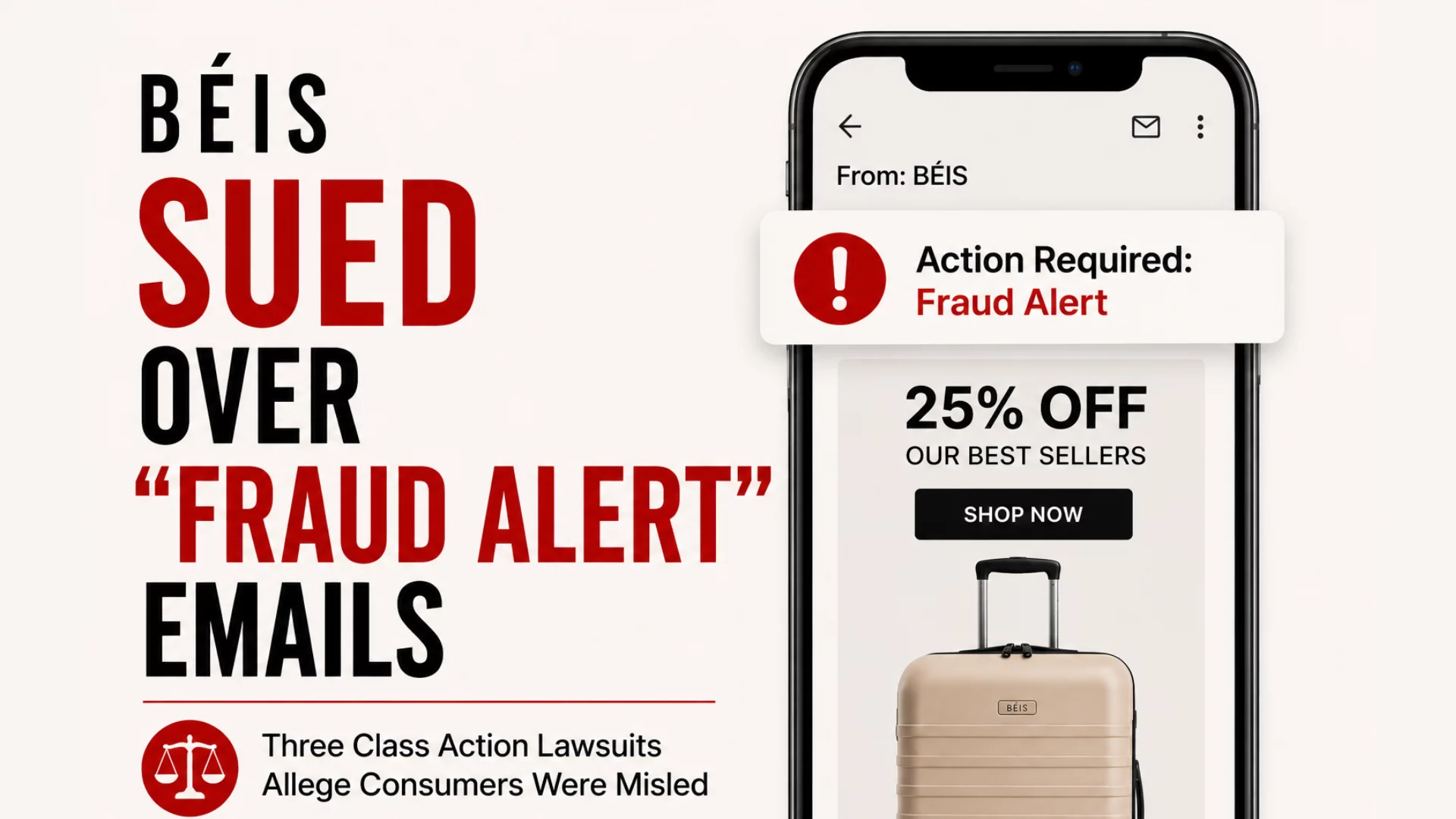
In the high-stakes world of digital marketing, the subject line is the final frontier—a gateway that determines whether a consumer engages with a brand or hits the delete button. For trendy luggage and travel accessory brand Béis, a December 2025 email marketing campaign has backfired in spectacular fashion. The brand is now facing three separate class-action lawsuits in Washington state, all centered on a controversial strategy: masquerading a promotional sale as a critical security alert.
What started as an attempt to drive holiday revenue has morphed into a significant legal challenge, testing the boundaries of Washington’s stringent Commercial Electronic Mail Act (CEMA). As the legal landscape in the state undergoes a seismic shift, Béis finds itself caught in the crosshairs of a judicial environment that has become increasingly hostile toward deceptive email marketing practices.
The Anatomy of the Alleged Deception
The controversy stems from a promotional email sent to consumers in December 2025. The subject line, crafted to mirror the urgent tone of a fraud alert or an account-security notice, was designed to trigger an immediate reaction. In an era where consumers are hyper-aware of digital security and data breaches, such notifications command instant attention.
However, once recipients opened the email, they were not met with news of unauthorized activity or a password reset requirement. Instead, they were greeted by a sales pitch. Even more damning for the brand, the body copy allegedly included a "wink and a nod" to the bait-and-switch tactic, featuring the phrase, "the fraud is us… sale now extended."
Plaintiffs in the three pending class actions—Huong v. Béis (King County), Noble v. Béis (Pierce County), and Mott v. Béis (Spokane County)—argue that this was not merely a clumsy marketing attempt, but a deliberate act of misdirection. By exploiting the inherent trust consumers place in security-related communications, the brand allegedly violated the sanctity of the digital inbox, turning essential safety protocols into a vehicle for commerce.
A Chronology of Legal Escalation
To understand why Béis is facing such significant peril, one must look at the recent evolution of Washington’s digital consumer protection laws.
The Turning Point: Brown v. Old Navy (April 2025)
For decades, CEMA existed as a dormant statute, rarely invoked in major litigation. That changed in April 2025 with the Washington Supreme Court’s landmark decision in Brown v. Old Navy. The court ruled that any false or misleading information in a commercial subject line constitutes a violation of CEMA. Crucially, the court established that a disclaimer or clarification buried within the body of an email does not "cure" a misleading subject line. While the court allowed for "puffery"—subjective marketing hype—it drew a hard line at factual claims regarding pricing, deadlines, and the nature of the communication itself.
The Floodgates Open (2025–2026)
Following the Old Navy ruling, the floodgates opened. Retailers like Nike and Crocs were quickly targeted as plaintiffs’ attorneys realized that subject line misdirection was now a viable, high-stakes cause of action. The legal momentum was further cemented in January 2026, when a federal court in Ma v. Nike ruled that the federal CAN-SPAM Act does not preempt Washington’s state-level CEMA laws, effectively stripping major corporations of their primary federal defense shield.
The Legislative Response (2026)
Recognizing the surge in litigation, the Washington legislature moved to refine the law. On March 23, 2026, Governor Bob Ferguson signed HB 2274 into law. The act, which took effect on June 11, 2026, sought to modernize CEMA, introducing a "knowledge" requirement for violations and adjusting statutory damages. However, because the Béis campaign occurred in December 2025 and the lawsuits were filed prior to the implementation of these reforms, the brand remains tethered to the much harsher legal standards of the old regime.
The Mechanics of the Lawsuit: Why CEMA Matters
The lawsuits against Béis leverage two primary statutes: the Commercial Electronic Mail Act and the state’s Consumer Protection Act (CPA).
Under the pre-reform version of CEMA, a violation carries a statutory penalty of $500 per email. Furthermore, a CEMA violation is considered a "per se" violation of the Consumer Protection Act. This is the "poison pill" for defendants: under the CPA, courts can award treble damages (three times the actual damages) and, in many cases, mandate the reimbursement of attorney fees.
The plaintiffs’ argument is built on the concept of "false urgency." Beyond the misleading security subject line, one complaint specifically highlights the brand’s use of countdown clocks and expiration deadlines that allegedly remained active long after the purported sale had ended. By creating an artificial sense of panic, the plaintiffs argue that Béis coerced consumers into making impulsive purchases under false pretenses.
Official Responses and Corporate Strategy
As of this writing, Béis has yet to issue a public apology or a detailed defense in court. The brand, known for its polished aesthetic and social-media-savvy marketing, is maintaining a low profile while its legal team prepares to navigate the three distinct county-level filings.
Legal experts following the case suggest that Béis may attempt to categorize their subject line as "creative marketing" or "hyperbole" rather than a factual security claim. However, given the Brown v. Old Navy precedent, this defense faces a steep uphill climb. If the court determines that the average consumer would reasonably interpret a "fraud alert" subject line as a transactional security notice, the brand’s intent will likely be viewed as malicious rather than merely creative.
Implications for the Email Marketing Industry
The Béis litigation serves as a cautionary tale for every digital marketer operating in the Pacific Northwest and beyond. The days of "creative" subject line trickery—often referred to as "clickbait"—are effectively over.
1. The Subject Line as a Legal Contract
Marketers must treat the subject line with the same scrutiny as a product label or a financial contract. If the subject line claims a sale is ending, the sale must end. If it claims a security update, it must contain a security update. Any deviation from the literal truth, especially regarding the nature of the communication, creates an immediate liability.
2. The Death of "False Urgency"
The use of countdown timers and artificial deadlines has been a staple of e-commerce for years. However, in the current legal climate, these tools are now considered "liability surfaces." If a brand uses a timer that persists past the stated deadline, they are effectively building a roadmap for a class-action lawsuit.
3. The "Trust Tax"
Perhaps the most damaging aspect of the Béis situation is the long-term erosion of brand equity. By abusing the trust associated with security alerts, the company has risked its reputation among its core demographic. In the digital economy, consumer trust is a finite currency; spending it on a short-term marketing lift often results in a "trust tax" that is far more expensive than any revenue gained from a sale.
What Lies Ahead: The 2027 Legislative Landscape
As these cases progress, they will serve as the definitive test for how Washington courts interpret the reach of CEMA. While Béis is being judged under the older, stricter rules, the 2027 legislative session is expected to bring further debates regarding the balance between consumer protection and the viability of e-commerce.
Retailers are lobbying for more leniency, arguing that the "knowledge requirement" introduced in HB 2274 is still too narrow. Meanwhile, consumer advocacy groups are pushing for even stricter enforcement to curb what they view as predatory digital practices.
For Béis, the path forward involves a complex negotiation. With three separate venues (King, Pierce, and Spokane counties), the brand faces the prospect of prolonged, expensive litigation. Whether these cases will be consolidated or settled remains to be seen, but one thing is certain: the era of the "deceptive subject line" is coming to a close. Brands that fail to adapt their communication strategies to these new, stringent standards will find that the cost of a single email can quickly escalate into a corporate crisis.