For more than a decade, the digital advertising industry has been defined by the "walled garden." To run ads on Meta, you lived in Meta’s Ads Manager. To optimize Google campaigns, you resided in Google Ads. These platforms were not just marketplaces for attention; they were self-contained cockpits where every lever, dial, and data point was proprietary and locked behind a specific user interface.
Meta has recently shattered this long-standing paradigm. With the official launch of Meta Ads AI Connectors, the company is moving the "center of gravity" for digital marketing away from its own proprietary platform and into the broader ecosystem of artificial intelligence. Advertisers can now create, manage, and analyze campaigns from within the third-party AI tools they already use—such as ChatGPT, Claude, or custom-built internal agents—without ever logging into Ads Manager.
This shift represents more than just a new feature; it is a fundamental re-engineering of how paid social execution functions. By removing the technical friction of APIs and developer credentials, Meta is signaling a future where the platform itself becomes the "backend," while the "frontend" becomes whatever AI interface a marketer prefers.
Main Facts: Breaking the Wall Between Analysis and Action
The core of the Meta Ads AI Connectors announcement lies in the integration of the Model Context Protocol (MCP). This open-source standard allows AI models to connect securely to external data sources and tools. By adopting this, Meta has removed the traditional hurdles of ad tech integration.
Key Features of the Release:
- Zero-Code Integration: Traditionally, connecting an external tool to Meta’s data required a complex API project, weeks of developer time, and rigorous credential chasing. AI Connectors eliminate this, allowing tools to link directly to live campaign data via an MCP server.
- Natural Language Execution: Advertisers can now perform complex tasks—such as "Increase the budget of the best-performing creative by 20%" or "Draft three new ad sets targeting Gen Z interests"—using simple conversational English.
- Bidirectional Flow: Unlike previous AI integrations that were "read-only" (meaning they could analyze data but not change it), these connectors are "read-write." The AI can pull reporting data, interpret it, and then reach back into the account to execute changes.
- Platform Agnosticism: While Ads Manager remains functional, it is no longer the mandatory interface for execution. The management layer has effectively migrated to the AI environment.
Chronology: The Evolution Toward Autonomous Advertising
To understand the weight of this announcement, one must look at the trajectory of Meta’s advertising technology over the last decade.
Phase 1: The Manual Era (2012–2018)
During this period, "platform fluency" was the most valuable skill a media buyer could possess. Success depended on knowing exactly which buttons to click and how to navigate the labyrinthine menus of Ads Manager. Optimization was manual, and data lived in silos.
Phase 2: The Black Box Era (2019–2022)
Meta introduced Advantage+ and automated bidding strategies. This moved the "work" away from manual clicking and into Meta’s internal algorithms. However, the advertiser still had to log into the platform to set the parameters. The AI worked inside Meta, but the human still had to go to Meta to talk to it.
Phase 3: The Interpretive AI Era (2023–Early 2024)
With the explosion of Large Language Models (LLMs), marketers began exporting CSV files from Meta and uploading them to ChatGPT to ask for insights. This created a "lag." The AI could tell you what was wrong, but it couldn’t fix it. You had to take that insight and manually re-enter Ads Manager to apply the fix.
Phase 4: The Connected Era (Late 2024–Present)
The launch of AI Connectors marks the beginning of the "Agentic" era. The wall between the interpretation (the AI) and the execution (the Platform) has been demolished. Action and analysis now happen in the same breath, in the same interface.
Supporting Data: The Cost of Friction and the Rise of Agentic Workflows
While Meta has not released specific internal ROI metrics for the initial beta testers of the AI Connectors, industry data on "Agentic Workflows" suggests the impact will be profound.
The Speed of Optimization
According to industry benchmarks from Gartner and Forrester, the average digital marketing team spends approximately 40% of its time on "operational maintenance"—tasks like pulling reports, adjusting budgets, and duplicating ad sets. Meta’s AI Connectors aim to reduce this "click-tax" to nearly zero. By moving to natural language commands, tasks that previously took 15 to 30 minutes of platform navigation can now be executed in seconds.
The Cross-Channel Reality
A 2023 study by Shopify found that the average successful merchant uses at least four different advertising channels simultaneously. The "silo problem" has been the greatest barrier to efficiency. When Meta data is locked inside Ads Manager, it cannot easily be weighed against Google Search data or Amazon Retail Media data. Meta’s adoption of the MCP server protocol is a direct response to this data fragmentation. By allowing Meta data to flow into a central AI "brain," marketers can finally achieve a holistic view of their marketing mix.
The Developer Gap
The removal of API dependencies is perhaps the most significant data point for small to medium-sized businesses (SMBs). Previously, only the top 1% of advertisers with dedicated engineering teams could build custom management layers. By making these connectors "plug-and-play," Meta is democratizing high-level automation for millions of advertisers who lack technical resources.

Official Responses: Meta’s Strategic Pivot
In official communications regarding the launch, Meta has emphasized that this move is about "meeting advertisers where they are."
A Meta spokesperson noted: "We recognize that the workflow of the modern marketer is no longer confined to a single tab in a browser. By opening these connectors, we are allowing our partners to build more flexible, intelligent, and responsive advertising operations that leverage the full power of generative AI."
Tech analysts suggest this is a defensive-turned-offensive move. By making it easier to manage Meta ads through third-party AI, Meta ensures that its platform remains the preferred destination for ad spend, even as marketers move toward "AI-first" workflows. They are essentially betting that by giving up control of the interface, they will retain control of the budget.
Furthermore, the integration with the Model Context Protocol (MCP) has been praised by the developer community. Anthropic, the creators of the protocol, welcomed the move, stating that Meta’s adoption proves the industry’s desire for open standards in how AI agents interact with professional tools.
Implications: A New Hierarchy of Marketing Skills
The introduction of AI Connectors carries implications that extend far beyond mere efficiency. It fundamentally alters the labor market for digital marketing and the strategic framework of brand growth.
1. The Death of the "Platform Specialist"
For years, a "Facebook Ad Specialist" was someone who knew the intricacies of the UI. As execution moves to natural language, this skill set is rapidly depreciating. The new premium is on Strategic Input Management. The most successful marketers will not be those who can navigate a menu, but those who can define the right guardrails, signals, and business objectives for the AI to follow.
2. The Rise of "Agentic Strategy"
We are moving toward a world of "Agentic Strategy," where a marketer oversees a fleet of AI agents. One agent might monitor Meta performance, another monitors Google, and a third adjusts budgets between them based on real-time inventory levels in a warehouse. Meta’s AI Connectors are the first major "pipe" to be laid for this autonomous future.
3. The Human as the "Ethical Governor"
With the ability to change campaigns through a single sentence, the stakes for human judgment have never been higher. If a human gives a poorly framed instruction to an AI connector, the system will execute it across a million-dollar budget in milliseconds. The human role is shifting from "pilot" to "air traffic controller"—ensuring that the automated systems are moving in a direction that aligns with brand ethics, long-term health, and creative integrity.
4. Redefining the Agency Model
Advertising agencies that charge based on "management hours" are facing an existential threat. If an AI can handle the execution and reporting, the billable hour for "campaign setup" disappears. Agencies must pivot toward becoming "AI Orchestrators," focused on the high-level creative and psychological insights that AI still struggles to replicate.
Conclusion: Where This Leaves the Industry
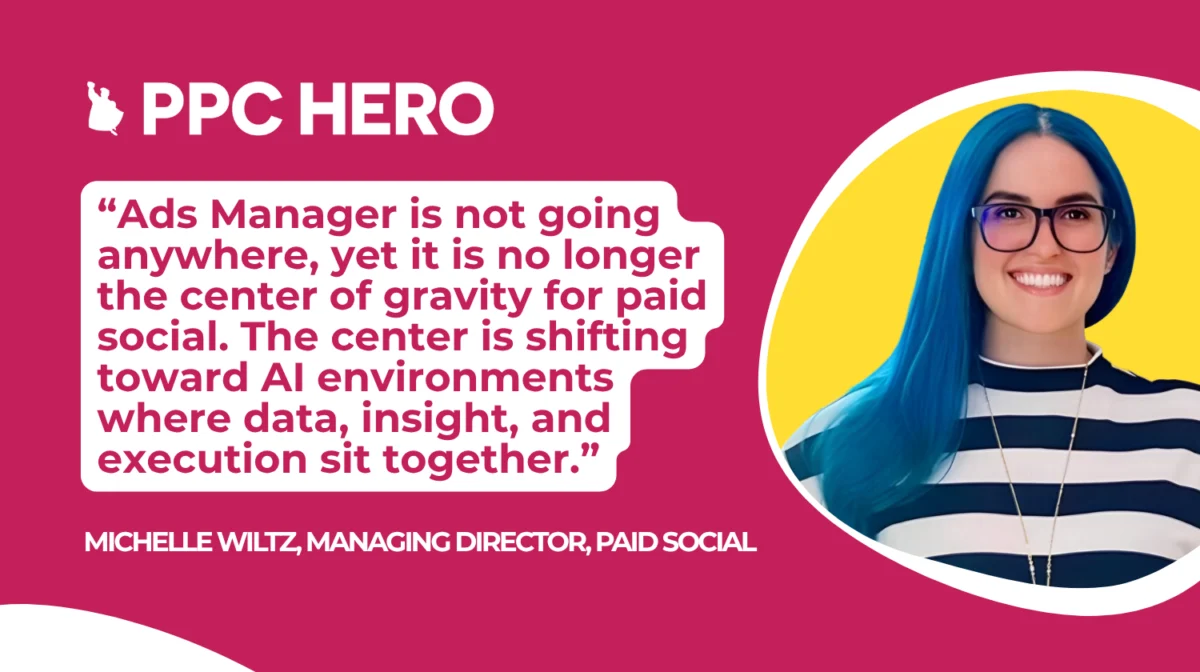
Meta Ads AI Connectors are not just another tool in the box; they represent a relocation of the box itself. By allowing the "execution layer" to leave the platform, Meta is acknowledging that the future of work is decentralized and AI-driven.
Ads Manager will likely remain a necessary backend for deep troubleshooting and advanced configurations, but its days as the daily "home" for the media buyer are numbered. The center of gravity has shifted to the AI environment—a space where data from every channel can be synthesized and acted upon in real-time.
For marketing teams, the message is clear: the advantage no longer goes to those who can work the machine the best. It goes to those who can direct the machine the most intelligently. The teams that thrive will be those that stop "logging in" and start "plugging in," redesigning their entire workflow around the speed and scale that these new connectors allow. Those who remain tethered to the old manual routines will find themselves increasingly outpaced by a system that never sleeps and executes at the speed of thought.