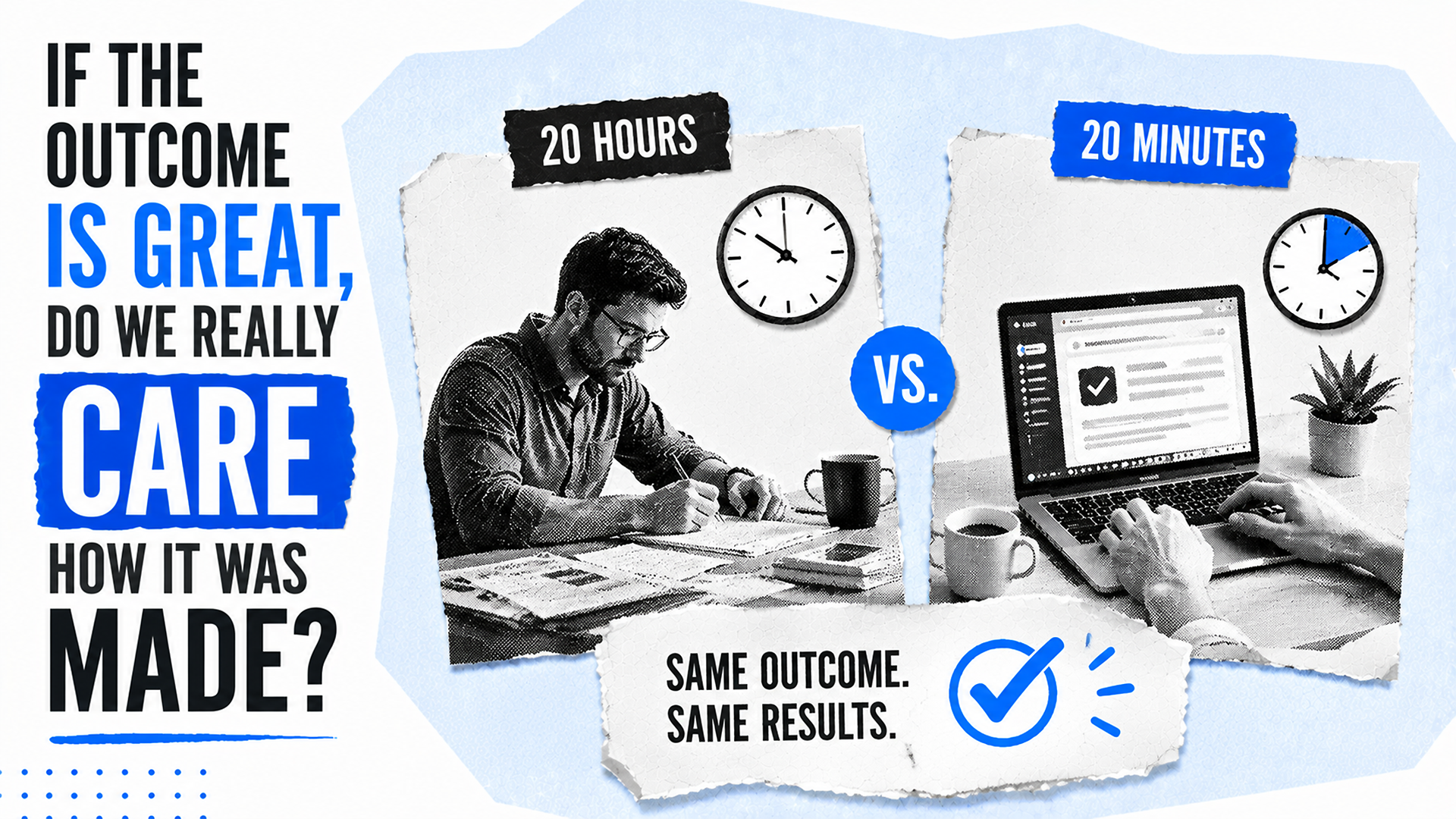
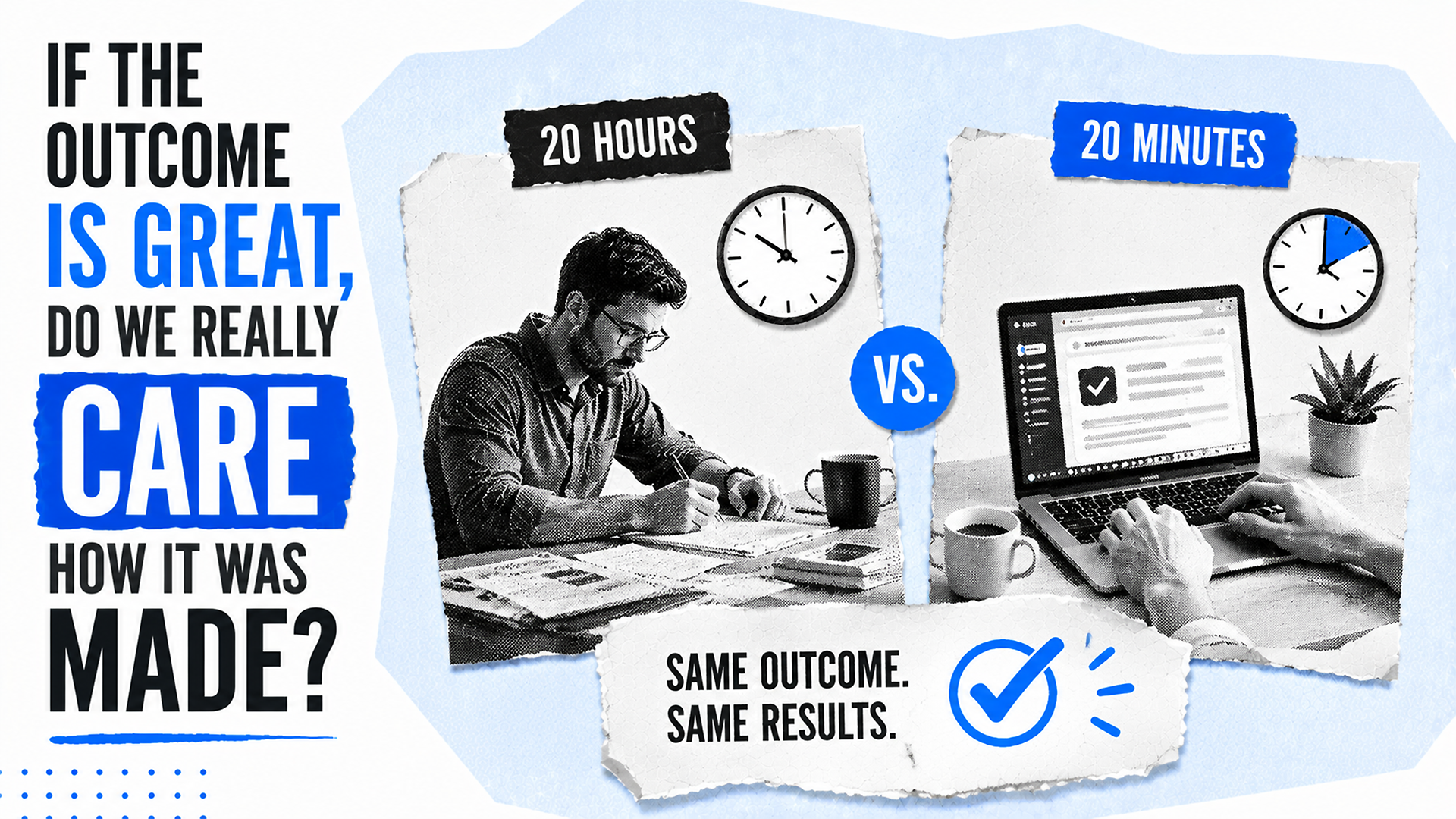
Main Facts: The 20-Hour vs. 20-Minute Dilemma
Consider a scenario rapidly playing out across modern professional services: A client receives two distinct deliverables from two different consultants. Both assets successfully solve the specific business problem they were commissioned to address. Both are highly accurate, practical, and lead to the exact same commercial outcomes. The client is initially highly satisfied, seeing no discernible difference in quality or performance.
Then, a critical piece of operational data is revealed: the first deliverable took 20 hours of manual labor to produce, while the second took just 20 minutes using generative artificial intelligence (AI).
Instantly, the client’s perception shifts. Satisfaction turns to skepticism, and a wave of challenging questions emerges:
- “Am I being overcharged?”
- “Why should I pay premium rates for automated output?”
- “If a machine did the heavy lifting, where is the proprietary value I am purchasing?”
This tension highlights a profound psychological and economic double standard in the modern workforce. While professionals enthusiastically adopt generative AI to optimize their internal workflows, save time, and eliminate administrative bottlenecks, they often experience deep discomfort when sitting on the buying side of the transaction. The discovery that a vendor leveraged AI to generate a premium deliverable frequently triggers a sense of transactional betrayal.
       [ Client Needs a Deliverable ]
                     │
       ┌─────────────┴─────────────┐
       ▼                           ▼
[ Deliverable A ]           [ Deliverable B ]
  • Manual Labor              • AI-Assisted
  • Time: 20 Hours            • Time: 20 Minutes
  • High Perceived Effort     • Low Perceived Effort
       │                           │
       └─────────────┬─────────────┘
                     ▼
        [ Identical Business Outcome ]
                     │
                     ▼
  [ The Paradox: Client feels Deliverable B ]
  [  has less value, despite equal utility.  ]
To explore this friction, prominent search engine optimization (SEO) consultant Nick LeRoy recently published a LinkedIn poll posing a fundamental question to the business community: If the final business outcome is exceptional, does it actually matter how the deliverable was made?
The response from hundreds of industry professionals exposed a critical reality: the primary objections to the deployment of AI in professional services have very little to do with the actual quality of the work. Instead, they stem from a deeply ingrained cultural bias that conflates time spent with value delivered—a systemic misalignment now colliding with the exponential speed of automated execution.
Chronology: From the Billable Hour to the Algorithmic Minute
To understand why the integration of AI creates such intense cognitive dissonance for clients, it is necessary to trace how modern commerce historically constructed its definitions of labor, value, and compensation.
┌─────────────────────────────────────────────────────────────────────────┐
│                          EVOLUTION OF VALUE                             │
├───────────────────┬───────────────────────────────┬─────────────────────┤
│ Era               │ Dominant Economic Metric      │ Human Role          │
├───────────────────┼───────────────────────────────┼─────────────────────┤
│ Industrial Age    │ Physical Output / Time Spent  │ Manual Laborer      │
│ Knowledge Age     │ Billable Hour / Specialized   │ Subject Expert      │
│ Algorithmic Age   │ Strategic Outcome / Trust     │ Editor & Director   │
└───────────────────┴───────────────────────────────┴─────────────────────┘
1. The Industrial Legacy and the Labor Theory of Value
For centuries, the relationship between effort and reward was linear and visible. In agricultural and manufacturing economies, value was directly tied to physical exertion and time. This concept was formalized by classical economists like Adam Smith and Karl Marx as the "Labor Theory of Value," which argued that the price of a commodity should be determined by the total amount of socially necessary labor time required to produce it. Under this framework, more hours naturally equated to a more valuable asset.
2. The Rise of the Billable Hour in Knowledge Work
As the global economy transitioned from industrial manufacturing to knowledge-based services in the mid-to-late 20th century, professional firms (particularly in law, accounting, consulting, and marketing) needed a standardized unit of transaction. They adopted the "billable hour."
This model institutionalized the assumption that a consultant’s expertise is best measured and monetized in incremental blocks of time. For decades, clients accepted this paradigm because human brainpower was the sole engine of execution; complex strategic analysis, copywriting, and technical auditing simply could not be accelerated beyond the limits of human cognitive processing speed.
3. The Generative AI Disruption (2022–Present)
The public launch of advanced large language models (LLMs) shattered this linear relationship between time and output. Tasks that previously required days of research, synthesis, drafting, and refinement can now be executed in seconds.
By compressing the execution phase of knowledge work to near-zero, AI has exposed the structural vulnerability of the billable hour. When a service provider uses an LLM to compress 20 hours of research into a 20-minute synthesis, they are suddenly penalized under an hourly pricing model, despite delivering the identical solution to the client in a fraction of the time.
Supporting Data: The Time vs. Value Fallacy
The discomfort surrounding AI-assisted deliverables is rooted in what economists call the "effort heuristic"—a mental shortcut where consumers assess the quality and monetary value of an object or service based on how much effort they perceive went into creating it.
The Tale of the $10,000 Tap
This psychological bias is perfectly illustrated by a classic business parable. A massive cargo ship’s engine breaks down, halting a multi-million-dollar shipping operation. After several local mechanics fail to repair the engine, the ship’s owners hire an engineer with 40 years of experience.
The veteran engineer spends 15 minutes quietly inspecting the complex system of pipes and valves. He then takes a small hammer from his bag, taps a specific valve once, and the engine instantly roars back to life.
A few days later, the ship owners receive an invoice for $10,000. Furious at the high price for what seemed like seconds of work, they demand an itemized bill. The engineer responds with the following breakdown:
- Tapping the valve with a hammer: $1.00
- Knowing exactly where to tap: $9,999.00
Total Invoice: $10,000
┌────────────────────────────────────────┐
│ [  ] Tapping the valve: $1.00 (1%)     │
│ [====================================] │
│      Knowing where to tap:             │
│      $9,999.00 (99.9%)                 │
└────────────────────────────────────────┘
This story highlights the core tension of the AI era: clients are rarely paying for the manual "tap" (the execution of the code, the writing of the draft, or the pulling of the data). They are paying for the decades of specialized experience required to know where and how to apply the tool. Generative AI is the ultimate hammer; it can tap a million valves in milliseconds, but it still requires human expertise to direct its force.
Analyzing the Objections: Trust Over Quality
When analyzing the pushback against AI usage in professional service deliverables, industry sentiment indicates that quality is no longer the primary battleground. Instead, client anxieties center on systemic risks that have nothing to do with speed:
- The Hallucination Factor (Accuracy): Generative models are probabilistic, meaning they predict the next most likely word or pixel rather than verifying factual truth. Clients fear paying for highly polished, authoritative-sounding misinformation.
- IP and Legal Vulnerability (Plagiarism): AI models are trained on vast datasets of copyrighted human work. Deliverables produced purely by AI carry risks of intellectual property infringement, leaving the purchasing client legally exposed.
- Homogenization (The "Sea of Sameness"): Because AI models train on existing public data, their outputs naturally trend toward the statistical average. Clients worry that relying on AI-generated work will strip their brands of original thought, unique voice, and competitive edge.
- Security and Data Privacy: Uploading proprietary client data, financial records, or pre-launch strategies into external, commercial AI models can lead to catastrophic data leaks and violations of non-disclosure agreements (NDAs).
Official Responses: Industry Perspectives and the Accountability Mandate
As these tensions mount, agency executives, legal counsels, and industry leaders are establishing clear boundaries regarding how AI-assisted work should be managed, billed, and disclosed.
The Agency Perspective: Shifting to Value-Based Pricing
Forward-thinking digital agencies and consultants are actively abandoning hourly billing to resolve the productivity paradox.
"If we continue to sell our time, we are actively disincentivizing innovation," says one veteran SEO director. "If an AI tool allows my team to identify a critical technical site error in 10 minutes instead of 10 hours, and that fix saves the client $100,000 in lost revenue, the value of that insight is $100,000—not the 10 minutes of labor. We must price the outcome, not the clock."
The Corporate Client Perspective: Demanding Transparency
On the buy-side, enterprise procurement departments are updating vendor master services agreements (MSAs) to include strict "AI Disclosure" clauses. Many corporations do not outright ban the use of generative AI, but they demand absolute transparency.
Clients argue that if a vendor is using automated systems to slash production times, those savings should be shared. Furthermore, corporate legal teams emphasize that they require explicit guarantees that any AI tool utilized complies with rigorous data privacy and copyright frameworks.
The Ultimate Human Safeguard: Accountability
The consensus among industry leaders is that the critical differentiator in a post-AI market is human accountability.
If an autonomous AI agent drafts an inaccurate financial report or generates an offensive marketing campaign, the software company that built the LLM bears no legal or financial liability. The responsibility falls squarely on the professional who approved and delivered it.
       [ Generative AI Output ]
                  │
                  ▼
       [ Human Review / Editor ] <─── Holds absolute accountability
                  │                   and strategic oversight
                  ▼
       [ Final Safe Deliverable ]
Because of this, the most valuable asset a modern consultant offers is no longer the ability to produce content, but the willingness to stand behind it. The professional acts as the ultimate guarantor, leveraging their reputation, professional indemnity insurance, and strategic judgment to validate the machine’s output.
Implications: The Future of Work and the Outcome Test
The rise of generative AI does not signal the obsolescence of human professionals; rather, it elevates their role from executioners of tasks to curators of outcomes.
The Outcome Test
To navigate this transition, organizations and clients must learn to evaluate work through a rigorous "Outcome Test." Instead of asking “How was this made?” or “How long did it take?”, they must ask:
- Does it solve the specific business problem?
- Is it accurate, legally safe, and highly performant?
- Does it deliver measurable commercial value?
- Is the provider willing to take full accountability for its real-world performance?
If the answer to all of these questions is a definitive "yes," then the specific ratio of human-to-machine labor utilized in its creation becomes functionally irrelevant.
The Evolution of the Competitive Landscape
The future of professional services will not be a battle of "Humans vs. Machines." Instead, it will be a competition between humans using AI and humans who refuse to adapt.
┌────────────────────────────────────────────────────────────────────────┐
│                        THE COMPETITIVE SHIFT                           │
├───────────────────────────────────┬────────────────────────────────────┤
│ Old Competitive Advantage         │ New Competitive Advantage          │
├───────────────────────────────────┼────────────────────────────────────┤
│ • Speed of manual execution       │ • Strategic judgment and curation  │
│ • Volume of deliverables produced │ • Risk management & accountability │
│ • Billable hours accumulated      │ • Business outcomes achieved       │
└───────────────────────────────────┴────────────────────────────────────┘
The professionals who find themselves displaced by automation will not be those who integrated AI to work faster. They will be the ones who continued to charge for their time and effort, while their competitors focused entirely on delivering superior, accelerated outcomes.
Ultimately, value is not a measure of suffering, sweat, or hours logged at a desk. In a digital economy powered by artificial intelligence, value is defined by results, verified by human judgment, and secured by personal accountability.