In the rapidly shifting landscape of digital marketing, business owners are frequently caught in a tug-of-war between two pillars of online visibility: Google Ads and Search Engine Optimization (SEO). While both aim to capture the attention of prospective customers, they operate on entirely different timelines, cost structures, and strategic intentions.
In a recent episode of the Niche Pursuits podcast, host Spencer Haws and digital marketing veteran Vi Wickam dismantled the common misconceptions surrounding these two channels. The discussion moved beyond abstract theory, providing a foundational blueprint for small businesses, e-commerce brands, and local service providers to navigate the complexities of search without depleting their budgets.
A Legacy of Search: Understanding the Evolution
To understand the current state of search, one must look at its trajectory. Vi Wickam, whose professional journey in digital marketing dates back to 1995, offers a rare, long-view perspective. Having built his first website during the infancy of the internet, Wickam has navigated every major shift in search engine behavior, from the early days of directory-based discovery to the modern era of AI-driven results.
Wickam’s experience underscores a fundamental truth: search is no longer a static target. Over the last two years alone, the integration of generative AI and the consolidation of search results have fundamentally changed the "rules of engagement." For business owners, this means that outdated strategies—such as keyword stuffing or relying solely on broad-match advertising—are no longer just ineffective; they are actively detrimental to the bottom line.
High-Level Comparison: The Short-Term Lever vs. The Long-Term Asset
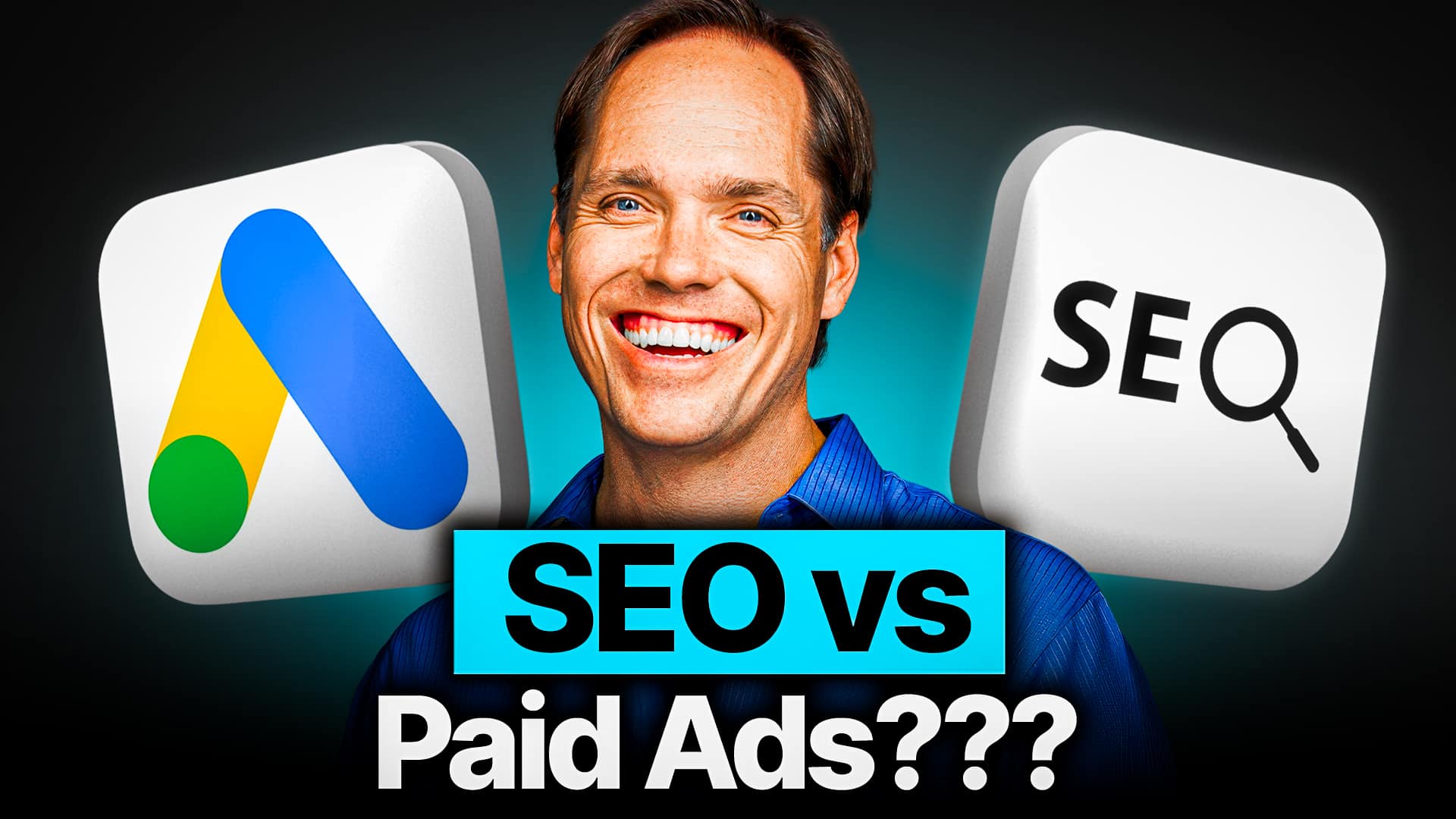
The central thesis of the conversation is that Google Ads and SEO are not interchangeable. They solve different business problems at different stages of the growth cycle.
Google Ads: The Tactical Sprint
Google Ads acts as a "short-term lever." When configured correctly, it can yield traffic and lead volume within weeks, or even days. It is an immediate response mechanism for businesses that need to fill a sales pipeline today. However, this immediacy comes with a significant caveat: the "faucet" principle. The moment you cease your ad spend, the traffic stops entirely. It is a system built on continuous investment for continuous return.
SEO: The Compound Interest of Marketing
Conversely, SEO is framed as a long-term asset. The effort put into SEO—creating high-quality content, optimizing site architecture, and building authority—often takes months to materialize. In some cases, it can take years for organic traffic to become a significant driver of revenue. However, once established, SEO creates a compounding effect. Unlike ads, organic rankings can continue to drive traffic long after the initial investment in a specific piece of content is made, creating a foundation of resilience that paid channels cannot replicate.
The Financial Reality: Moving Beyond Vanity Metrics
A significant portion of the discussion focused on the "break-even math" that many business owners fail to perform. Wickam highlighted that looking at "Top-line ROAS" (Return on Ad Spend) is a common trap.
A campaign showing a 2x return on ad spend might look successful on a dashboard, but if the business operates on thin margins—perhaps with a 60% or 70% cost structure—that campaign is effectively losing money. Wickam stresses that businesses must calculate their specific break-even point before scaling. True success is measured by profit, not by the vanity metrics of traffic volume or click-through rates.
Furthermore, Wickam shared a critical rule of thumb regarding "impression share." He suggests that advertisers can typically scale their impression share into the 60% to 75% range before encountering diminishing returns. Beyond this threshold, costs per click (CPC) and costs per acquisition (CPA) often spike dramatically. Understanding where a market "ceilings out" is a hallmark of an advanced media buyer.
Strategy: Intent Over Volume
When it comes to campaign structure, the mantra is "intent over volume." Many businesses make the mistake of casting too wide a net, chasing generic keywords that result in high traffic but low conversion rates.
Wickam advocates for a laser-focused approach:
- High-Intent Targeting: Start where the buyer is closest to the point of purchase. For a local plumber, this means prioritizing search terms like "emergency plumber near me" rather than "how to fix a sink."
- Message Match: The connection between the search query, the ad copy, and the landing page must be seamless. If a user clicks an ad for a specific product, they should land on that exact product page, not a generic home page. This increases the Google "Quality Score," which in turn lowers costs and improves performance.
- Inventory Syncing: For e-commerce, utilizing Google Merchant Center to bridge the gap between product inventory and search results ensures that potential buyers see accurate pricing and availability, further qualifying the traffic before they even click.
Local Service Ads (LSAs) and the Future of Discovery
A specialized segment of the discussion was dedicated to Local Service Ads (LSAs). These differ from traditional search ads as they are "pay-per-lead" and are reserved for specific, verified service providers.
LSAs were Google’s response to the encroachment of large aggregator sites like Yelp, HomeAdvisor, and Angi, which had begun to dominate local search results. By prioritizing verified local businesses at the top of the SERP (Search Engine Results Page), Google created a safer, more direct path for users to find service providers.
However, the space is shrinking. As AI summaries and new layout designs take precedence, the number of visible LSA slots is decreasing. Wickam predicts that we are moving toward a "mediated transaction" model, where AI assistants will eventually handle the booking process directly within the search interface. This shift mandates that local businesses focus on reputation management and booking efficiency, as rankings alone may soon be insufficient to secure customers.
Cross-Pollination: Using Ads to Inform SEO
One of the most profound takeaways is the symbiotic relationship between paid and organic efforts. Because Google Ads provide rapid feedback, they serve as a perfect "laboratory" for SEO strategy.
By running ads, a business can test which headlines, value propositions, and keywords actually convert into sales. Once these winners are identified, that data can be funneled into the long-term SEO content strategy. This prevents the "guesswork" often involved in content marketing, where businesses spend months ranking for terms that drive traffic but yield zero revenue.
Avoiding Common Pitfalls
Wickam provided a cautionary tale regarding a wedding videographer who lost $10,000 on poorly managed campaigns. The failure wasn’t in the platform; it was in the execution—wrong geography, lack of negative keywords, and poor targeting.
He notes that the behavior of match types has also become more "loose" in recent years. Phrases and exact matches are now broader than they once were, meaning that advertisers must be more vigilant than ever about excluding irrelevant search terms to prevent budget leakage.
On the SEO side, the most common mistake remains the pursuit of "traffic for the sake of traffic." Writing content that attracts views but lacks a clear path to conversion is a waste of resources. SEO must be viewed as a commercial activity, not just a content-creation exercise.
Iteration and Resilience: The Path Forward
Setting expectations is the final hurdle for most business owners. Wickam suggests that a new Google Ads campaign requires a two-to-three-month "dial-in" period, during which four to six rounds of revisions are typically necessary. Panic-stopping a campaign after two weeks is a recipe for failure.
Similarly, SEO is inherently iterative. Not every page will be a winner, and that is acceptable. The goal is to learn from what doesn’t work and double down on the content pieces that drive actual business growth.
Final Implications
The future of search is increasingly "human-first." While AI can assist in the technical aspects of structure and schema, the content itself must solve real problems for real people. In a world where discovery and decision-making are becoming increasingly blended, businesses must move away from viewing SEO and Ads as isolated tactics.
Instead, they should be viewed as a unified engine for growth. By leveraging the speed of Google Ads to validate demand and the endurance of SEO to build long-term authority, business owners can create a robust, resilient presence that survives the ever-changing algorithms of the digital age. Success, as Wickam concludes, belongs to those who are willing to be patient, stay focused on profit over vanity, and adapt to the shifting intent of the searcher.