The landscape of professional work is undergoing a seismic shift, and for the B2B marketing sector, the tremors are being felt in every department, from content creation to lead generation. According to the newly released 2026 State of AI for Business Report, the gap between "AI-forward" professionals and those lagging behind is not just widening—it is becoming a chasm that may define the career trajectories of millions.
The report, which synthesized insights from over 2,100 professionals—84% of whom operate within B2B organizations—serves as a wake-up call. As artificial intelligence moves from the experimental fringes to the core of enterprise strategy, marketers must confront a reality where efficiency, governance, and autonomous systems are no longer competitive advantages, but requirements for survival.
The Core Findings: A Snapshot of a Changing Industry
The 2026 State of AI for Business Report provides a critical look at the maturity, anxiety, and strategic alignment of the modern workforce. While the hype cycle of generative AI has begun to settle into a rhythm of practical application, the underlying data reveals a profession in the midst of an identity crisis.
1. The Paradox of Job Security
Perhaps the most striking finding is the cognitive dissonance regarding job stability. Seventy-one percent of respondents now believe that AI will eliminate more jobs than it creates over the next three years—a staggering 18-percentage-point jump from the previous year. Among marketers specifically, this anxiety is even more acute, with 70% anticipating significant workforce disruption.
However, this systemic pessimism is met with individual optimism. Only 20% of professionals are personally concerned about their own job security. This "optimistic detachment" suggests that while professionals acknowledge a storm is coming, they believe their specific expertise will provide shelter. As Taylor Radey, Director of Research at SmarterX, notes, "Seventy-one percent expect AI to cut jobs across the economy, but 20% think it might actually happen to them."
2. The Mandate from the Top
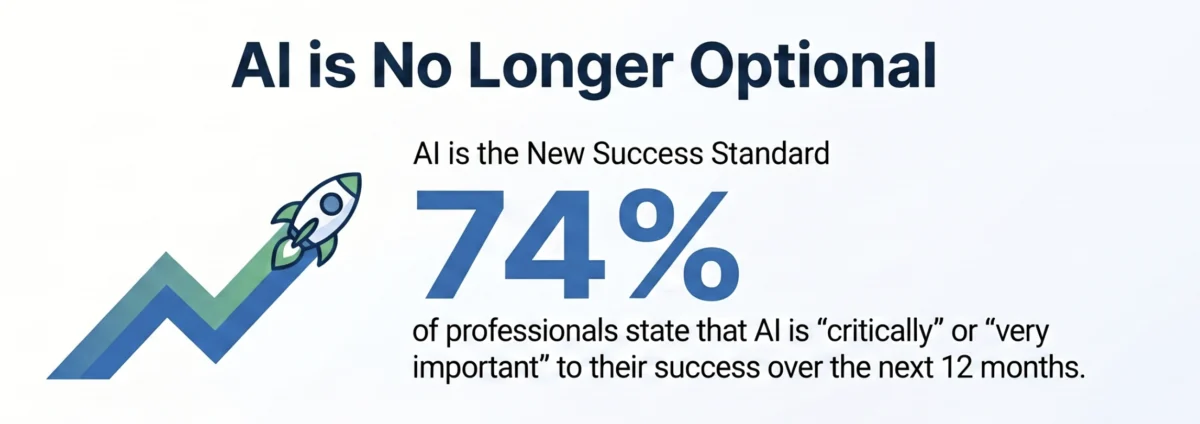
AI has officially graduated from the IT department to the C-suite. Roughly 74% of professionals classify AI as "critically" or "very important" to their organization’s success over the next year. When filtering for CEOs and founders, that figure climbs to 89%. This represents a fundamental shift: AI is no longer a sandbox for digital-native teams; it is a primary lever for growth and efficiency that leadership is now demanding.
Chronology: The Rapid Evolution of AI Adoption
To understand where we are, we must look at how quickly the narrative has shifted over the past 24 months.
- 2024: The Year of Experimentation. Organizations largely viewed AI through the lens of individual productivity tools. The primary focus was on writing assistants, image generators, and basic automation tasks.
- 2025: The Year of Integration. Companies began moving beyond "prompting" and started looking at how AI could be integrated into existing CRM, email, and analytics platforms. The focus shifted from "What can this tool do?" to "How does this fit into our workflow?"
- 2026: The Year of Agentic Autonomy. We have entered the era of agents. The conversation has moved away from static tools to dynamic systems capable of performing multi-step tasks, autonomous research, and strategic decision-making support.
This rapid acceleration explains why the previous year’s training efforts, often focused on basic prompting, are now being viewed as obsolete.
Supporting Data: The Gaps in Readiness
The report highlights a critical failure in organizational preparedness: The Training Deficit.
While 46% of organizations now offer some form of AI training—a marked improvement from 32% the previous year—a majority of the workforce remains unequipped to handle the next generation of AI tools. Even more concerning is the disconnect between what is taught and what is needed.
- Workflow Integration (58%): Professionals want to know how to connect AI to their daily operations.
- AI Agents (51%): The hunger for understanding autonomous systems is profound.
- No-Code Tools (45%): There is a shift toward building solutions without needing deep engineering expertise.
- Prompting (15%): The "basics" are no longer the primary interest.
This data suggests that corporate L&D (Learning and Development) programs are often behind the curve, focusing on entry-level concepts while employees are already hungry for sophisticated, systems-level instruction.
Official Responses and Strategic Perspectives
The leadership at SmarterX and the Marketing AI Institute emphasize that the differentiator between the "AI-forward" professional and the rest is not merely technical skill—it is the ability to deliver tangible, high-value outcomes.
Paul Roetzer, founder and CEO, offers a stark assessment of the future: "If you know you’re the one bringing 5x, 10x value, then you’re feeling pretty good about the future." His perspective shifts the focus from "Will AI take my job?" to "How can I leverage AI to become the most valuable person in the room?"
Taylor Radey adds that the core competency of the future is systems thinking. As marketers move from managing individual tasks to overseeing networks of AI agents, the ability to architect workflows and maintain the integrity of those systems will define success. "The idea of being able to be a systems thinker is very helpful, especially when you start thinking about rebuilding workflows and working with agents," Radey explains.
The Four Pillars of Governance
The report underscores a major strategic vulnerability: The Governance Gap. Only 13% of organizations have successfully implemented the "four foundations" of AI governance:
- A clear AI roadmap.
- An AI council.
- Formal generative AI policies.
- Established AI ethics guidelines.
Nearly a third of organizations (32%) have none of these in place. This lack of structure is not just a regulatory risk—it is an operational bottleneck. The data shows that organizations with governance in place are 50% more likely to describe their AI momentum as "accelerating." Governance, in this context, is not bureaucracy; it is the infrastructure required to scale.
Implications: What B2B Marketers Must Do Now
For the B2B marketer, the path forward is clear but demanding. The "wait-and-see" approach is no longer viable.
1. Shift from "Tool" to "System"
Marketers must stop viewing AI as a collection of widgets and start viewing it as a system. The interest in AI agents (40% of respondents) indicates that the market is ready for systems that can act autonomously. Learning to design, monitor, and iterate these agents will be the most valuable skill set for the remainder of the decade.
2. Demand Better Training
If your organization is stuck on basic prompting workshops, it is time to advocate for higher-level training. Push for courses that cover workflow integration, agentic frameworks, and no-code development. If the organization isn’t providing it, the individual must take the initiative to bridge the gap.
3. Champion Governance
Do not view policy as a hurdle to progress. If you are building AI-driven marketing workflows without a clear ethical or operational framework, you are building on sand. Advocate for the formation of an AI council or, at the very least, a clear set of guidelines for your team.
4. Become an "AI-Forward" Professional
The gap between the AI-literate and the AI-illiterate is widening fast. The report makes it clear: the professional who actively engages with these tools, understands their limitations, and maps them to business value is effectively insulating themselves from the disruption that is clearly on the horizon.
Conclusion: The Road Ahead
The 2026 State of AI for Business is a testament to an industry in the middle of a massive pivot. While the numbers on job displacement are sobering, they are also a roadmap for personal and organizational evolution. AI is no longer a "nice-to-have" experiment; it is the fundamental infrastructure upon which the future of B2B marketing will be built.
As the industry moves toward agentic workflows and automated systems, the successful marketer will be one who acts as the conductor of these systems—designing, governing, and optimizing them to drive the kind of value that machines alone cannot replicate. The future belongs to those who do not fear the disruption, but rather, those who learn to harness it.
For those looking to deepen their understanding of these shifts, the upcoming AI for B2B Marketers Summit will feature further insights from Taylor Radey on the future of work. More information can be found at the Marketing AI Institute events page.