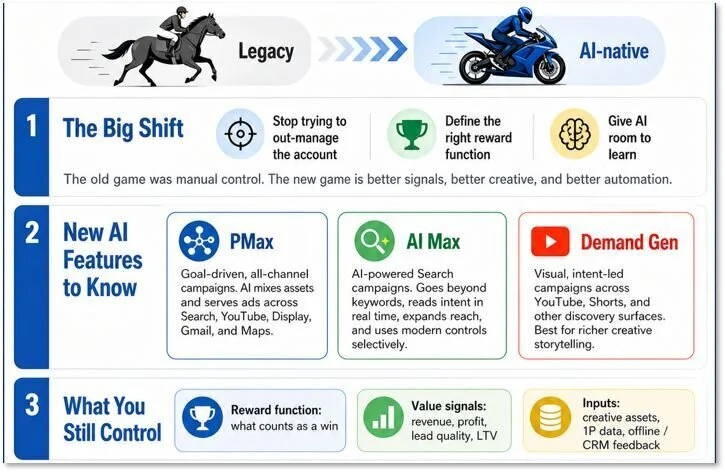
In the modern digital landscape, the tools available to performance marketers have evolved from manual, labor-intensive interfaces into sophisticated, autonomous ecosystems. Yet, a striking paradox remains: while the technology has shifted from the equivalent of horse-drawn carriages to high-performance, long-range motorcycles, a significant portion of the marketing industry insists on holding the reins.
This article explores the fundamental shift toward AI-native advertising, examining why the traditional "Search Marketing" playbook is not just obsolete—it is actively eroding profitability.
The Paradigm Shift: From Human Control to AI Autonomy
For years, the gold standard of Search marketing was defined by granular control. Professionals prided themselves on their ability to manipulate match types, adjust bids based on hourly trends, refine geo-targeting, and obsessively manage negatives. Agencies frequently proved their value by boasting about the volume of manual changes made to an account on a daily basis.
However, Google’s aggressive transition toward an "AIfied" platform—mirrored by similar shifts at Meta—has rendered this "control-first" mentality a relic of the past. Today, the most successful marketers are those who have stopped micromanaging and started "feeding the machine." The core philosophy has moved from manual optimization to strategic orchestration.
Chronology of the AI Evolution in Search
To understand where we are, one must look at the trajectory of Google’s platform development:
- The Manual Era (Pre-2015): The era of "AdWords." Success was predicated on human expertise, keyword research, and granular structural management.
- The Hybrid Era (2015–2021): Automation began to creep in. Smart Bidding and Responsive Search Ads were introduced, but the human-in-the-loop remained the primary driver of performance.
- The AI-Native Era (2022–Present): The introduction of Performance Max (PMax), AI Max, and Demand Gen campaigns signaled a departure from keyword-centric models to intent-centric models. Google’s AI now synthesizes vast, real-time datasets—far exceeding human processing capacity—to determine where, when, and how to deliver ads to optimize for a specific "reward function."
Supporting Data: The Cost of Stagnation
The persistence of legacy practices is not merely a philosophical disagreement; it is a financial one. Data consistently shows that companies clinging to manual segmentation—such as separating campaigns by match type or device—often achieve inferior results compared to those leveraging full-funnel automation.
The "modern" approach rests on two pillars:
- Reward Function Optimization: Defining exactly what "winning" looks like for the business (e.g., profit, lead score, or CLV).
- Signal Expansion: Allowing the AI to process signals—beyond just search queries—to predict and capture user intent across the Google ecosystem, including YouTube, Gmail, Maps, and Display.
The Maturity Assessment: Are You a Tourist or a Resident?
Industry veteran and former Google insider Avinash Kaushik suggests that many marketing organizations are merely "tourists in the present." To bridge the gap, he has developed a maturity model that forces teams to confront their reliance on legacy tactics.
The Two-Dimensional Framework
The maturity model is built on two distinct dimensions:
- Capability Scoring (0–4): A measure of technological sophistication, ranging from "Legacy" (manual, proxy-based) to "AI-Native" (full integration of business value signals).
- Depth Scoring (0–4): A measure of the percentage of business spend or outcomes currently utilizing modern AI tools.
The Six Dimensions of Maturity
To achieve a high maturity score (85+), organizations must focus on six critical areas:
- Measurement & Value Architecture: Shifting from optimizing for vanity metrics (clicks, sessions) to true business value (revenue, profit, CRM-integrated lead quality).
- Search Operating Model: Moving away from manual bid modifiers and exact-match obsessions toward AI Max and broad-intent matching.
- 1P Data & Audience Intelligence: Utilizing first-party data to feed the AI accurate customer signals.
- Surface Breadth & Campaign Mix: Embracing multi-channel automation.
- Creative & Landing Page Adaptability: Allowing AI to test and iterate on creative assets.
- Operating Cadence & Governance: Moving from daily micro-adjustments to high-level strategic oversight.
Official Perspectives on the AI Transition
The shift toward AI is not without its skeptics. Critics often point to the "black box" nature of PMax or the loss of granular control as significant risks. However, the prevailing sentiment from industry leaders is governed by Hanlon’s Razor: never attribute to malice that which is adequately explained by the learning curve of new technology.
AI-powered systems are, by definition, learning systems. They will make mistakes, but they do so at a scale and velocity that human teams cannot match. The professional consensus is that the risk of occasional, AI-driven "doozy" decisions is vastly outweighed by the 30–40 wins achieved for every 3–4 losses.
Implications for the Future of Work
The rise of AI in advertising forces a fundamental redefinition of the "Marketing Professional." If the machine handles the auction, the match types, and the bidding, what is left for the human?
The New Role of the Marketer
The role of the marketer is migrating from tactician to architect. The new requirements for the profession include:
- Data Integrity: Ensuring the AI is fed "clean" and accurate business data.
- Creative Strategy: Developing high-quality assets that the AI can then iterate upon.
- Strategic Governance: Defining the business objectives (the "reward function") that the AI should pursue.
- Cross-Functional Alignment: Ensuring that the marketing signals align with sales, finance, and product goals.
Cultural Resistance
The greatest hurdle to adoption is not technical; it is cultural. Many agencies and in-house teams are anchored to the past because their business models or internal KPIs were built on the premise of "manual work = value." Transitioning to an AI-native model requires a complete overhaul of how we define "success" in a marketing department.
Conclusion: Embracing the "Motorcycle"
The choice to remain in the "AdWords era" is no longer a viable business strategy. In an environment where competitors are utilizing AI to scale their reach and optimize their profit margins, sticking to manual, keyword-based bidding is effectively putting a company’s growth in reverse.
As the industry continues to evolve, the goal is not to fight the machine, but to master the art of directing it. By focusing on high-quality data, clear value signals, and a willingness to relinquish control over tactical minutiae, marketers can unlock unprecedented levels of efficiency. The "horse-and-buggy" days of search are over; it is time to embrace the motorcycle and start riding toward the future of performance marketing.