In an era where linear television audiences have fractured into a thousand niche streaming services, sports remains the final, immovable monolith of live media. Last year, nearly all of the top 50 most-watched telecasts in the United States were sports-related. From the NFL’s dominance to the cultural gravity of major championship events, the "watercooler effect" has migrated almost entirely to the sporting arena. The few non-sports exceptions—such as the 97th Oscars, the SNL 50th anniversary, a high-profile 60 Minutes interview, and the 67th Grammys—only serve to highlight the rule: if you want a mass, simultaneous audience, you have to be in the game.
This reality has triggered a gold rush. Streaming giants are aggressively acquiring broadcasting rights, and marketers are pouring billions into stadium naming rights, jersey patches, and pitch-side signage. Yet, amidst the luxury hospitality suites and the thrill of rubbing shoulders with icons like Tom Brady, a critical question is finally reaching the boardroom: Is this $38 million investment actually driving business, or is it just an expensive vanity project?
The Anatomy of the Sports Marketing Boom
The chronology of this shift is clear. As traditional advertising channels became cluttered and easily skippable, brands pivoted toward "unskippable" environments. Sports offered the promise of a captive audience, a halo of prestige, and the rare opportunity to be associated with genuine human emotion.
However, the assumption that presence equals performance is where the strategy often fails. Marketers have treated sports sponsorships as a "set it and forget it" investment. They sign the check for the logo on the sideboard or the car on the court, hoping that the prestige of the team will magically transfer to the brand.
But as analytics expert Avinash Kaushik argues, the fundamental laws of marketing do not stop at the stadium gate. If a creative message is too weak to capture attention on a 1.2-second TikTok scroll, it will not suddenly become compelling simply because it is plastered on the back panel of a post-game interview. In fact, because the audience’s primary intent is the game itself, the brand’s message faces an even steeper uphill battle for attention.
The Pitfalls of "Spike and Silence"
A recurring failure in the current sports marketing landscape is the "spike and silence" phenomenon. Brands often treat sponsorships as one-off activations or seasonal surges. In reality, building brand equity requires a "spike and sustain" model.
The irony of sports marketing is that the sport itself often acts as a barrier to the brand message. Because the viewer is focused on the outcome of the match, the logo is merely background noise. To penetrate that noise, a brand requires a frequency of interaction—often cited as three exposures per user per week—that far exceeds what a simple sponsorship deal provides. Without consistent, paid media support that integrates the sport and the athlete into the creative narrative, the sponsorship remains a silent, passive asset.
The Myth of Influencer Reach
Many brands assume that having a sports star post about their product is a shortcut to engagement. Yet, much like "massive global influencers" in other sectors, organic posts by athletes often suffer from dismal reach due to social media algorithm suppression. Relying on an athlete to "carry your water" without a robust, operational paid-social strategy is a common, costly mistake that drains marketing budgets without moving the needle on revenue.
Measuring Impact: The Impact Intelligence Score (IIS)
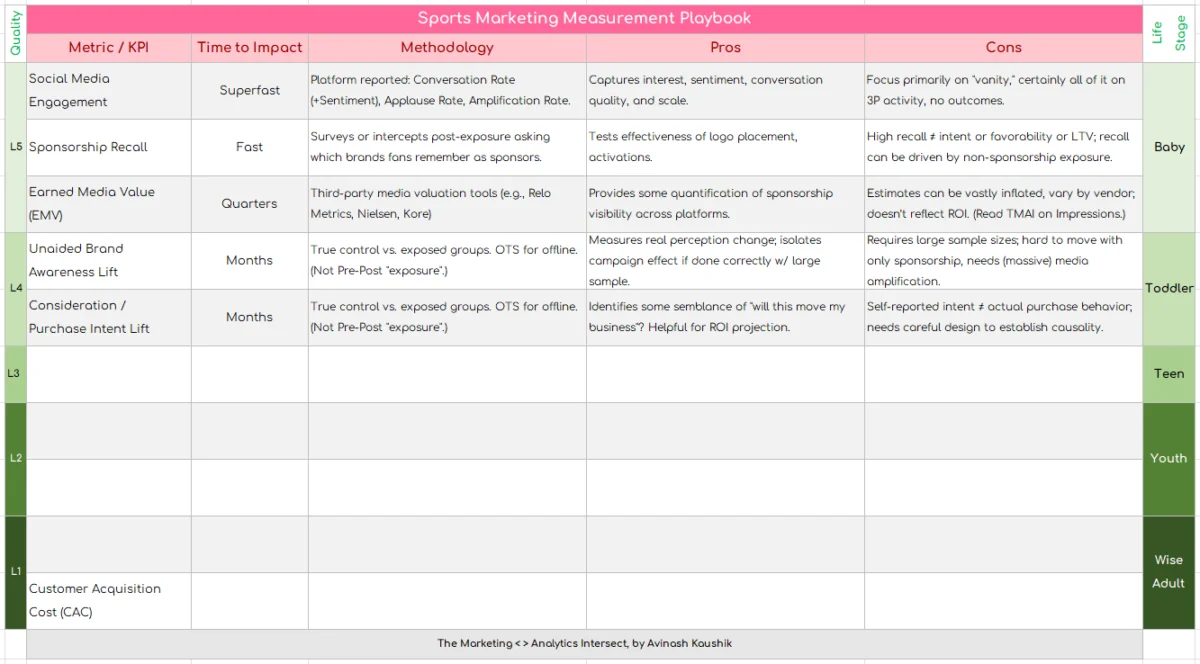
To address the lack of accountability, we must establish a hierarchy of measurement. Kaushik’s "Impact Intelligence Score" (IIS) categorizes sports marketing measurement into five levels of sophistication, ranging from the purely vanity-driven (Level 5) to the gold standard of incremental financial proof (Level 1).
Level 5: The Opening Gambit (Vanity Metrics)
Most companies reside at Level 5, which prioritizes volume over value.
- Social Media Engagement: Measuring conversation and amplification rates is useful for real-time monitoring but fails to explain business impact.
- Sponsorship Recall: Often conducted via post-exposure surveys, this metric is frequently flawed by "aided" questioning. When fans are asked if they are aware of a sponsor, they are prone to bias. True recall should be unaided.
- Earned Media Value (EMV): Often called "Ad Value Equivalency," this is perhaps the most discredited metric in the industry. It calculates the cost of an ad if the brand had paid for the seconds of screen time their logo received. It is fundamentally flawed because it assumes all exposure is equal, ignoring audience quality and the lack of a cohesive marketing message.
Level 4: The Quest for Brand Impact
At Level 4, companies begin to shift from measuring "noise" to measuring "human impact." This involves assessing whether the sponsorship has actually shifted the needle on Unaided Brand Awareness (UBA) or purchase intent.
- Methodology: Using control and test groups is essential. By comparing those exposed to the sports marketing content against a similar group that was not, firms can begin to isolate the "lift" caused by the sponsorship.
- The B2B Advantage: For companies with long, complex sales cycles, L4 measurement is a game-changer. It provides the necessary data to demonstrate that the sponsorship is keeping the brand top-of-mind for key decision-makers.
Implications for Future Strategy
The transition from Level 5 to Level 4 represents the difference between a company that "sponsors" and a company that "invests." The implications are clear:
- Creative Responsibility: Since creative quality accounts for 60% to 70% of brand marketing success, companies must consciously decide to either lean into the athlete’s existing brand story or invest heavily in their own unique narrative. Handing over storytelling to the sport can be profitable, but only if the brand is prepared to integrate that story into a broader, multi-channel campaign.
- Long-Term Commitment: Short-term sports marketing is, by and large, a waste of capital. The lag time for shifting brand perception and purchase intent is significant. A minimum five-year commitment is usually necessary to see measurable, cumulative business results.
- Integrating MMM: Marketing Mix Modeling (MMM) should be the end goal for any serious sponsor. By integrating sponsorship data into the overall MMM, a company can finally isolate the incremental profitability of the sports investment, proving the ROI to the CFO and the Board.
Conclusion: Turning the Lights On
Sports marketing is not inherently ineffective; it is often just poorly measured and improperly executed. By moving away from the comfort of vanity metrics and embracing a rigorous, data-driven approach, brands can stop "sponsoring in the dark."
The goal for the modern marketer is to treat sports sponsorships not as a hospitality perk for the executive team, but as a strategic lever for business growth. When you treat sports marketing with the same analytical scrutiny as you would a digital performance campaign—testing, measuring, and optimizing for causality—you move from the periphery of the game to the center of the bottom line.
The industry is currently at a turning point. As streaming platforms become the new gatekeepers of live sports, the data available to marketers will become more granular, and the excuses for poor measurement will evaporate. The brands that win will be those that realize that while the game happens on the field, the business value is won in the data.