In the modern digital marketing ecosystem, where data is often conflated with insight, many global organizations have fallen into a trap of superficial optimization. A striking example of this occurred during a recent strategic consulting engagement for a multi-national corporation operating across 75 countries. The directive was clear: develop a marketing strategy for the next generation of success. However, during an initial deep-dive meeting with the regional marketing team, the firm identified a critical failure in the organization’s foundational metrics: the primary success indicator was “Cost Per Session.”
For a veteran consultant with decades of experience, having authored bestselling books on analytics and pioneered new data measurement tools, this was a startling revelation. While “Cost Per Sale” (CPS) is a standard industry term, “Cost Per Session” as a North Star metric is not just inadequate—it is symptomatic of a fundamental disconnect between marketing activity and business survival.
The Mirage of Activity: Why "Cost Per Session" Fails
In the hierarchy of marketing metrics, Cost Per Session represents the lowest form of intellectual rigor. It treats traffic as a commodity, prioritizing the volume of clicks—often at the cheapest possible price—without any regard for the quality of that traffic or its subsequent contribution to the bottom line.
This reliance on low-value metrics like Impressions, Views, and Sessions is a dangerous trend. These are not metrics; they are “things.” When organizations focus on the cost of a session, they are essentially tasking their marketing teams to act as traffic brokers rather than revenue drivers. This approach encourages a "race to the bottom," where the goal is to drive cheap, often low-intent traffic to a website, regardless of whether that user has any intention of engaging, converting, or becoming a customer.
The Chronology of Optimization: Moving Toward Accountability
To transition from mere "activity" to actual "accountability," marketing leaders must navigate a logical, tiered evolution of measurement. This journey is essential for any CMO aiming to align their department’s output with the rigorous demands of a CFO.
1. The Activity Phase
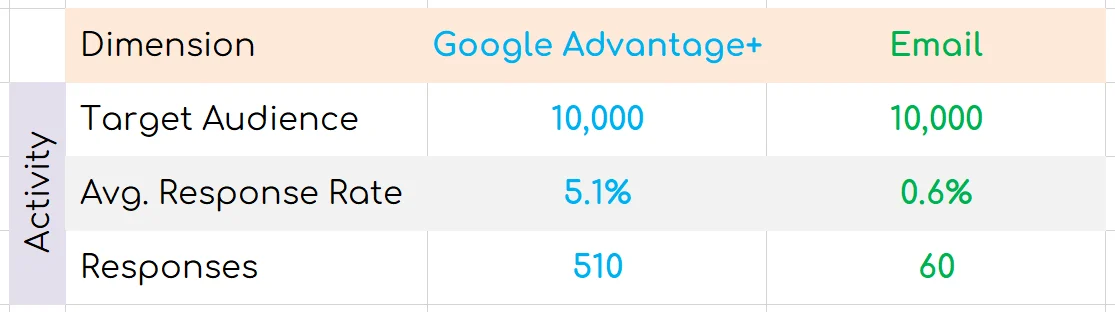
Most organizations begin here. They look at Google Advantage+ campaigns or similar automated platforms and celebrate high response rates or increased traffic volume. The immediate reaction is to shift more budget toward these platforms because they appear to be "working" in terms of volume.
2. The Outcome Phase
The first step toward true maturity is shifting the focus from traffic to outcomes. Even in complex industries—such as B2B, pharma, or long-cycle B2C—measuring revenue and conversion rates is non-negotiable. If a direct outcome is difficult to track, organizations must employ micro-conversions, multiplying them by average lead-to-conversion rates and average outcome values. This provides a proxy for success that, while perhaps only 85% accurate, is infinitely more valuable than looking at activity alone.
3. The Accountability Phase
This is where the CFO becomes an ally rather than an antagonist. To reach this level, marketing must account for the costs of generating that revenue. This involves calculating:
- Campaign Costs: The actual spend on media.
- Cost of Goods Sold (COGS): The expense associated with producing the products sold.
By subtracting both from the total revenue, an organization can calculate true Profit. Metrics like Return on Ad Spend (ROAS) are often used here, but they are flawed because they do not account for the cost of the goods sold or the initial ad spend in a way that reflects true profitability. A more robust approach utilizes Return on Investment (ROI) and, ultimately, Profit on Ad Spend (POAS) or Profit on Investment (POI).
Supporting Data: The Case for Profitability
The difference between these metrics is not merely academic; it is the difference between growth and insolvency. Consider a hypothetical scenario where Google Advantage+ delivers massive revenue compared to an Email channel.
- The Revenue Trap: If you look only at revenue, Google Advantage+ appears to be a massive success.
- The Reality Check: When you factor in the campaign costs and the COGS, the profit margin for the Google channel might be razor-thin or even negative. In the case study discussed, while Google generated 12 times more revenue than email, the profit generated per dollar spent was significantly lower.
In some instances, the data revealed that for every $1 spent on Google, the campaign returned only $0.70 in profit—essentially, the marketing department was paying to subsidize the platform’s success while actively eroding company value. Meanwhile, email marketing delivered a healthy profit of $5.70 for every dollar spent. The lesson is clear: Revenue is a vanity metric; Profit is the sanity metric.
Official Guidance: The Impending AI Shift
The transition away from Cost Per Session is not just a best practice; it is a defensive necessity against the evolution of Search. With Google’s transition into an “AI-first” search environment, the nature of the “session” is fundamentally changing.
Google’s own guidance for AI Search emphasizes that clicks from AI Overviews are inherently higher quality. Users arriving from these experiences are more likely to spend significant time on a site because the AI has provided context, effectively pre-qualifying the visitor. Google explicitly warns marketers: “You might not optimize for these [engaged audiences] if you focus too much on clicks instead of the overall value of your visits.”
If the platform itself is telling you to stop obsessing over clicks and start measuring the value of the visit, ignoring that advice is a strategic error of the highest order.
Implications: Building an AI-Proof Career
For marketing professionals, the path forward is clear. If you find yourself in an organization that refuses to move away from Cost Per Session, your goal is to "suck less." Shift the metric to Cost Per Non-Bounced Session. By filtering out the traffic that lands and immediately leaves, you force your team and your agencies to justify the cost of high-intent traffic.
The Five-Step Path to Profitability
- Immediate Audit: Cut spending on channels that cannot prove high green POI (Profit on Investment). Do not be intimidated by the drop in traffic; prioritize the recovery of profit.
- Invitation to Perform: Challenge your internal teams, agencies, and platform representatives to deliver strategies that prioritize profit over volume.
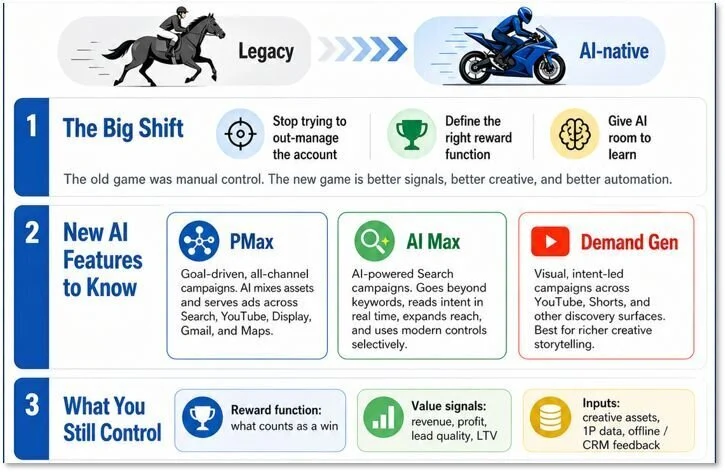
- Strategy Alignment: Re-evaluate the intent available on the platform, match it with better creative/offers, and leverage AI-powered features to optimize for that intent.
- Rigorous Testing: Scale spend only when you observe consistent, high green POI.
- CFO Alignment: Define what "high" and "too low" profit looks like in partnership with your CFO.
Conclusion
The era of the "click-chaser" is coming to an end. As artificial intelligence continues to reshape the landscape of digital interaction, the ability to demonstrate, track, and optimize for business impact will be the primary separator between marketing leaders and those who are easily replaced by automated systems.
Prioritizing Outcomes over Activity and Accountability over Outcomes is more than just a reporting change; it is an organizational survival strategy. It demands hard work, uncomfortable conversations, and the courage to stop "doing" and start "delivering." By adopting these principles, marketing professionals can insulate their careers from disruption and, more importantly, transform their departments from cost centers into engines of sustainable business growth.