For years, the prospect of taking a WordPress website multilingual was a daunting, high-stakes endeavor. It was a project defined by logistical nightmares: identifying strings for translation, contracting expensive human linguists, navigating complex plugin configurations, and managing the inevitable "post-translation bloat." However, as discussed on a recent episode of the WP Tavern Jukebox podcast, the landscape of digital communication has undergone a seismic shift.
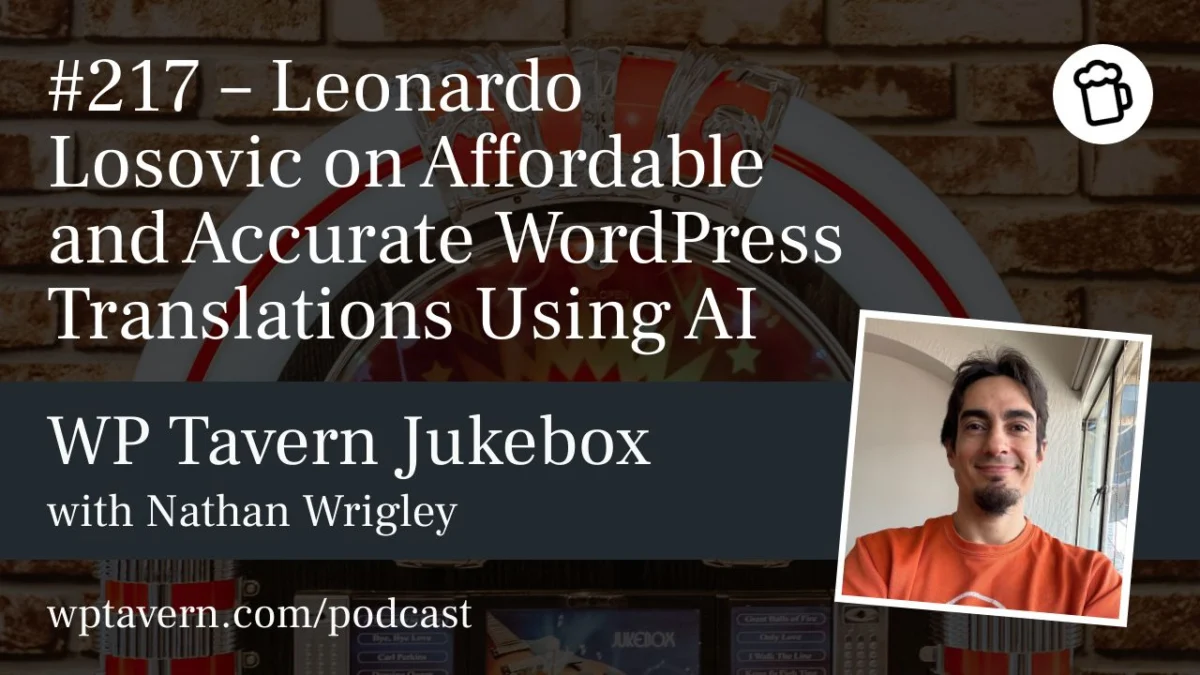
Leonardo Losoviz, a long-time WordPress developer and creator of Gato AI Translations for Polylang, joined host Nathan Wrigley to explore how artificial intelligence is democratizing global reach. By reducing the barrier to entry from thousands of dollars and weeks of labor to mere cents and a few clicks, AI is not just changing how we translate—it is changing the fundamental expectations of site owners and developers.
The Evolution of WordPress Translation
To understand the current state of the industry, one must look back at the past decade. Historically, translating a website into even one additional language required a professional translator. A business owner had to negotiate rates, manage workflows, and carefully ensure that technical jargon remained accurate. This process was prohibitively expensive for small-to-medium-sized businesses, effectively cordoning off international markets to only the largest, well-funded corporations.
"In the past, this was a fairly lengthy, probably quite costly enterprise," noted Wrigley. "You had to figure out which bits of the website needed to be translated… and then somehow figure out how to make it so that the English string is converted into the German string."
Today, the integration of large language models (LLMs) like OpenAI, Anthropic, and Gemini has fundamentally altered this trajectory. Developers like Losoviz have built plugins that act as a bridge between the WordPress editor and these powerful AI engines, allowing for near-instant, high-quality translation across dozens of languages.
The Moral and Business Argument for Multilingualism
The conversation quickly pivoted to a fundamental question: Should you translate your site if you aren’t legally required to do so?
For many, the answer is no longer just about compliance—it is about opportunity. If a business has the capability to reach a wider audience, failing to do so is, in essence, a missed opportunity for growth. Losoviz argues that the "why wouldn’t you?" factor has become the primary driver. If a tool exists that can cost-effectively open your content to speakers of Spanish, Portuguese, Japanese, or French, there is little strategic justification for staying monolingual.
However, the "arms race" aspect of this technology cannot be ignored. As translation becomes ubiquitous and cheap, it moves from being a "competitive advantage" to a "baseline requirement." If your competitors are using AI to serve content in the native languages of your shared potential customers, they are effectively capturing market share that you are ignoring. In this sense, adopting AI translation is an act of digital preservation.
Technical Implementation: The "Gato" Approach
Losoviz’s solution, Gato AI Translations for Polylang, operates on a philosophy of simplicity and efficiency. By leveraging the existing architecture of the popular Polylang plugin, it treats translations as parallel entities.
Key Technical Highlights:
- Parallel Post Structure: Rather than injecting dynamic strings on the fly (which can be performance-heavy), the plugin creates separate post entries for each language. This allows for native WordPress caching and better SEO performance.
- Media Handling: A common concern is the storage of images. The plugin handles this by creating separate database entries for media attachments that link to the same physical file, preventing redundant file storage while allowing for localized captions and alt-text.
- SEO Integration: By utilizing standard hreflang meta tags, the plugin ensures that search engines like Google understand the relationship between the original post and its localized versions, preventing duplicate content penalties and ensuring the right content reaches the right audience.
The "Invisible Gotchas": A Checklist for Success
During his presentation at WordCamp Asia, titled The Invisible Gotchas of WP Translation, Losoviz highlighted that while the technology is powerful, it is not a magic wand. He emphasizes that a "measure twice, cut once" approach is vital.
His advice to site owners is to finalize the source content completely before initiating any translation. This includes:
- Refining the Source: Ensure no typos or structural errors exist in the original language.
- Visual Assets: Avoid embedding text directly into images. If text is required, use overlay components in page builders like Gutenberg, Elementor, or Bricks, which can be translated as text rather than re-creating the image file itself.
- Contextual Awareness: Ensure that embedded media, such as YouTube videos, are relevant to the target audience. A video in English might be useless or confusing to a reader in a non-English-speaking region.
Future Horizons: Collaborative AI and WordPress 7.0
Perhaps the most exciting development discussed is the potential for WordPress 7.0. The upcoming phase three of the Gutenberg project, which focuses on collaborative editing—similar to the functionality found in Google Docs—will be a game changer for translation workflows.
Currently, the interaction with AI is often a one-way street: the user sends the text, and the AI sends back the translation. However, with collaborative editing, the UI could theoretically allow for an AI to act as a "commenter."
"Imagine the scenario where you translate everything and then you edit the translated post," Losoviz theorized. "We’ll have these windows on the right-hand side… [where] the AI can interact with the person, saying, ‘Hey, this translation, I’m not sure, please double check.’"
This would transform the AI from a simple utility into an active editor, providing confidence scores and requesting human intervention only when necessary, such as with complex technical or industry-specific terminology.
The Reality of the "Arms Race"
Despite the technical advancements, Losoviz offered a sobering reflection on the nature of digital progress. He noted that while AI makes us significantly more productive, it also sets a new standard for the "ordinary."
"Because it’s easy to you, it’s easy to everybody," he explained. "If everybody does the same, once again, you are not ahead of them. You’re on the same place."
This sentiment underscores the reality of the modern web: technology rarely offers a permanent edge. Instead, it shifts the playing field. For the WordPress community, the focus is now moving away from the logistics of translation and toward the strategy of internationalization.
Conclusion
The era of manual, expensive, and slow website translation is effectively over. With tools like Gato AI Translations and the impending collaborative features of WordPress core, the path to globalizing a website is open to any user with a WordPress dashboard.
While professional human oversight remains necessary for high-stakes technical or legal content, the vast majority of web content can now be bridged across language barriers in seconds. For the site owner, the question is no longer "How can I afford this?" but rather, "Why am I waiting?" As the digital world becomes increasingly interconnected, the ability to communicate in a user’s native language is no longer a luxury—it is the baseline for modern digital success.