In the evolving landscape of cybersecurity, the industry has long championed email authentication protocols—SPF, DKIM, and DMARC—as the gold standard for verifying the identity of a sender. However, a sophisticated and ongoing phishing campaign targeting the hospitality sector across Europe and Asia has exposed a fundamental, and perhaps fatal, flaw in this reliance: authentication confirms who sent the email, but it says absolutely nothing about what the email contains.
Microsoft Threat Intelligence recently disclosed that since April 2026, malicious actors have been leveraging “authentication laundering,” a technique that exploits the inherent trust placed in legitimate, multi-tenant software-as-a-service (SaaS) platforms like Calendly and Google to bypass traditional security filters. This campaign serves as a sobering wake-up call for the email industry, proving that even the most secure infrastructure can be turned into a conduit for malicious activity.
The Mechanism: Trust as a Weapon
The core of this attack is the subversion of sender reputation. Because SPF (Sender Policy Framework), DKIM (DomainKeys Identified Mail), and DMARC (Domain-based Message Authentication, Reporting, and Conformance) were designed to verify that a message originates from an authorized server, they are inherently binary. When a threat actor creates an account on a legitimate platform like Calendly and utilizes its notification infrastructure, the emails generated are technically "authentic."
From the perspective of a secure email gateway (SEG), an email sent via Calendly is indistinguishable from a legitimate appointment notification. It passes every cryptographic check, carries a valid digital signature, and arrives with a clean DMARC pass. The threat actor is not spoofing an identity; they are "laundering" their malicious intent through the pristine reputation of a trusted third-party provider.
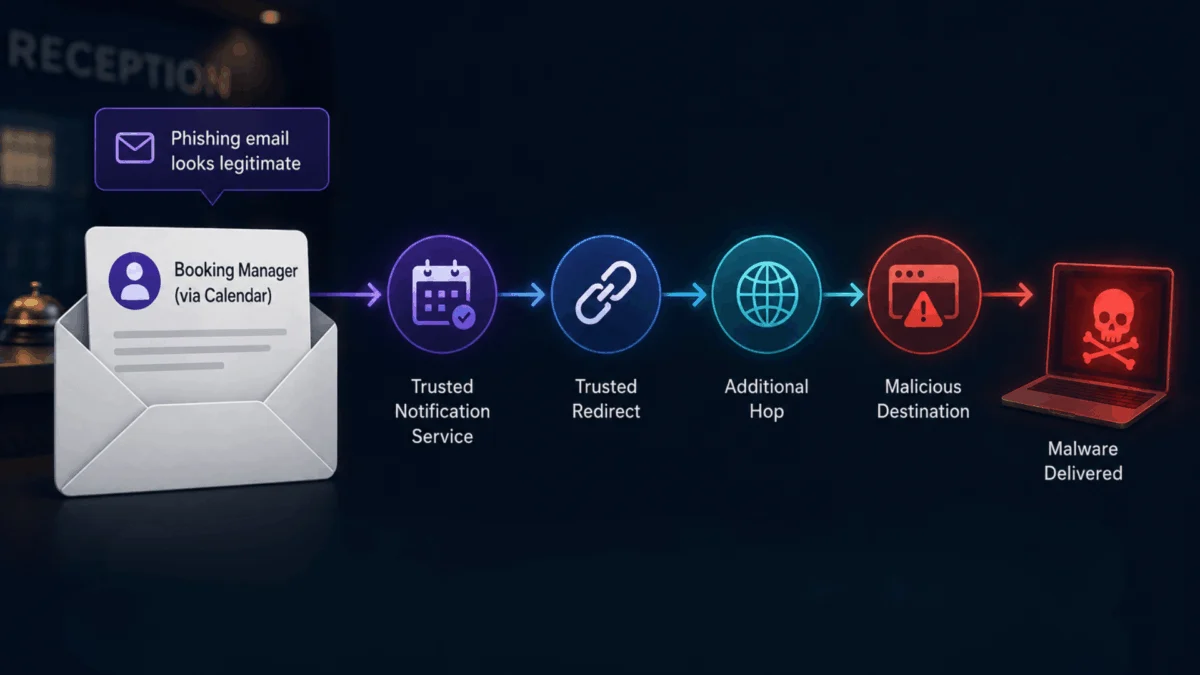
By labeling every message as originating from "Booking Manager (via Calendly)," attackers effectively exploit the workflow habits of hotel reception and reservations staff. These employees, conditioned to process high volumes of guest-related communications, are primed to treat these notifications with a degree of implicit trust.
Chronology of an Evolving Threat
The campaign, which Microsoft has been tracking since its inception in April 2026, exhibits a high degree of adaptability. While the initial goal appeared to be the compromise of hospitality systems, the methodology has evolved through several distinct phases:
- April 2026: Initial deployment of the campaign. Threat actors begin using Calendly notification systems to deliver lures. The focus is on generic, high-volume list-driven sending rather than targeted spear-phishing.
- May 2026: Refinement of the payload delivery mechanism. The attackers introduce a multi-stage redirect chain, leveraging Google’s URL redirect services to further sanitize the malicious links.
- June 25, 2026: Microsoft officially discloses the campaign, highlighting the shift toward “authentication laundering” and identifying the specific use of ZIP archives containing obfuscated shortcuts.
- Ongoing (Late 2026): The campaign continues to mutate. Microsoft reports that the malicious PowerShell scripts utilized in the attack have undergone at least seven distinct phases of obfuscation, indicating an active development cycle by the threat actors to evade signature-based detection.
Anatomy of the Attack: A Multi-Layered Deception
The phishing emails are intentionally generic, utilizing subject lines that trigger immediate concern or professional duty: “guest complaints,” “room enquiries,” “bedbug reports,” and “inspections.” By writing these in local languages—Japanese, Dutch, and Danish—the attackers ensure that they bypass basic language-based filters while appearing relevant to regional hotel staff.
When a victim clicks the link within the Calendly-originated email, they are not immediately taken to a malicious site. Instead, they are routed through a “trust-laundering” relay:
- The Calendly Relay: The initial email provides the "authorized" infrastructure.
- The Google Hop: The link utilizes
share.googleandgoogle.comredirects. This second layer of laundering serves to strip away security telemetry and mask the final destination, leveraging Google’s massive, trusted web infrastructure. - The Cloudflare Gate: The user arrives at a freshly registered
.cfddomain, fronted by Cloudflare. - The Turnstile Challenge: Before the payload is delivered, the user must interact with a Turnstile challenge. This acts as both an anti-analysis tool (preventing automated security scanners from probing the final link) and a geolocation gate to ensure the victim is in the target region.
- The Payload: The victim is prompted to download a ZIP archive. Inside, a disguised shortcut—typically
IMG-numbers.png.lnkorPHOTO-numbers.png.lnk—awaits. Executing this file fires an obfuscated PowerShell script, which eventually installs a persistent Node.js implant.
This implant establishes a connection to command-and-control (C2) servers on non-standard ports, granting the attackers durable access to the victim’s machine.
Official Perspectives and Industry Response
Microsoft has not yet attributed this campaign to a specific advanced persistent threat (APT) group. However, the techniques mirror findings previously reported by organizations like SOC Prime and ITOCHU, which have observed similar shortcut-to-PowerShell-to-Node.js infection chains in the hospitality sector.
Security researchers point to the “durable access” obtained by the attackers as a significant red flag. The lack of immediate data exfiltration or ransomware deployment suggests a “reconnaissance-first” approach. The attackers are likely establishing a foothold, mapping the internal networks of hotel chains, and preparing for a more disruptive second phase—potentially targeting reservation databases, point-of-sale (POS) systems, or customer loyalty programs.
Implications for the Email Ecosystem
The “uncomfortable gap” highlighted by Microsoft is that DMARC and SPF provide a false sense of security. As long as platforms like Calendly, DocuSign, or Salesforce allow users to generate outgoing mail, the risk of a single compromised account tarnishing the reputation of an entire platform exists.
For Senders and ESPs (Email Service Providers)
The era of blind trust in infrastructure reputation is ending. ESPs must move toward more granular monitoring. This includes:
- Per-subaccount monitoring: Detecting anomalous behavior at the user level rather than just the domain level.
- Link Hygiene: Implementing proactive scanning of links generated within notification streams. If a user-generated link points to a newly registered domain, the system should treat it with extreme prejudice, regardless of the sender’s DMARC status.
For Mailbox Providers
For organizations like Microsoft (Outlook/Exchange), Google (Gmail), and others, the lesson is that content must now be evaluated independently of sender authentication. When a passing DMARC score is paired with a reputable SaaS domain, it is merely a "weak proxy" for safety. Mailbox providers must prioritize:
- Redirect Analysis: Tracking the entire chain of a link before allowing it to reach the end user.
- Behavioral Signals: Monitoring for unusual PowerShell execution or registry changes, as Microsoft has recommended.
Strategic Mitigation: Hunting the Behavior
Microsoft’s advice to organizations is to focus on the behavior rather than the indicators. Indicators (such as specific domains or file hashes) can be rotated by attackers in minutes. Behaviors, however, are harder to mask. Security teams should be on the lookout for:
- Photo-themed ZIP archives: Especially those originating from unexpected business notifications.
- Node.js execution: Monitoring for Node.js instances running from user-profile directories, which is a major deviation from standard administrative behavior.
- PowerShell/ .NET activity: Detecting .NET code compiled by PowerShell scripts in real-time.
- Defender Exclusions: Monitoring for any attempts to modify antivirus exclusions, a common tactic for ensuring the persistence of an implant.
Conclusion: The New Baseline
The hospitality sector, while specifically targeted in this instance, is merely a canary in the coal mine. As authentication protocols continue to tighten, attackers will increasingly turn to “living off the land” using the infrastructure we rely on every day.
The security industry must accept that authentication is a hygiene baseline, not a trust verdict. SaaS-generated transactional mail is now an attack surface that requires rigorous, content-aware inspection. For IT managers and security professionals, the mandate is clear: Stop waving through notifications simply because the digital signature is correct. In an age of authentication laundering, if the content seems out of place, the "trusted" sender is likely the greatest threat of all.