In the rapidly shifting landscape of web development, Artificial Intelligence (AI) has moved from a peripheral curiosity to a core operational pillar for digital agencies. For those operating within the WordPress ecosystem, the challenge is no longer about whether to adopt AI, but how to do so without sacrificing security, quality, or the collaborative spirit that defines the platform.
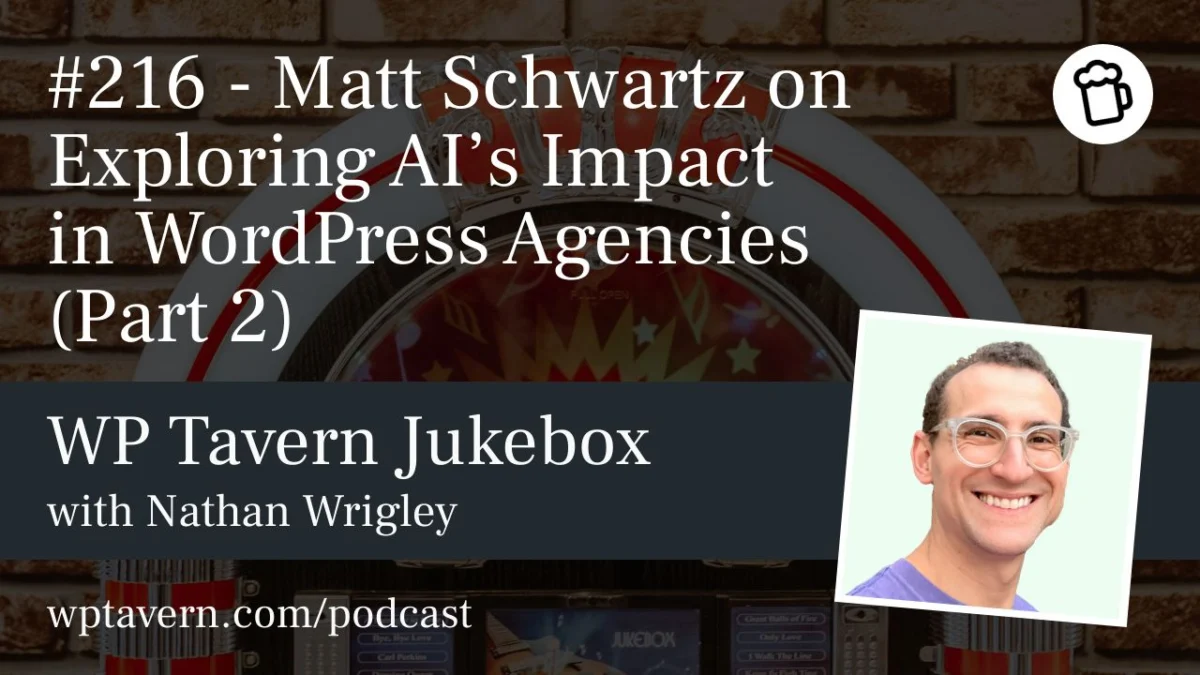
In a recent two-part special of the WP Tavern Jukebox podcast, host Nathan Wrigley sat down with Matt Schwartz, an Atlanta-based agency owner and developer behind the QA tool CheckView, to dissect the practicalities of integrating AI into agency workflows. Schwartz, who has been active in the WordPress space since 2011, offers a roadmap for agencies looking to bridge the gap between "vibe coding" and enterprise-grade reliability.
Main Facts: The Strategic Integration of AI
The core argument presented by Schwartz is that AI, when used correctly, acts as a force multiplier for agency productivity. However, the "wild west" approach of throwing AI at every problem is inherently dangerous. Instead, successful agencies are focusing on three main areas:
- Institutional Knowledge Access: Connecting AI chatbots to internal documentation, wikis, and project management tools (like ClickUp or Asana) to create an "agency brain" that reduces hallucinations and ensures consistent project execution.
- The Model Context Protocol (MCP): A burgeoning standard that allows agencies to securely connect AI agents to internal systems without the risks associated with manual, complex API management.
- Risk-Aware Tooling: Distinguishing between internal "vibe coded" tools—which are low-risk and highly beneficial for internal productivity—and client-facing or mission-critical systems that require rigorous manual code review.
Chronology of the AI Evolution in Agencies
The transformation of the agency model via AI has been swift, moving through several distinct phases:
- The Exploratory Phase: Agencies began by using LLMs for simple content generation and code snippets.
- The Automation Phase: Teams started building internal "agents" to handle repetitive tasks like ticketing, time tracking, and basic project management.
- The Infrastructure Phase (Current): Agencies are now adopting protocols like MCP to create secure, interconnected environments where AI can interact with the agency’s tech stack under strict guardrails.
- The Future Outlook: The industry is moving toward highly productized services where AI manages the execution, and human experts shift their focus to strategy, monitoring, and high-level quality assurance.
Supporting Data: Why "Guardrails" are Mandatory
While the benefits of AI are tangible, the risks are equally significant. Schwartz emphasizes that AI is essentially a pattern-matching engine, not a reasoning entity. Without guardrails, the potential for catastrophic failure is high.
Data Security and Privacy
A critical, often overlooked concern is the status of input data. Many popular AI platforms treat user input as public training data. Agencies holding sensitive client credentials must ensure they are using enterprise-grade instances or local models where data privacy is guaranteed.
The Cost of Overdependence
There is a looming "vendor lock-in" risk. As agencies build their workflows around specific AI tools, they become vulnerable to sudden pricing changes. Schwartz notes that if a major AI provider decides to move a feature from a $20/month subscription to a enterprise-scale model, agencies that have built their entire operations on that tool could face massive, unexpected overheads.
Error Handling
Because AI tools can be "vibe coded"—built quickly without deep architectural planning—they often lack robust error handling. In a client-facing environment, an AI-generated script that works 99% of the time can be a liability. The 1% failure rate could, in a worst-case scenario, result in the deletion of a client’s entire website infrastructure.
Official Perspectives: The Community Impact
The rise of AI has sparked a debate regarding the future of the WordPress community itself. As AI automates the creation of utility plugins and simple troubleshooting, some fear a "hollowing out" of the ecosystem.
"There is a slow ebbing away of the community," noted Nathan Wrigley during the discussion. Traditionally, developers learned the ropes by building and maintaining small, utility-focused plugins. If AI renders these small projects obsolete, the pathway for new developers to engage with, learn from, and contribute to the community may be severed.
Furthermore, as AI provides immediate answers, forum engagement and collaborative problem-solving—once the heartbeat of WordPress—may decline. The consensus is that while the ecosystem will survive, it will likely favor larger, more complex plugin companies, potentially losing the "garage-shop" culture that built WordPress.
Implications for Agency Owners
For agency owners and freelancers, the implications of this technological shift are clear. To thrive, agencies must evolve their hiring and service delivery models.
From Execution to Management
The role of the junior developer or content specialist is shifting. Execution-heavy roles are increasingly being handled by AI, meaning agencies are looking for staff who can act as "AI managers"—individuals who possess the technical acumen to oversee, audit, and refine AI outputs.
Productized Services
Agencies should leverage AI to create highly specific, productized services. By narrowing their focus (e.g., "Websites for Plumbers"), agencies can use AI to build deep, repeatable, and automated processes that are far more valuable than a generic "we build websites" approach.
The Human-in-the-Loop Requirement
Despite the efficiency gains, the "Human-in-the-Loop" (HITL) model remains the gold standard for sustainability. Whether it is verifying that a no-index tag isn’t accidentally left on a production site or performing a final audit on a financial dashboard, human oversight is the final, non-negotiable safety net.
Conclusion: A Cautious Path Forward
As Matt Schwartz concluded, the goal for any agency should be to "dabble with intention." By documenting processes, setting up secure infrastructure, and maintaining a healthy skepticism toward AI-generated code, agencies can navigate this transition.
The future of WordPress will not be defined by whether we use AI, but by our ability to maintain the balance between machine-led efficiency and human-led quality. As the industry moves toward 2026 and beyond, the agencies that survive will be those that treat AI as a powerful, albeit fallible, tool—never as a replacement for the expertise, ethics, and strategic oversight that only a human team can provide.
For those interested in the full technical breakdown, including the specific implementation strategies for MCPs and internal documentation, the full transcript and resource documents can be found at wptavern.com/podcast.