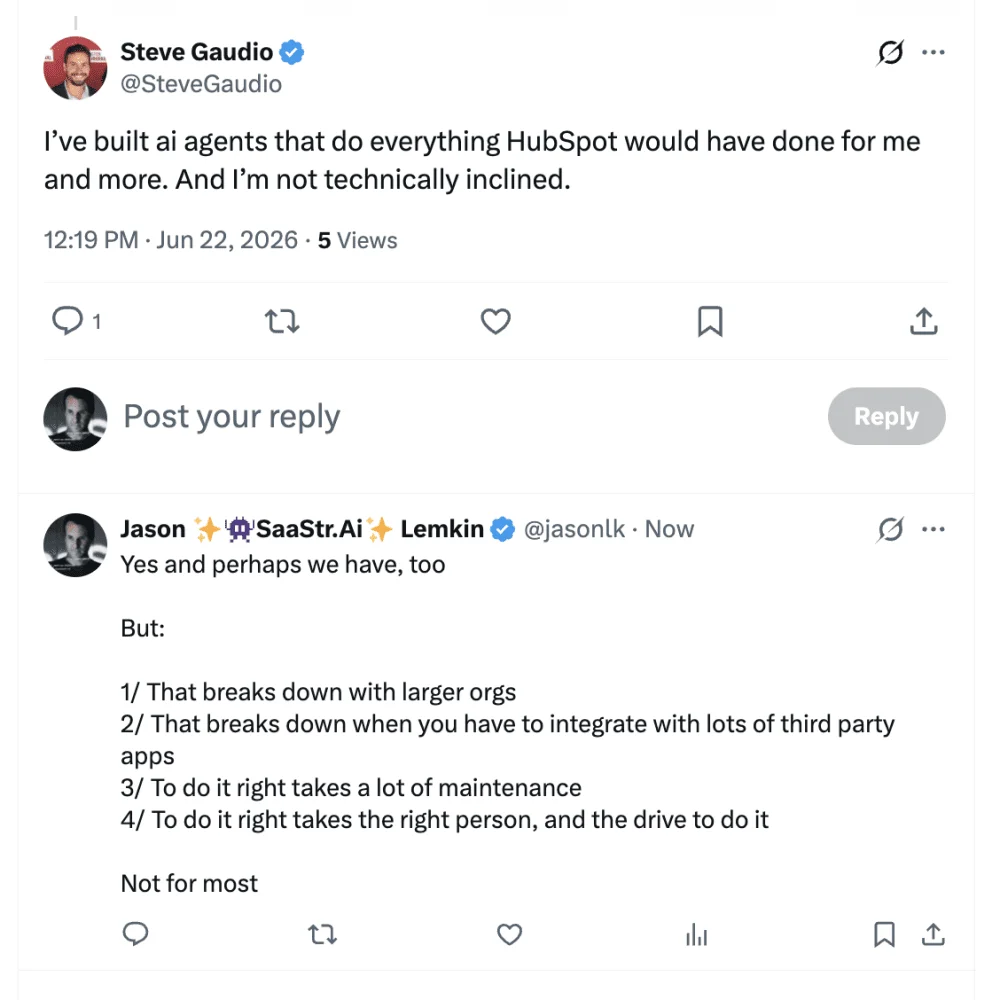
In the rapidly evolving landscape of 2026, a bold narrative has captured the imagination of the SaaS community: the "vibe-coded" CRM. A recent viral post on X (formerly Twitter) sparked a firestorm of debate, with a user claiming, "I’ve built AI agents that do everything HubSpot would have done for me and more. And I’m not technically inclined."
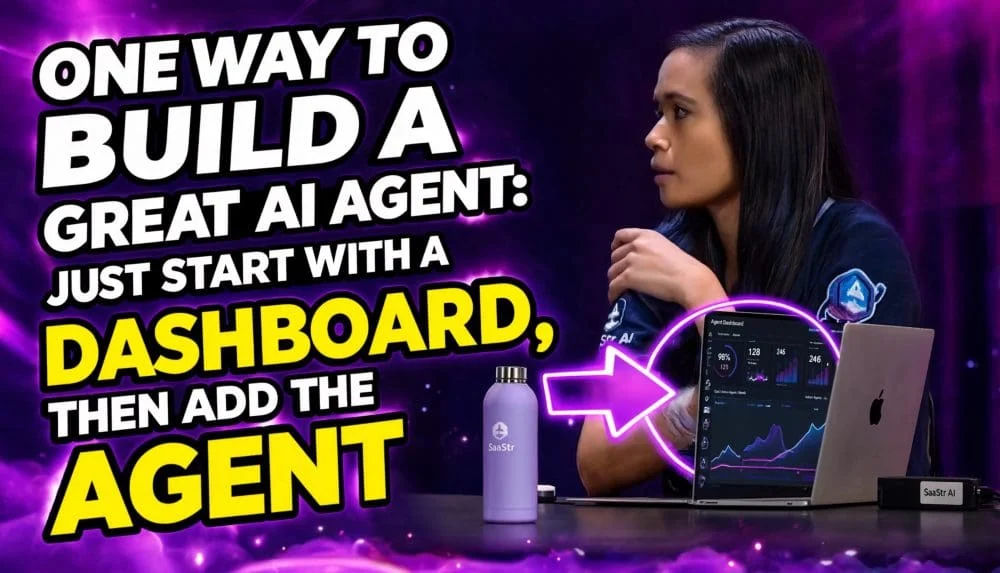
While the sentiment is seductive—promising a future where expensive, bloated software platforms are replaced by nimble, bespoke AI agents—the reality of modern business operations is far more nuanced. At SaaStr AI, we have lived this transition. We currently run a significant portion of our go-to-market operations through a suite of autonomous agents. We employ an AI SDR, a custom-built AI VP of Marketing (codenamed "10K," spanning 14,000 lines of code across 74 files), and "QBee," an AI VP of Customer Success managing over 100 sponsor relationships.
However, we are not here to bury Salesforce or HubSpot. We are here to clarify that "vibe coding" your own infrastructure is not a universal panacea. There is a vast, often misunderstood chasm between building a bespoke AI interface and dismantling the foundational systems of record that keep modern enterprises solvent.
The Shift: Headless Operations Over Homegrown Replacements
To understand why the "death of the CRM" is a premature obituary, one must first understand what successful AI implementation actually looks like. The most effective strategy is not to rebuild a CRM from scratch, but to go "headless."
In this model, platforms like Salesforce remain the system of record. They store every deal, contact, sponsorship, and support ticket. The fundamental change is not the data—it is the interface. Humans no longer spend their days navigating complex dashboards. Instead, our agents read real-time revenue data, pipeline health, and lead flow via API, executing tasks autonomously while keeping the human team informed.
The platform is the data layer; the agent is the executor. This "headless" approach allows businesses to harness the power of AI without incurring the catastrophic risks associated with abandoning established enterprise infrastructure.
1. The Scaling Paradox: Why Homegrown Systems Crumble
For a solo founder, a homegrown CRM is a playground of efficiency. If an agent misinterprets a lead status, the developer fixes it in 20 minutes. But scale is the enemy of simplicity.
Once you introduce 40, or 400, sales representatives into the mix, the requirements shift from "utility" to "governance." Large organizations require rigid permission structures, territory rules, audit logs, and onboarding protocols that ensure a new hire can be productive on day two. A CRM is not merely a database; it is a forced alignment of process. When you build your own system, you are essentially building a custom operating system for your sales team. If the logic isn’t universally understood and strictly enforced, your agents will simply accelerate the chaos, allowing hundreds of people to ignore the process at lightning speed.
2. The Integration Labyrinth: The Hidden Cost of Connectivity
A common trap for those "vibe coding" their own CRM is the simplicity of the demo. An agent reading an inbox and updating a deal record is an impressive feat. However, B2B revenue operations are defined by complexity.
Enterprise data lives in a sprawling ecosystem: billing software, product analytics, marketing automation platforms, data warehouses, and legacy accounting systems that finance departments refuse to abandon. The primary value proposition of incumbents like Salesforce and HubSpot is their ability to maintain thousands of fragile, ever-changing API connections.
When you build your own system, you inherit the "boring, miserable" burden of integration maintenance. If a vendor changes their API on a Tuesday, your homegrown agent doesn’t just stop working—your entire revenue visibility potentially vanishes. Unless you have the budget and engineering talent to manage an orchestration layer that is currently in a state of flux, you are effectively signing up for a full-time, perpetual development project.

3. Maintenance: The 90% That Nobody Talks About
Building a custom agent stack is the "fun 10%." The remaining 90% is maintenance. Models evolve, business logic shifts, and edge cases inevitably surface during the most critical deals.
At SaaStr AI, our 10K agent has required 373 commits to stay relevant. When you rely on agents to handle revenue-critical tasks, the data layer becomes the "brain" of the company. If the data is flawed, the agent’s output is flawed—and it is produced at scale against real-world contacts. There is no "undo" button for an agent that sends 5,000 incorrect emails to your highest-value prospects. The "I’m not technically inclined" argument often ignores the reality that these systems require constant, professional-grade vigilance.
4. The Talent Requirement: The "Builder" Personality
There is a specific archetype of operator who thrives in the maintenance-heavy environment of homegrown agents. These individuals enjoy tinkering on Saturdays and find debugging a creative challenge.
Most founders, however, are not developers. Most VPs of Sales want to hit their revenue targets, not manage a one-customer software company. If you are not inherently driven to maintain your infrastructure, you will eventually find yourself back at a $50-per-seat subscription model because it is, quite simply, the only way to ensure someone else is responsible for the uptime. You cannot "fake" the drive required to be your own in-house engineering, DevOps, and integration team.
5. Governance, Security, and Liability: The CISO’s Nightmare
The most critical argument against replacing established vendors lies in the invisible work they perform: compliance.
When you pay for a major CRM platform, you are not just paying for features; you are buying SOC 2 compliance, penetration testing, data residency, encryption, and the legal weight of a breach response team. These are the barriers to entry for enterprise deals.
When a prospective enterprise client sends you a 200-line vendor questionnaire, "I built it on a weekend with AI" is not an acceptable answer. In an agentic era, governance is the only thing standing between a company and a catastrophic liability event. If an agent acts on bad rules and exposes sensitive PII, the "blast radius" is massive. Established vendors have entire departments dedicated to mitigating these risks. To go homegrown is to assume that responsibility yourself—a move that is often existential for a startup.
Implications: The CRM is More Important Than Ever
The most counterintuitive outcome of the AI revolution is that the CRM has become more important, not less. We have had multiple vendors offer to migrate our data for free, and we have turned them down. Why? Because our most sophisticated agents are now "Salesforce-native."
Migrating to a new platform would require a full-scale reconstruction of our agent stack—months of work that would pull our engineers away from innovation. Our agents have essentially "locked in" our choice of platform. We now spend roughly 15 times more on agent infrastructure than on CRM licenses. The CRM has become a commodity utility, but the agents built on top of it have become the business itself.
Conclusion: Vibe Code the Last Mile
The "vibe-coded" CRM is not a myth, but it is a luxury that few companies can afford to manage at scale. The future of software is not the replacement of the platform; it is the "headless" utilization of it.
If you are a rare, technical builder with an appetite for constant maintenance, by all means, build your own. But for the vast majority of companies, the path forward is clear: Buy the platform, build the "last mile" using agents, and let the vendor carry the weight of the 90% you don’t want to do. The CRM category isn’t dying; it is being upgraded. The companies that thrive will be those that understand the difference between reinventing the wheel and putting a turbocharger on it.