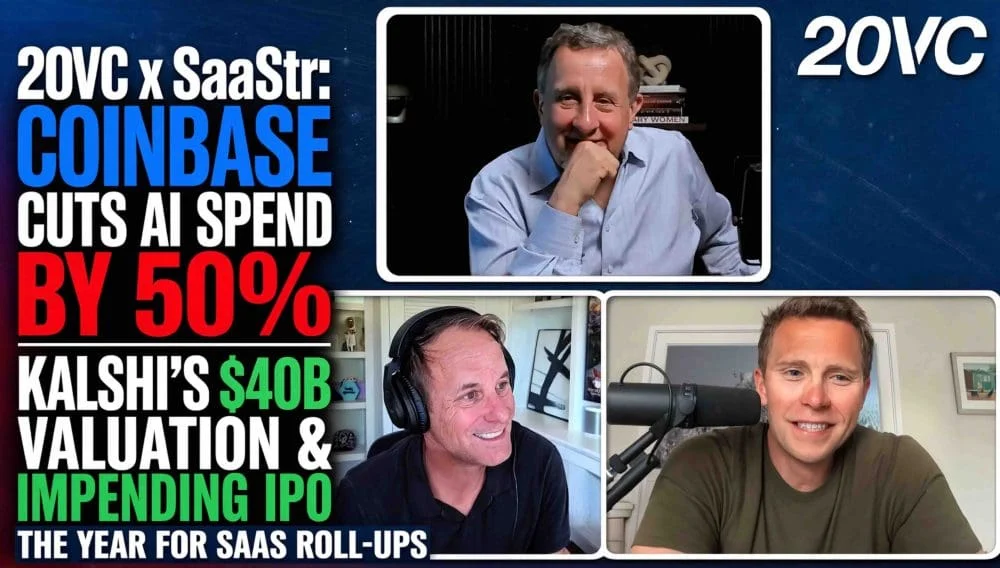
In a candid, wide-ranging discussion recorded at the close of June, industry veterans Harry Stebbings, Jason Lemkin, and Rory O’Driscoll dissected a pivotal shift in the artificial intelligence landscape. The consensus was stark: the honeymoon phase of "AI at any cost" is officially over. As companies face the sobering reality of the "Token ROI Crisis," the focus has pivoted from experimental excitement to cold, hard fiscal discipline.
1. The Token ROI Crisis: When the Revenue Line Won’t Budge
The most pressing narrative of the first half of 2026 is the explosion of token expenditure. Data suggests that companies quintupled their AI spending during this period, yet for the vast majority, this investment failed to yield a corresponding lift in top-line revenue.
The trend toward austerity was signaled by Coinbase CEO Brian Armstrong, who recently revealed that his firm reduced AI spending by 50% this quarter while simultaneously increasing actual usage. By shifting from expensive "frontier" models to a more efficient mix of open-source models and better infrastructure routing, Coinbase demonstrated that fiscal discipline—not just arbitrary spending caps—is the new mandate for engineering teams.
For the SaaStr Fund, the reality has manifested in portfolio board meetings. Even high-performing companies with "all green" dashboards are finding that when requested capital for AI expansion is tied to projected ROI, the narrative falls apart. If an AI investment in engineering doesn’t directly accelerate product velocity or output, it is increasingly viewed as an unforced error. The industry is entering a "mature phase" where software companies must prove that their AI spend is a growth engine, not a vanity project.
2. Chronology: The Arc of the AI Boom
- Late 2025 (The Fever): The industry experiences an explosion in "agentic coding," leading to an aggressive ramp-up in token consumption. Companies hire and deploy AI agents at record speeds.
- Q1 2026 (The Reality Gap): Enterprises realize that while their token bills are mounting, the expected revenue surge has not materialized.
- June 2026 (The Pivot): Influential leaders like Brian Armstrong publicly pivot to cost-optimized AI strategies. Venture capital firms begin to tie funding rounds and budget approvals strictly to demonstrable ROI.
- July 2026 (The IPO Window): Bending Spoons goes public at a $20B valuation, signaling that while the "AI bubble" is being scrutinized, the broader market remains open for disciplined, high-execution companies.
3. Supporting Data and Market Dynamics
The tension between proprietary frontier models and the rise of open-source alternatives is the defining structural challenge of the year.
- Anthropic’s Scale: Anthropic’s run rate has seen meteoric growth, climbing from $1B at the start of 2025 to $44B by mid-2026. However, this success faces a "cannibalization trap." If the bulk of enterprise tokens shift toward cheaper, open-source models, the capital expenditure (capex) required to maintain frontier labs becomes harder to justify.
- Microsoft’s Stumble: Microsoft experienced its worst month since 2000, with shares dropping roughly 16.5%. The market has begun to punish the company for its lack of a standalone, owned frontier model and the deceleration of Azure growth—which is currently heavily reliant on supporting OpenAI’s inference, rather than owning the end-customer relationship.
- The "Casino" Economy: Kalshi, a prediction market, is raising capital at a $40B valuation, highlighting the massive appetite for betting on outcomes. With an endorsement from the Intercontinental Exchange (owners of the NYSE), this signals that prediction markets and "financial entertainment" are becoming a $50B–$100B category.
4. Regulatory Battles: The Anthropic-China Controversy
A significant flashpoint in the discourse is Anthropic’s recent appeal to the Senate Banking Committee. Anthropic alleges that Chinese open-source firms are using "distillation"—feeding Anthropic’s models prompts and training their own models on the outputs—to bootstrap their technology.
While Anthropic describes this as a breach of terms of service and a national security risk, the panel noted a deep irony: every major foundation model was trained on vast swathes of human-generated IP, often without explicit consent. By attempting to involve the U.S. government, Anthropic is essentially seeking to "turn a contractual dispute into regulatory capture."
Rory O’Driscoll drew a poignant analogy: this would be equivalent to the U.S. government in 1982 banning Dell and Compaq to protect IBM’s margins. Such protectionism serves to keep AI "dear" (expensive) rather than "cheap," ultimately hurting the rest of the economy. The fear is that the U.S. will prioritize propping up the current AI "oil barons" at the expense of long-term, competitive innovation.
5. Implications: The Path Forward for B2B
The current environment has fundamentally changed the criteria for venture capital success.
The End of the "Easy" Series A
Harry Stebbings noted that a startup with $1.5M in ARR growing to $5M is no longer a guaranteed "Series A winner." The opportunity cost of capital has risen significantly. Founders who are "conflict-averse" or who refuse to provide honest feedback to their teams are doing a disservice to the ecosystem. Investors now demand that companies "cut their cloth accordingly," suggesting that if a startup isn’t a venture-scale growth story, it should focus on profitability and long-term sustainability rather than chasing unsustainable rounds.
The Bending Spoons Blueprint
The successful IPO of Bending Spoons serves as a counter-narrative to the AI-hype machine. By acquiring underperforming consumer products, optimizing costs, and raising prices, they have proven that operational excellence often beats raw, unrefined growth. The panel proposed that a "Bending Spoons for B2B" is the next big opportunity: identifying decaying, sticky software products (like Marketo or PagerDuty), injecting real operational leadership, and re-engineering them with AI to unlock new revenue.
The "Claude Tag" Experiment
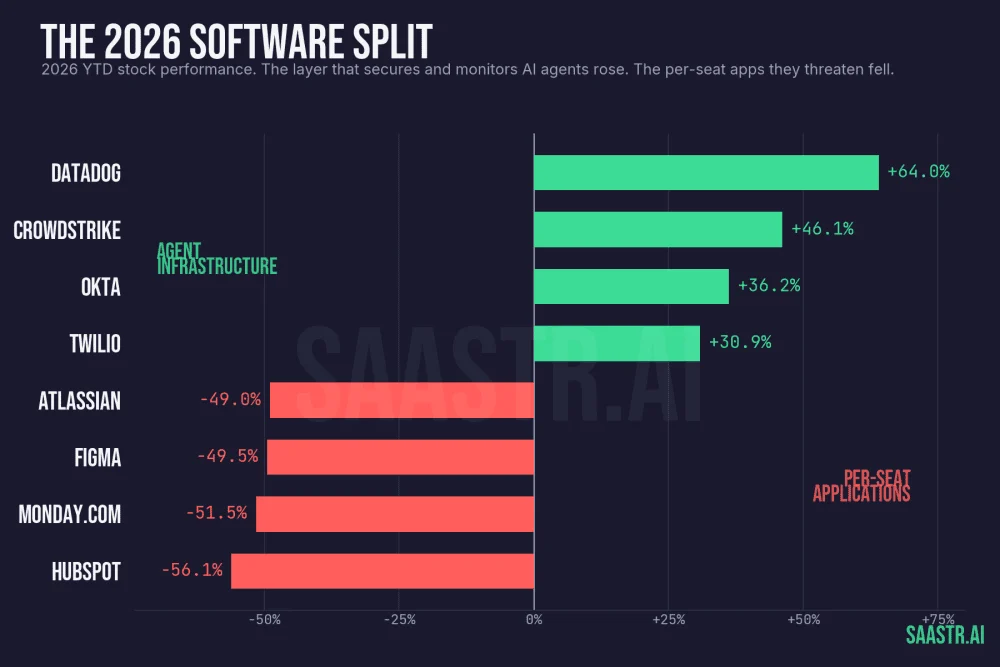
The introduction of "Claude Tag" in Slack represents an existential threat to traditional enterprise software. If an agent can operate autonomously across Salesforce, HubSpot, and other databases, the "headless" future arrives. The software applications themselves risk becoming "dumb databases," while the agent becomes the primary user interface. Salesforce’s decision to allow such integrations is a defensive necessity, though it highlights the precarious position of incumbent software platforms.
Conclusion: Growing Up
The recurring theme throughout the discussion is that the AI industry is reaching a moment of maturity. As Jason Lemkin succinctly put it, "It’s time for the next mature phase of token spending. It’s time, boys, to grow up."
For the rest of the year, the market will likely distinguish between "performative" AI companies—those using the buzzword to mask lack of growth—and those that can show a clear, quantifiable link between AI investment and the bottom line. The era of the "free pass" is over. Whether it is in the frontier labs of Anthropic, the cloud infrastructure of Microsoft, or the Series A pitches of new startups, the demand for accountability is the new gold standard.
As we look toward the end of 2026, the companies that will thrive are not necessarily those with the most tokens, but those with the most discipline. The AI era is no longer about the potential for the future; it is about the delivery of the present.