LONDON — In the high-stakes arena of performance marketing, data is often treated as the ultimate source of truth. However, a growing consensus among industry experts suggests that a "technical black hole" existing between the ad click and the final conversion is causing brands to hemorrhage millions in potential revenue.
The crisis is not one of strategy, but of infrastructure. As automation and machine learning take the wheel of global advertising platforms like Google and Meta, the "garbage in, garbage out" mantra has evolved into a more dangerous reality: "garbage at scale."
The $63 Billion Blind Spot: Main Facts
For years, digital marketers have operated under the assumption that if a campaign’s Return on Ad Spend (ROAS) falls below a certain threshold—say, 4x—it is a logical, data-driven decision to pause it. Yet, recent analysis from industry leaders, including insights shared at the Hero Conf UK, reveals a startling discrepancy. Many campaigns reporting a 4x ROAS are actually delivering a 5x return. The missing 20% of data isn’t just a reporting error; it is a fundamental breakdown in the "post-click" journey.
This discrepancy stems from a "no-man’s land" in organizational responsibility. While media buyers own the campaign settings (bids, copy, and audiences) and developers own the website’s functionality, the technical stretch in between—redirects, tag firing sequences, and server-side handshakes—often falls through the cracks.
The financial implications are staggering. With global invalid traffic (IVT) estimated to have cost advertisers $63 billion last year, and technical "leaks" potentially obscuring up to 30% of legitimate conversions, the industry is facing a crisis of confidence in its own dashboards.
The Evolution of Attribution: A Chronology
To understand how the industry reached this tipping point, one must look at the transition from manual optimization to algorithmic reliance.
The Era of Manual Adjustment (2010–2018)
During this period, a 10% to 15% loss in conversion data was considered a "tolerable margin of error." Human account managers would manually adjust bids and read the numbers with a grain of salt, intuitively knowing that "Direct" traffic in Google Analytics often contained misattributed paid clicks.
The Rise of the Machine (2018–2022)
The introduction of Google’s Smart Bidding and Performance Max (P-Max) shifted the paradigm. Control was handed to the algorithm. Data stopped being a mere report card for humans and became the "training set" for the machine. If 15% of data was missing, the machine simply didn’t know those customers existed.
The Modern Feedback Loop (2023–Present)
In the current landscape, the algorithm’s speed outpaces human oversight. When bad data—such as bot conversions or spam leads—enters the system, the algorithm optimizes for more of the same. This has transformed technical measurement from a back-office concern into a front-line strategic priority.

The Five Post-Click Leaks: Supporting Data
Industry analysts have identified five primary "leaks" where budget is quietly drained after the click has already been paid for.
1. The Latency Tax: Page Speed
The correlation between load time and conversion rate is well-documented but frequently ignored in the context of ad spend. Research indicates that every second of load time can cost a business between 7% and 20% of its conversions. For mobile users, the threshold is even tighter: 53% of visits are abandoned if a page takes longer than three seconds to load.
When an advertiser pays $1.80 for a click that lands on a page taking four seconds to load, they are often paying for a "loading spinner" rather than a potential customer. Because the user leaves before the tracking tag even fires, this loss is invisible in the dashboard.
2. The Redirect Chain and the "Direct" Traffic Myth
Technical debt often leads to complex redirect chains (e.g., jumping from HTTP to HTTPS or shifting between subdomains). Each "hop" in a redirect chain provides an opportunity for the Google Click Identifier (GCLID) to be stripped from the URL.
When the GCLID is lost, the Google tag cannot attribute the session to a paid campaign. Consequently, the sale is recorded as "Direct" or "Organic" traffic in GA4. This leads to a paradoxical situation where an advertiser’s most successful channel appears to be underperforming, while their "free" channels look artificially inflated.
3. Invalid Traffic (IVT) and Delayed Refunds
Invalid traffic—encompassing scrapers, click farms, and bots—now accounts for an estimated 11% to 22% of all PPC clicks. While platforms like Google eventually catch and refund a portion of this traffic, the damage to the bidding algorithm is often permanent.
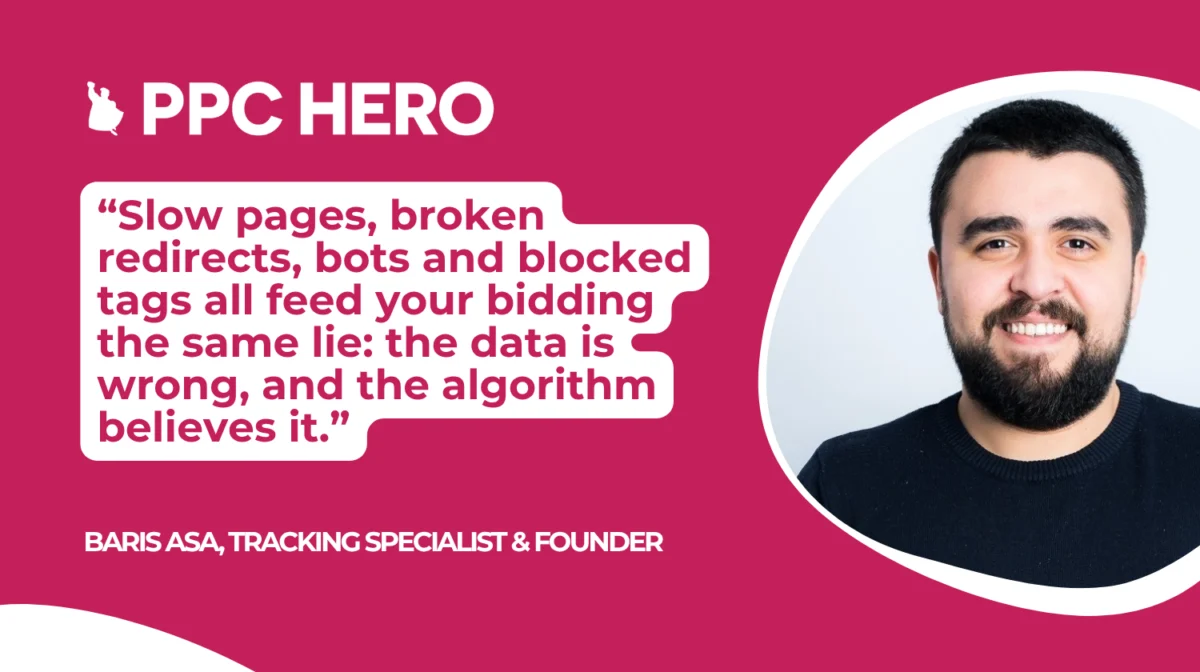
"The refund lands in your account, but the two weeks of skewed bidding doesn’t," notes Baris, a PPC expert and speaker at Hero Conf. During the time the bot traffic was active, the Smart Bidding algorithm was optimizing against inflated, non-human numbers, effectively "training" the campaign to seek out more bots.
4. The Spam Lead Feedback Loop
For lead-generation businesses, the "test test" and spam submissions in a CRM are more than just a nuisance; they are a toxic data source. If 30% of a campaign’s conversions are spam, and those conversions are fed back into the ad platform, the machine will prioritize finding more users who exhibit "spam-like" behavior. This creates a tightening loop of diminishing returns that is difficult to break without filtering data at the server level.
5. The Privacy and Ad-Blocker Wall
The rise of privacy-centric browsing (Safari’s ITP, Firefox’s ETP) and the widespread use of ad blockers mean that a significant portion of the audience is "invisible" to standard client-side tracking. Estimates suggest that 15% to 30% of real conversions never make it to the ad dashboard. When a marketer sees a 4x ROAS, the reality might be closer to 5.5x, yet the campaign is often paused due to the perceived failure to meet targets.

Official Responses and Industry Perspectives
The response from major tech platforms has been a push toward "Enhanced Conversions" and "Server-Side Tagging."
A Google spokesperson recently emphasized that "first-party data and durable measurement solutions are essential for businesses to navigate the changing privacy landscape." However, many small to mid-market agencies argue that the technical barrier to implementing server-side tracking is too high for the average business.
Privacy advocates, on the other hand, argue that the "leaks" are a natural byproduct of a more private internet. "The industry’s obsession with tracking every single click is at odds with consumer demand for privacy," says a representative from a leading digital rights NGO. "Advertisers need to move toward modeled conversions rather than intrusive tracking."
Despite these differing views, the consensus among technical marketers is that the "Edge"—the layer between the user and the server—is where the battle for data integrity will be won. Solutions like Cloudflare Workers and server-side GTM (Google Tag Manager) are being positioned as the "handful of settings" that can fix what a full developer sprint cannot.
Implications: The New Edge in Paid Media
The implications of this measurement crisis are profound. In an era where creative strategies and audience targeting are increasingly democratized by AI, the "technical edge" has become the new competitive advantage.
The Shift to "Data Engineering" in Marketing
The role of the PPC manager is evolving into that of a data steward. Agencies that fail to audit the "post-click" technical journey are essentially gambling with their clients’ budgets. Conversely, firms that can reclaim the 15% to 30% of lost data will see an immediate improvement in algorithmic performance without changing a single keyword or ad copy.
The Death of the Dashboard?
As the gap between "dashboard reality" and "bank account reality" widens, brands may begin to move away from platform-reported ROAS as their primary North Star. Instead, a move toward "Marketing Efficiency Ratio" (MER)—total revenue divided by total ad spend—is gaining traction as a more honest, albeit less granular, metric.
Final Outlook
The "gap nobody owns" is no longer a mere footnote in a monthly report; it is the primary source of waste in digital advertising. As we move deeper into 2024 and 2025, the winners in the paid media space will not be those with the biggest budgets or the flashiest creative, but those who ensure that every dollar spent is accurately accounted for by the machines they have hired to spend it.
For the marketer who paused a 5x campaign thinking it was a 4x, the lesson is clear: in the age of AI, your algorithm is only as good as the data you feed it. To fix the campaign, you must first fix the pipe.