In the rapidly evolving landscape of digital marketing, a paradigm shift is occurring within the corridors of Meta’s global advertising infrastructure. For over a decade, media buyers and performance marketers have relied on a granular approach to campaign management—meticulously segmenting audiences, micro-managing placements, and manually ushering users through the traditional "marketing funnel."
However, as we move toward 2026, those legacy strategies are becoming obsolete. The catalyst for this transformation is Andromeda, Meta’s sophisticated, retrieval-based, AI-powered ad ranking and delivery system. This article explores the mechanics of Andromeda, the move toward "galaxy-scale" account structures, and why the future of advertising lies in creative diversity rather than audience segmentation.
1. Main Facts: The Architecture of Andromeda
At its core, Andromeda represents the most significant overhaul of Meta’s ad-serving technology in more than ten years. Named after the Andromeda galaxy—a poetic nod to the system’s ability to navigate trillions of data points—the engine is designed to solve the "needle in a haystack" problem of modern digital commerce.
The Retrieval-Based Shift
Unlike previous systems that relied on rigid, pre-defined audience filters, Andromeda utilizes a retrieval-based architecture. In real-time, the system scans tens of millions of potential ad-to-user matches. Instead of asking, "Which users fit into this ‘Interest: Interior Design’ bucket?" the system asks, "Which of our millions of active ads is most likely to drive a conversion for this specific user at this exact micro-moment?"
The End of Manual Control
The primary takeaway for advertisers is the death of "micro-planet" management. Andromeda thrives on data density and consolidation. By aggregating signals across various placements (Reels, Feed, Stories) and behaviors, the AI identifies patterns that human operators simply cannot see. Consequently, the industry is moving away from hyper-segmented campaigns toward unified, "broad" structures that allow the algorithm to breathe.
Creative as the New Targeting
In the Andromeda era, the creative asset itself performs the targeting. Because the AI can analyze the visual and textual components of an ad, it determines who should see it based on the "hook" and the "message." This shifts the media buyer’s role from a technical optimizer to a creative strategist.
2. Chronology: From Manual Segmentation to Algorithmic Autonomy
The journey to Andromeda has been a multi-stage evolution, driven by both technological ambition and external privacy pressures.

- 2010–2018: The Era of Granular Control: Advertisers focused on "Interest Stacking" and "Lookalike Audiences." Success was defined by how well a human could guess the hobbies and demographics of their ideal customer.
- 2019–2021: The "Power 5" and Signal Loss: Meta began pushing for "The Power 5" (Auto Advanced Matching, Simplified Account Structure, etc.). However, the 2021 rollout of Apple’s iOS 14.5 (App Tracking Transparency) severely hampered Meta’s ability to track users across the web, creating a "signal crisis."
- 2022–2024: The Rise of Advantage+: To combat signal loss, Meta introduced Advantage+ Shopping Campaigns (ASC). This was the precursor to Andromeda, testing the waters of total automation and machine-learning-driven delivery.
- Late 2024–2026: The Andromeda Integration: Meta officially launched the Andromeda retrieval engine. This transition marked the move from "ranking" existing sets to a full-scale "retrieval and ranking" ecosystem, allowing the AI to source ads from a massive pool of creative assets to find the perfect match for the user.
3. Supporting Data: The Power of Signal Consolidation
To understand why Andromeda requires a change in strategy, one must look at how AI processes information. The system requires "clean signals"—uninterrupted streams of data that show a clear path from impression to conversion.
The "89% Rule"
Internal Meta analysis and industry case studies have highlighted a startling statistic: Different creative motivators unlock new audiences 89% of the time.
Previously, marketers believed that if they had a winning ad, they should spend their entire budget on it. Andromeda proves the opposite. Because different people buy the same product for different reasons, a single "winning" ad will eventually hit a ceiling. By introducing diverse creative hooks—addressing different "personas"—advertisers can reach segments of the market that the original "winning" ad never could.
The Math of Consolidation
In the legacy model, an advertiser might spend $1,000 across 10 ad sets ($100 each). This dilutes the signal. Under Andromeda, that $1,000 is better spent in a single campaign. This concentration of data allows the algorithm to exit the "Learning Phase" significantly faster, reducing the Cost Per Acquisition (CPA) by an average of 20–30% in high-volume accounts.
The Creative Matrix: A Data-Driven Approach
According to performance data, the most successful campaigns in 2026 utilize a "Creative Matrix" to feed Andromeda. This involves testing specific "Hooks" against "Personas."
| Hook Type | Primary Persona | Data-Backed Messaging |
|---|---|---|
| Problem/Solution | The "Mess-Fatigued" Parent | Focus on durability, stain resistance, and ease of cleaning. |
| Discovery/Aesthetic | The Interior Designer | Focus on room transformation, "unboxing" moments, and style. |
| Social Proof | The Skeptical Shopper | Focus on UGC (User Generated Content), reviews, and "as seen on" clips. |
| Practicality | The Time-Poor Professional | Focus on quick maintenance, machine washability, and "set it and forget it" utility. |
4. Official Responses: Meta’s Engineering Perspective
Meta’s engineering team has been vocal about the technical necessity of Andromeda. In a recent technical deep dive, Meta Engineering explained that the previous infrastructure was struggling to keep up with the sheer volume of content generated by the "Creator Economy."
"Andromeda is not just an update; it is a fundamental re-architecting of our retrieval stack," Meta’s engineering blog noted. The goal was to move away from a "two-tower" model (one for users, one for ads) toward a more integrated system that understands the semantic relationship between what a user interacts with and what an ad promises.

Industry experts have corroborated this. PPC specialists at leading agencies have noted that "Andromeda rewards honesty and variety." Meta’s official guidance now explicitly discourages "small tweaks" (like changing a button color). Instead, the system looks for "meaningful variety"—completely different visual styles, different creators, and different emotional angles.
5. Implications: The Future of the Media Buyer
The rise of Andromeda has profound implications for the advertising industry, shifting the value proposition of human workers and the structure of marketing departments.
From "Button Pusher" to "Creative Strategist"
For years, the value of a media buyer was their ability to "hack" the Facebook Ads Manager—finding hidden interests or optimizing bidding strategies. Andromeda automates these tasks entirely. The new "Value Add" for humans is:
- Consumer Psychology: Understanding why people buy.
- Creative Production: Coordinating the creation of diverse assets (Reels, Statics, Lo-Fi vs. Hi-Fi).
- Data Analysis: Interpreting the "business goals" rather than just "platform metrics."
Structural Simplification
The "Galaxy" approach requires a drastic simplification of account structures.
- The Old Way: 15 Campaigns (TOF, MOF, BOF), 50 Ad Sets (Interests, LALs, Retargeting), 3 Ads per set.
- The Andromeda Way: 2–3 Campaigns (Main Scaling, Creative Testing), Broad Targeting (Age/Gender/Location only), 20+ Diverse Creative Assets.
The Scalability Paradox
The irony of Andromeda is that while the tools have become more "complex" under the hood, the interface has become "simpler." However, scaling is now harder for those who lack a creative engine. In 2026, a brand’s ability to scale is directly tied to its ability to produce high-quality, varied creative content. Without a "creative factory," Andromeda has nothing to retrieve, and the "galaxy" remains empty.
Conclusion: Building for the Future
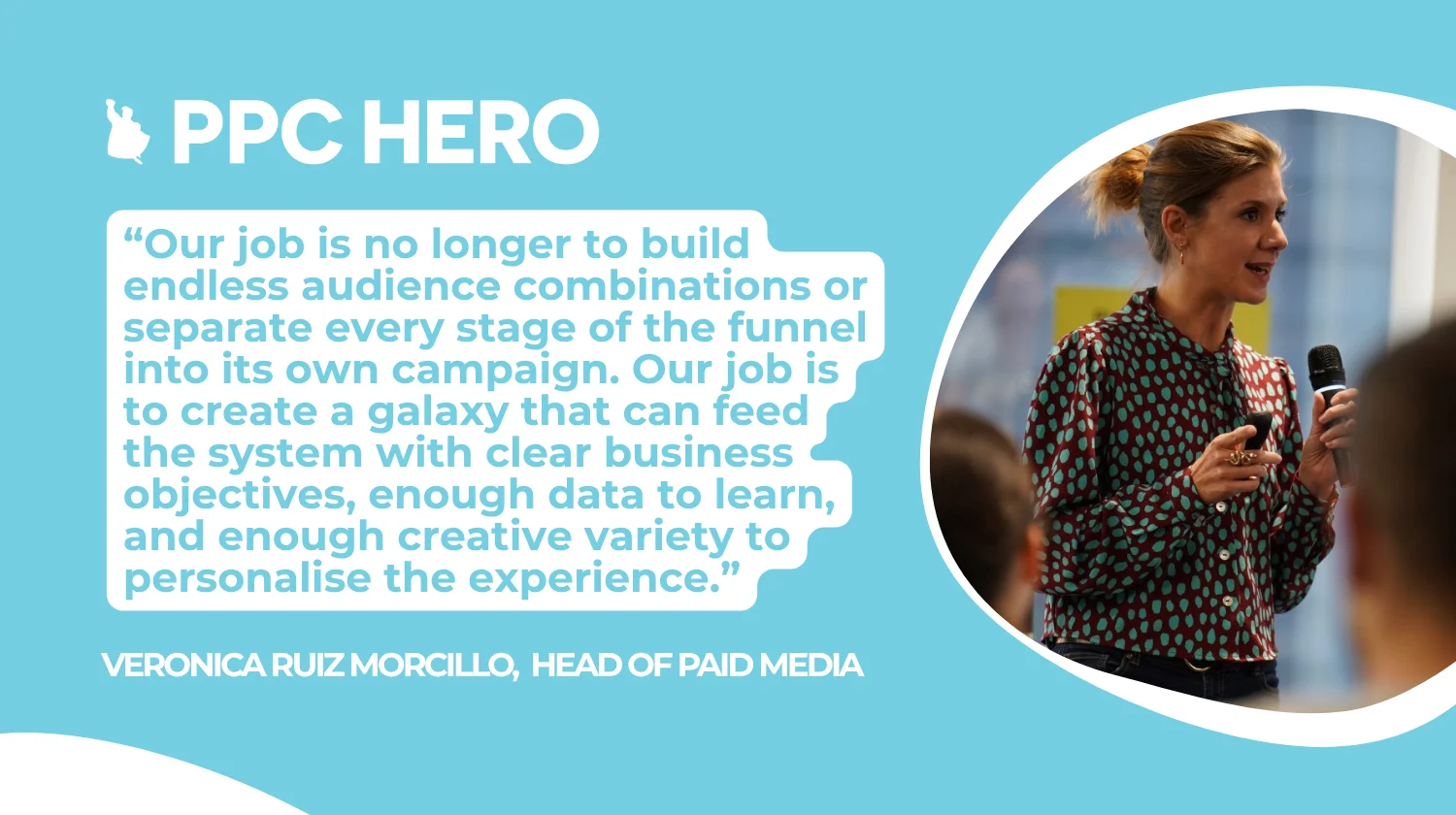
The shift from "Micro-Planets" to "Galaxies" is not merely a change in campaign settings; it is a change in philosophy. Advertisers must stop trying to "control" the algorithm and start "feeding" it. By providing Andromeda with clear business objectives and a rich tapestry of creative variety, brands can unlock levels of personalization and efficiency that were previously impossible.
In the world of 2026, the most successful marketers will be those who spend less time organizing audiences and more time understanding people. The "poetic" scale of Andromeda demands nothing less.