In an era of fragmented media consumption, sports remains the last, great campfire of the digital age. Last year, nearly all of the top 50 most-watched telecasts in the United States were sports-related. From the NFL’s persistent dominance—exemplified by the curious fact that even a broadcast titled "NFL Weather Delay" draws massive viewership—to the occasional cultural outlier like the Oscars or the Grammys, live sports stands alone as the only content category capable of unifying a fractured national audience.
This reality has not been lost on the titans of industry. Streaming giants, legacy broadcasters, and multinational corporations are engaged in a relentless arms race to acquire sports broadcasting rights and high-profile sponsorship deals. Yet, as the capital investment in these ventures climbs into the tens of millions, a growing number of senior leaders are beginning to ask the uncomfortable, necessary question: "I’ve enjoyed the hospitality suites and the photos with star athletes, but is this $38 million marketing spend actually moving the needle for the business?"
The Illusion of Visibility: The "Spike and Silence" Trap
To understand the efficacy of sports marketing, one must first accept that the fundamental laws of marketing do not suspend themselves simply because a logo is placed on a jersey or a stadium wall. If a brand’s creative and narrative fail to capture attention in the fleeting 1.2-second window of a TikTok scroll, that same creative will surely fail when plastered across a race car or an interview backdrop.
In fact, sports marketing often presents a higher barrier to entry. Because the audience is primarily focused on the game, the threshold for brand resonance is significantly higher.
The Fallacy of Passive Exposure
Many marketers fall into the "spike and silence" trap. They believe that a single high-profile placement—such as a star athlete holding a branded water bottle or a one-off mention by an influencer—will generate lasting brand equity. In reality, this approach is often a colossal waste of resources.
True brand transformation requires "spike and sustain." The halo effect of a sporting event or an athlete does not automatically transfer to a brand. To achieve a meaningful impact, marketers must apply the same rigors of frequency—ideally a cadence of three exposures per user per week—that they would apply to traditional paid media. Relying solely on organic sports placements often leads to a disconnect where the sport itself becomes an obstacle, effectively masking the brand message rather than amplifying it.
The Measurement Playbook: Moving Beyond Vanity Metrics
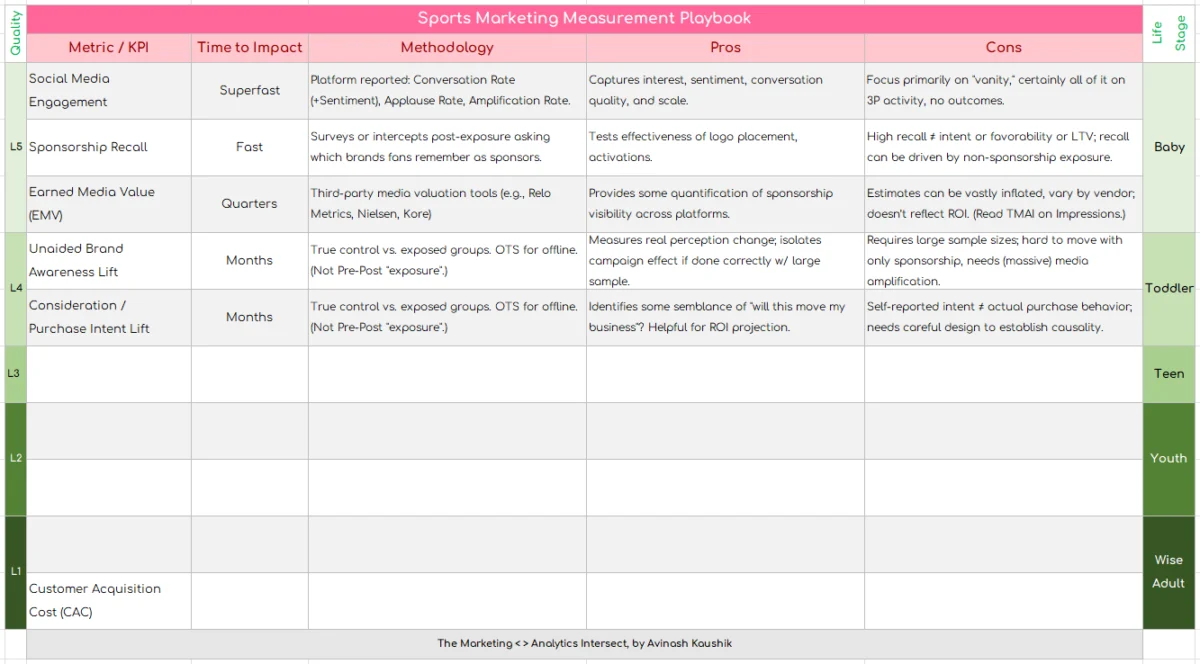
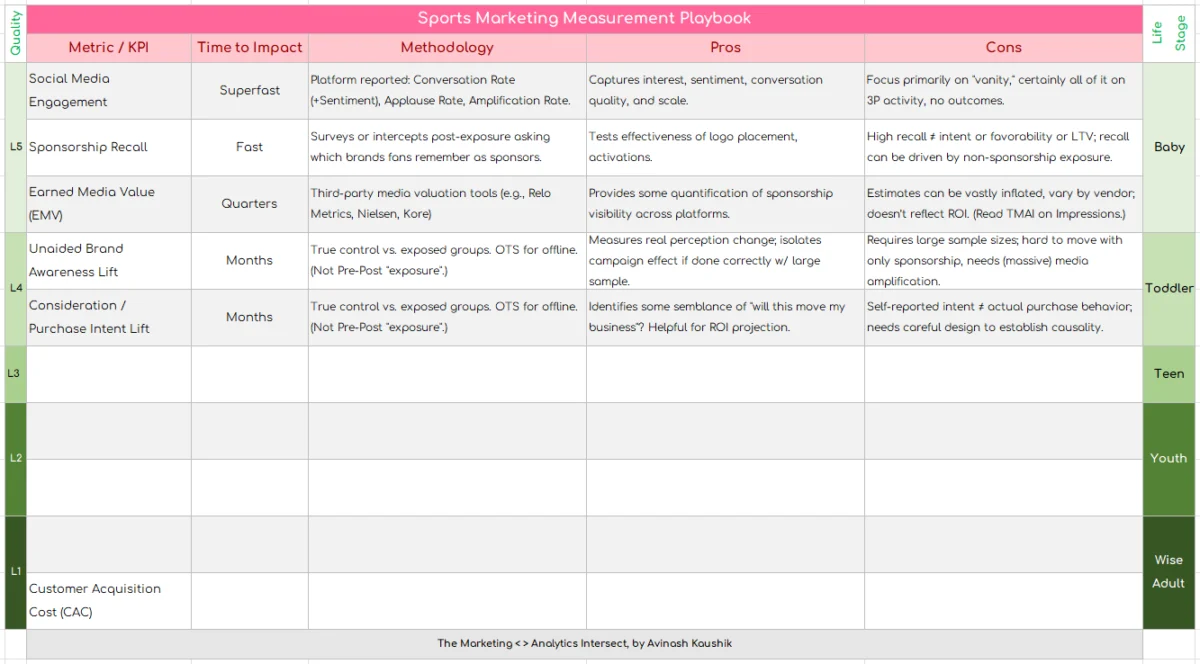
The industry is currently plagued by an over-reliance on what can be termed "Impact Intelligence Level 5" metrics—the realm of vanity. Companies frequently tout "450 million impressions" in their board decks, yet these numbers measure activity, not business outcomes.
Level 5: The Opening Gambit (Vanity Metrics)
At this entry level of sophistication, organizations focus on three primary, yet flawed, data points:
- Social Media Engagement: While useful for measuring immediate conversation and applause rates, these metrics are often disconnected from revenue.
- Sponsorship Recall: Often conducted via aided surveys, these studies suffer from signal quality issues. Asking a fan if they are "aware" of a sponsor is a far cry from measuring if they actually care.
- Earned Media Value (EMV): Frequently cited by agencies, EMV is widely considered the industry’s "dirty secret." It calculates the cost of advertising space as if the brand had purchased it outright, ignoring the quality of the audience, the lack of a targeted message, and the hyper-cluttered nature of the environment.
Level 4: The Quest for Brand Impact
To progress, brands must shift toward "Level 4," which prioritizes true test-versus-control measurement of brand impact. The core question at this stage is: "Did the sponsorship shift what people think and feel about our brand?"
- Unaided Brand Awareness (UBA) Lift: A long-term revenue driver that requires patience. Effective sports marketing should move the needle on UBA, provided the investment is sustained over years, not months.
- Consideration and Purchase Intent: This is where the CFO begins to pay attention. By utilizing traditional brand tracking tools—such as propensity score matching between exposed and control groups—brands can isolate the causal impact of their sports investments on future purchase behavior.
Strategic Implications for the C-Suite
For companies navigating this space, the implications are clear: sports marketing can be immensely effective, but only if treated as a strategic business lever rather than a hospitality perk.
The Power of Delegated Storytelling
There is a profound opportunity for brands that struggle with internal creative development. Because creative execution is responsible for 60% to 70% of brand marketing success, some companies find it more profitable to "outsource" their narrative to the sport or athlete. By aligning with the values inherent in a specific sport, a brand can inherit those qualities. However, this must be a conscious decision, not an accidental byproduct of a sponsorship deal.
The Requirement for Incrementality
The ultimate goal for any marketing organization is to move from vanity to value. Once a brand masters the foundational levels of measurement, they must aim for "Level 1": the proof of incrementality. This is the gold standard, where the brand can definitively show that its sports marketing spend resulted in sales that would not have occurred otherwise.
A Future of Accountability
As we look toward the future of sports marketing, the era of "sponsoring in the dark" is coming to a close. The convergence of advanced data analytics and rigorous marketing frameworks allows for a level of transparency that was previously impossible.
Key Takeaways for Marketing Leaders:
- Reject the "One-Off": Short-term sports marketing deals rarely yield meaningful ROI. Long-term commitment is the only way to build brand equity in a crowded market.
- Prioritize Creative Quality: The sport is the vehicle, but the creative is the engine. If the ad creative is weak, the platform (no matter how prestigious) cannot save it.
- Demand Causal Data: Move your team away from EMV and vanity impression counts. Insist on data that reflects shifts in brand sentiment and purchase intent.
- Integrate the Funnel: Sports marketing should not exist in a silo. It must be woven into the broader marketing mix, supported by paid media that reinforces the message rather than just shouting the logo.
Conclusion: Turning the Lights On
Sports marketing remains one of the most powerful tools in a brand’s arsenal. It provides a unique, emotive environment that few other mediums can replicate. However, the prestige of the field should not act as a shield against accountability. By adopting a structured approach to measurement—moving from vanity-based L5 metrics to outcome-based L1 analysis—marketers can transform their sports sponsorships from expensive brand "noise" into a reliable, profitable driver of business growth.
The hospitality suites at Augusta National or the courtside seats at an NBA game are, ultimately, just locations. The real work happens in the data. For the leader willing to "turn the lights on," the reward is not just a closer relationship with a star athlete, but a clearer, more defensible path to long-term market dominance.
This article is based on insights regarding marketing analytics and strategic frameworks. For professionals looking to sharpen their approach to performance and brand measurement, the ongoing discourse in the field—rooted in decades of practical application—remains the most reliable path to professional and commercial success.