The global private equity (PE) and venture capital (VC) industries are currently navigating a structural bottleneck of unprecedented proportions. According to recent reporting by The Wall Street Journal and corroborated by comprehensive industry data from Bain & Company, the private equity sector is currently sitting on a backlog of unsold portfolio companies that would take approximately nine years to clear at current exit velocities. This is not merely a temporary market dip; it is a fundamental shift in the machinery of private markets, where the traditional "buy, fix, and sell" cycle has effectively stalled.
The Scale of the Stagnation: 33,000 Companies and $3.8 Trillion
The sheer volume of capital currently trapped in private portfolios is staggering. Bain’s 2026 Global Private Equity Report paints a sobering picture: the industry is currently holding roughly 33,000 unsold companies, representing a combined valuation of $3.8 trillion. This figure has been steadily climbing, rising from $3.6 trillion just a year prior. When one accounts for venture-backed "unicorns"—many of which were valued at peak 2021 multiples—the total includes over a thousand software companies that currently lack a viable path to liquidity.
In the United States alone, the number of companies held in private equity portfolios reached approximately 13,500 by mid-2026. Of these, nearly 4,000 have been held for six years or longer, while 1,500 have remained in portfolios for nine years or more. These statistics stand in direct opposition to the standard private equity model, which historically aims for an exit within three to five years. When the average holding period stretches toward seven years—as it has now—the entire investment lifecycle is disrupted, forcing a slowdown in new deal flow and creating a crisis of confidence among Limited Partners (LPs).
A Chronology of the Slowdown
To understand how the industry reached this point, one must look at the macro-environment of the last decade.
- 2010–2021: This era was defined by cheap debt, high growth expectations, and a "growth at all costs" mentality. Private equity firms and venture capitalists deployed capital at record rates, often paying premium multiples for companies during the 2021 peak.
- 2022–2024: As interest rates rose and the cost of debt increased, the exit markets—specifically the IPO market and large-scale M&A—began to contract. The "easy money" period ended, leaving firms with portfolios that could not be sold for the returns expected by their investors.
- 2025: The "soft" environment became entrenched. Buyout fundraising fell by 16% to $395 billion, and the number of closed funds dropped by 23%.
- 2026: The current year has solidified the stagnation. First-half fundraising hit $159.6 billion, trailing behind even the lackluster performance of 2025. Distributions to LPs have remained below 15% of Net Asset Value (NAV) for four consecutive years, marking an ignominious industry record.
The Software "Freeze" and the Valuation Wall
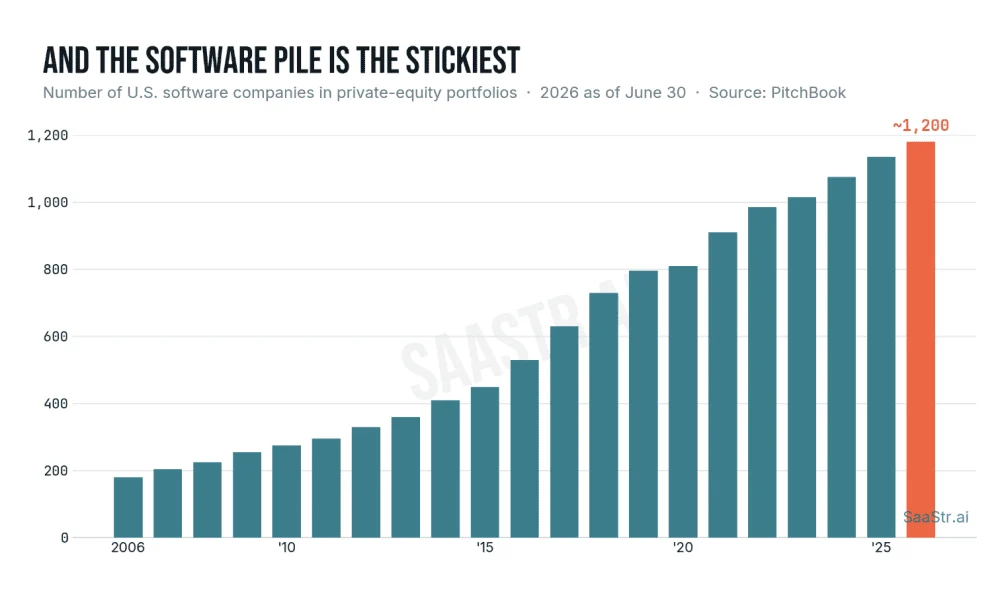
Within the broader stagnation, the software sector is experiencing the most acute "freeze." While software companies represent only about 1,200 of the 13,500 PE-owned entities, they account for a disproportionate amount of trapped capital.
Darius Craton of Raymond James has highlighted that the 2021 vintage of software investments represents the most significant challenge. Companies purchased during that period were bought at historical highs; today, the market environment for SaaS and tech multiples has corrected sharply downward. This has created a "valuation wall": firms are unwilling to sell at a loss, yet public markets are unwilling to pay the inflated prices required for the PE firms to achieve their target returns.
The Bain midyear report illustrates the severity of this issue: technology buyout deal value plummeted 70% between Q4 2025 and Q1 2026. Furthermore, the number of large-scale tech deals—those exceeding $1 billion—fell from 15 to a mere four in the same period.
The Venture Capital Conundrum: 859 Unicorns in Search of an Exit
While PE deals with buyout-heavy portfolios, the venture capital side is grappling with a different flavor of the same problem. According to the 2026 NVCA Yearbook, U.S. venture firms deployed $320 billion in 2025, with 65% of that capital funneled into AI. Currently, there are 859 venture-backed unicorns waiting for an exit. Globally, the World Economic Forum estimates there are 1,920 privately held unicorns, with 59% of them having been founded more than a decade ago.
The financial performance of these funds has been lackluster. The median VC Internal Rate of Return (IRR) for North American vintages since 2019 sits in the low single digits. More concerning is the median Distributed to Paid-In Capital (DPI) for the past decade, which remains below 1x. This means that after ten years of investment, the median fund has yet to return the principal capital to its investors, let alone generate a profit.

Implications for the Three Traditional Exits
For any private company, the exit usually follows one of three paths: an IPO, an acquisition (M&A), or a secondary sale. Each of these paths is currently restricted.
1. The IPO Keyhole
While IPOs are technically "back," they are restricted to a tiny fraction of the market. In the first half of 2026, 16 companies went public with PE backing, raising $10.1 billion. While this was the strongest six-month period since 2021, it remains highly selective. Roughly 67% of the unicorns that attempted an IPO in 2025 were forced to price below their last private valuation.
Furthermore, the pipeline for future IPOs is dangerously thin. While giants like OpenAI, Anthropic, and SpaceX represent massive potential exit value, they do not provide a roadmap for the hundreds of other companies struggling to find a public market exit.
2. The M&A Slowdown
M&A has historically been the "backup plan" for private equity, but it has become increasingly difficult to execute. Antitrust regulatory scrutiny has intensified, making large-scale mergers more complex and time-consuming. Additionally, many of the assets in the current backlog are "stranded"—they are too large to be easily absorbed by mid-market buyers, yet their valuations are too high for strategic acquirers to justify.
3. The Rise of Secondaries and Continuation Vehicles
As traditional exits close, liquidity is being forced through "alternative" channels. Direct secondary volume on the venture side now accounts for roughly 2% of total unicorn value, and this is increasingly viewed as a core strategy rather than a fallback. Similarly, private equity firms are increasingly utilizing "continuation vehicles," which allow LPs to cash out while the sponsor retains ownership of the asset. These tools are essential, but they act as a "side door" to liquidity because the front door remains locked.
Strategic Shifts: What is Clearing the Market?
Despite the gloom, some capital is moving. The market has signaled a clear preference for specific sectors: AI, defense, fintech, and space. These industries benefit from either structural growth or government tailwinds, making them the only sectors capable of sustaining IPO momentum.
Two other trends are emerging as potential solutions:
- The Roll-up Model: Firms like Bending Spoons are finding success by acquiring "tired" businesses, streamlining their operations, and holding them for the long term. This approach resonates with public investors who are looking for cash-flow stability rather than speculative growth.
- The Normalization of Down-Rounds: The stigma surrounding down-round IPOs is rapidly evaporating. As 2025 proved, the market can absorb these offerings, and founders are increasingly accepting that a "reset" price is a better outcome than a decade of stagnation.
Conclusion: A New Era of Discipline
The nine-year backlog is a loud wake-up call for the private markets. It signals the end of an era defined by valuation expansion and the beginning of an era defined by operational efficiency. As the backlog continues to weigh on the industry, the firms that survive will likely be those that prioritize real cash flow, embrace realistic down-round valuations, and stop banking on a return to the liquidity conditions of 2021. For the investors, founders, and employees caught in this cycle, the message is clear: the path to liquidity has changed, and it will require far more patience and pragmatism than the market has seen in years.