For two decades, the "slow lane" of the B2B software industry was considered the gold standard of financial stability. It wasn’t about hyper-growth or disruptive moonshots; it was about the "annuity." Investors prized high Net Revenue Retention (NRR), thick margins, and the kind of sticky, workflow-embedded contracts that made churn a distant memory. For years, this was the playbook: capture a niche, lock in the data, and generate predictable cash flow. If growth slowed, companies didn’t collapse; they simply transitioned from high-growth stocks into "bonds with upside."
However, as of mid-2026, that fundamental deal is effectively dead. A new, harsh reality has emerged where "slow growth" has been replaced by "terminal state," and the market is no longer pricing these companies as reliable annuities. The era of the predictable software subscription is being dismantled by the rise of AI agents, leaving a bifurcated landscape where the winners are those who power the revolution, and the losers are those who rely on the old, seat-based model.
Chronology: The Erosion of the Software Premium
To understand how we reached this inflection point, one must look at the transition of the software valuation model over the last several years.
- 2005–2020: The Golden Age of Seats: The SaaS model flourished on the back of headcount expansion. Every new hire in a company meant a new CRM, ITSM, or storage seat. High NRR (often >110%) was the North Star.
- 2021–2023: The Inflationary Hangovers: As interest rates rose, the market began to punish "growth at all costs." Software companies pivoted to profitability, a transition many navigated successfully by trimming headcount and optimizing margins.
- 2024–2025: The AI Infiltration: While software firms were focused on internal cost-cutting, AI agents began to demonstrate functional utility that rivaled human output in support, documentation, and data entry.
- 2025 (Q3): The Peak of the IGV: The software sector hit its peak before the current correction. Since then, the IGV (iShares Expanded Tech-Software Sector ETF) has plummeted roughly 30%, wiping out approximately $2 trillion in market capitalization.
- 2026 (Current): The Terminal State Realization: Investors have stopped treating sub-5% growers as "stable." Instead, they are being valued as legacy entities with questionable long-term durability.
Supporting Data: When Growth Drops Below 5%
In the traditional software investment model, a Discounted Cash Flow (DCF) analysis relied heavily on terminal value. When a company grew at 30%, the near-term growth story overshadowed long-term terminal concerns. But when growth slips into the single digits—below 5%—the math shifts entirely. The terminal value becomes the story.
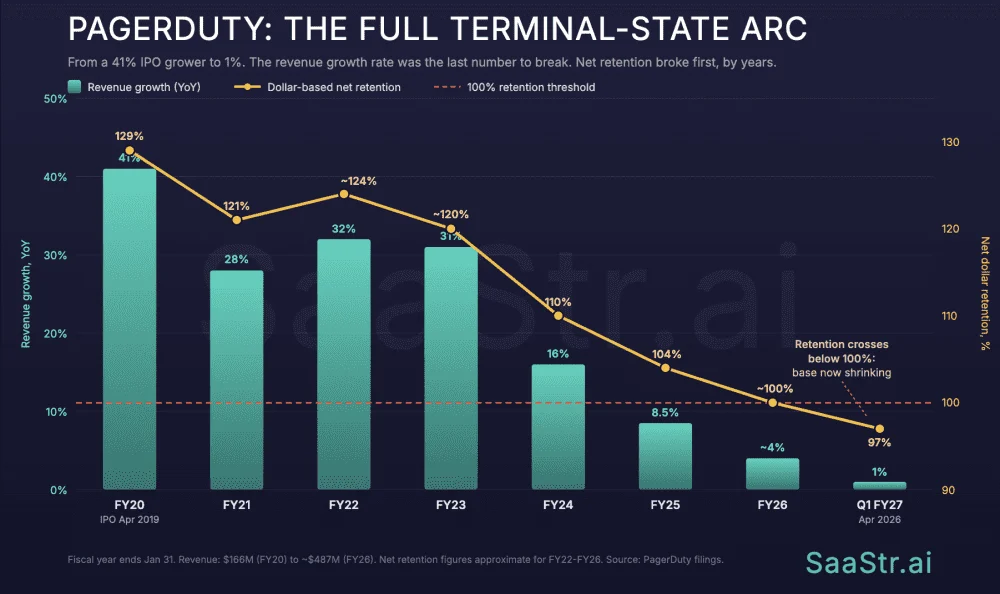
Current market data from 2026 paints a grim picture for companies like Dropbox, Zoom, DocuSign, and PagerDuty. These firms are no longer experiencing a temporary slowdown; they are trapped in a low-growth purgatory. As of June 2026, software trades at approximately 22.7x forward earnings—a valuation that, for the first time in history, sits below the S&P 500 average.
This isn’t a cyclical dip like the 2008 financial crisis. In 2008, the underlying economics of software—the necessity of digital infrastructure—remained intact. Today, the market is questioning whether the "annuity" exists at all. When HubSpot, a titan of the CRM space, sees its customer count growth slide for five consecutive quarters (from 21% down to 16%), it signals a structural trend that cannot be ignored.
The Mechanism: How AI Agents "Eat" Seats
The primary engine of the last twenty years was the seat-based licensing model. It was simple: the more people a client hired, the more revenue the software company generated. This model was built on the assumption that headcount would always increase, or at least remain steady.
AI agents have fundamentally broken this mechanism. If a company can deploy an AI agent to perform the work of ten customer support representatives, the demand for those ten seats vanishes. The AI does not just reduce the need for seats; it makes the data within those applications far more portable, lowering switching costs and eroding the "sticky" nature of the software.
Furthermore, the "budget pie" for IT spending is finite. CIOs are not magically increasing their budgets to accommodate AI; they are reallocating them. When a massive portion of the $450 billion in hyperscaler infrastructure spend is diverted toward AI deployment, that money is effectively being siphoned away from traditional SaaS seat expansion. Anthropic’s explosive growth—reaching an annualized run rate of $19 billion in 2026—is essentially being funded by the cannibalization of legacy software seat budgets.

The Bifurcation: Infrastructure vs. Application
The most critical takeaway for investors and operators is that software is no longer a monolith. The industry has split into two distinct categories:
1. The Infrastructure Beneficiaries
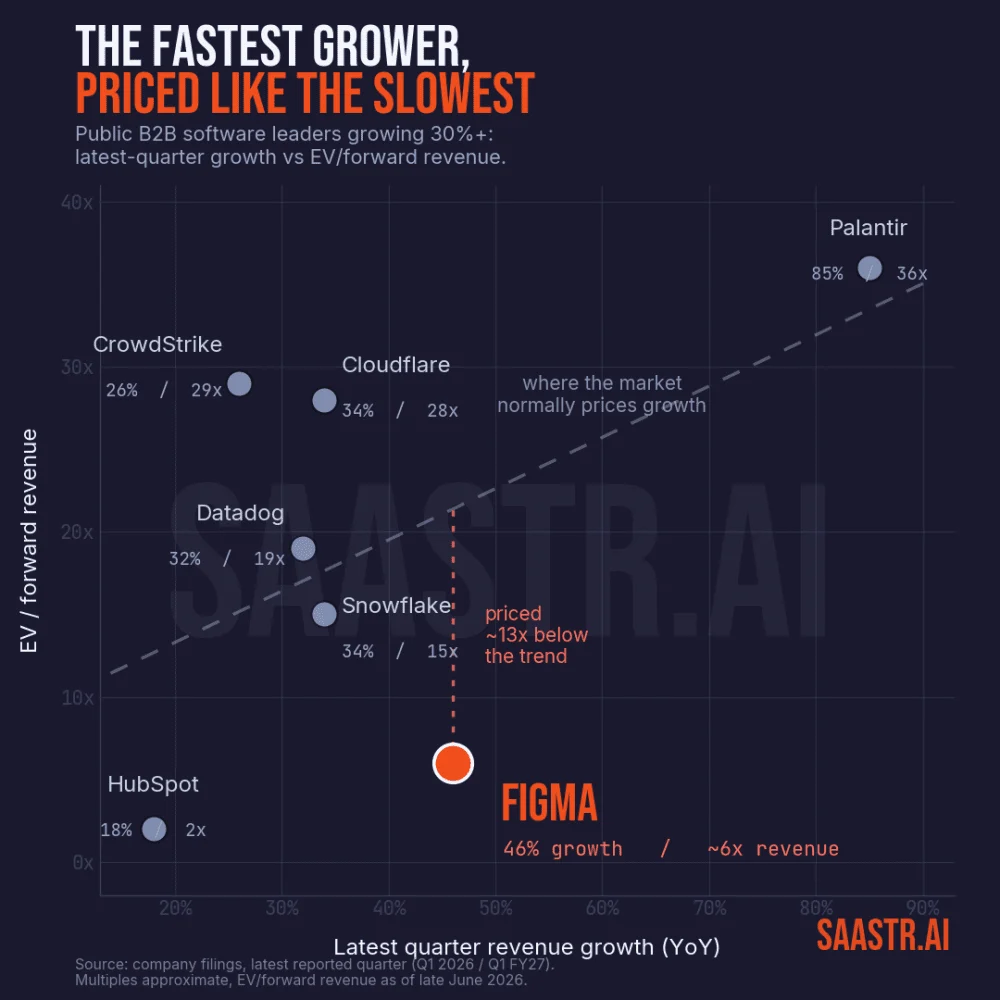
These are the companies that AI "feeds." Cloudflare, Snowflake, Twilio, and DigitalOcean are seeing re-acceleration because they are the "picks and shovels" of the AI era. As AI agents consume compute, storage, bandwidth, and data, these companies see their revenue climb. Twilio, for instance, recently posted 20% growth—its fastest in three years—driven specifically by AI voice workloads.
2. The Application Victims
These are the companies that AI "feeds on." Any platform that relies on human-driven seat counts as its primary growth lever is under existential threat. As workflows become automated, the value proposition of a "seat" declines. These companies are drifting toward a terminal state, where they must either pivot their entire business model or face a slow, inevitable decline in relevance.
Implications: The Death of Graceful Decline
In the past, a software company could "get profitable" and coast into a comfortable existence as a cash-cow business. That era has ended. Simply achieving profitability is no longer a sufficient defense against a declining revenue base.
The implications for the industry are profound:
- Valuation Compression: As long as software companies are tied to seat counts, they will be valued lower than companies that can demonstrate direct, usage-based scaling with AI.
- The End of Private Equity "Safe Havens": Private equity firms that previously bought these slow-growth companies to optimize for cash flow will find it increasingly difficult to exit. If the "annuity" is not durable, the exit multiples will collapse.
- The Pivot or Perish Mandate: Application companies must find ways to charge for "value provided" or "agent-orchestrated outcomes" rather than "human seats." If they cannot make this transition, they will not survive the decade as independent entities.
Official Responses and Market Sentiment
Wall Street analysts are increasingly revising their long-term models. While some executives in the application space argue that human oversight will always be required, the market is voting with its capital. The massive sell-off in the IGV is a clear signal that institutional investors have lost faith in the "durable annuity" narrative.
As we look toward the remainder of 2026, the question for any B2B software leader is simple: Is your product an infrastructure component that powers the AI agent, or is it a seat-based legacy platform that the agent is destined to replace?
There is no longer a comfortable middle ground. The "slow lane" has become a dead end, and the only path forward is to align with the technological shift—or be consumed by it.