The digital marketing landscape is currently undergoing its most significant transformation since the advent of social media advertising. As of mid-2026, OpenAI has officially transitioned from a provider of productivity tools to a global advertising powerhouse. With the full rollout of its self-service advertising platform, brands now have the unprecedented ability to place sponsored content directly within the conversational flow of ChatGPT—a space previously reserved for purely organic interactions.
This evolution marks a paradigm shift in how businesses reach consumers. Unlike traditional search engines that rely on static queries, OpenAI’s platform leverages the contextual depth of Large Language Models (LLMs) to serve ads that are not just relevant to a keyword, but to the very logic of a user’s ongoing dialogue.
Main Facts: The New Frontier of Digital Media
OpenAI’s Ads Manager represents the first major challenge to the Google-Meta duopoly in the AI era. The platform allows businesses to bid for placement beneath ChatGPT responses, effectively capturing user attention at the exact moment of intent.

The core mechanics of the platform mirror established systems like Google Ads and Meta Ads Manager, making it accessible to veteran media buyers, yet it introduces unique AI-driven features. Key highlights include:
- Contextual Integration: Ads appear as "sponsored suggestions" or follow-up blocks directly below the AI’s generated text.
- Three-Tier Hierarchy: The system uses a standard Campaign-Ad Group-Ad structure.
- Objective-Based Optimization: Advertisers can choose between Reach, Clicks, or Conversions.
- Semantic Targeting: Instead of rigid keyword matching, the platform utilizes "Context Hints" to align ads with the nuances of a conversation.
As brands scramble to claim their territory, early data suggests that the "first-mover advantage" is significant, with engagement rates on conversational ads currently outpacing traditional display banners.
Chronology: The Global Rollout of 2026
The expansion of OpenAI’s advertising capabilities was executed with surgical precision throughout the first half of 2026, targeting high-value markets with high AI adoption rates.

March 2026: The Pilot Phase
The journey began in the Southern Hemisphere. OpenAI launched its initial advertising platform in Australia and New Zealand. These markets served as the testing ground for the platform’s infrastructure, allowing OpenAI to calibrate how ads impacted the latency and user experience of the ChatGPT interface.
May 5, 2026: The North American Watershed
Following the success of the pilot, OpenAI opened its fully self-service platform to all advertisers in the United States. This was a pivotal moment, as it allowed small-to-medium enterprises (SMEs) to compete alongside major corporations for the first time in the conversational AI space.
June 2026: Global Expansion
By June, the platform reached the high-tech corridors of Japan and South Korea. Simultaneously, the United Kingdom became the first European market to launch ChatGPT ads, marking OpenAI’s entry into the strictly regulated GDPR environment. This month also saw a massive influx of brand participation, with industry reports indicating a 315% increase in active advertisers between May and June alone.

Supporting Data: Navigating the Ads Manager
For media buyers, the OpenAI Ads Manager offers a familiar interface but requires a new strategic mindset. The platform is anchored by the Performance Trend Dashboard, which provides real-time visibility into spend, impressions, clicks, and CPC.
Campaign Architecture and Objectives
The platform’s logic is built on three specific objectives, each governed by an algorithm that prioritizes different user behaviors:
- Reach: Optimized for maximum visibility and brand awareness.
- Clicks: Targeted toward users most likely to engage with the destination URL.
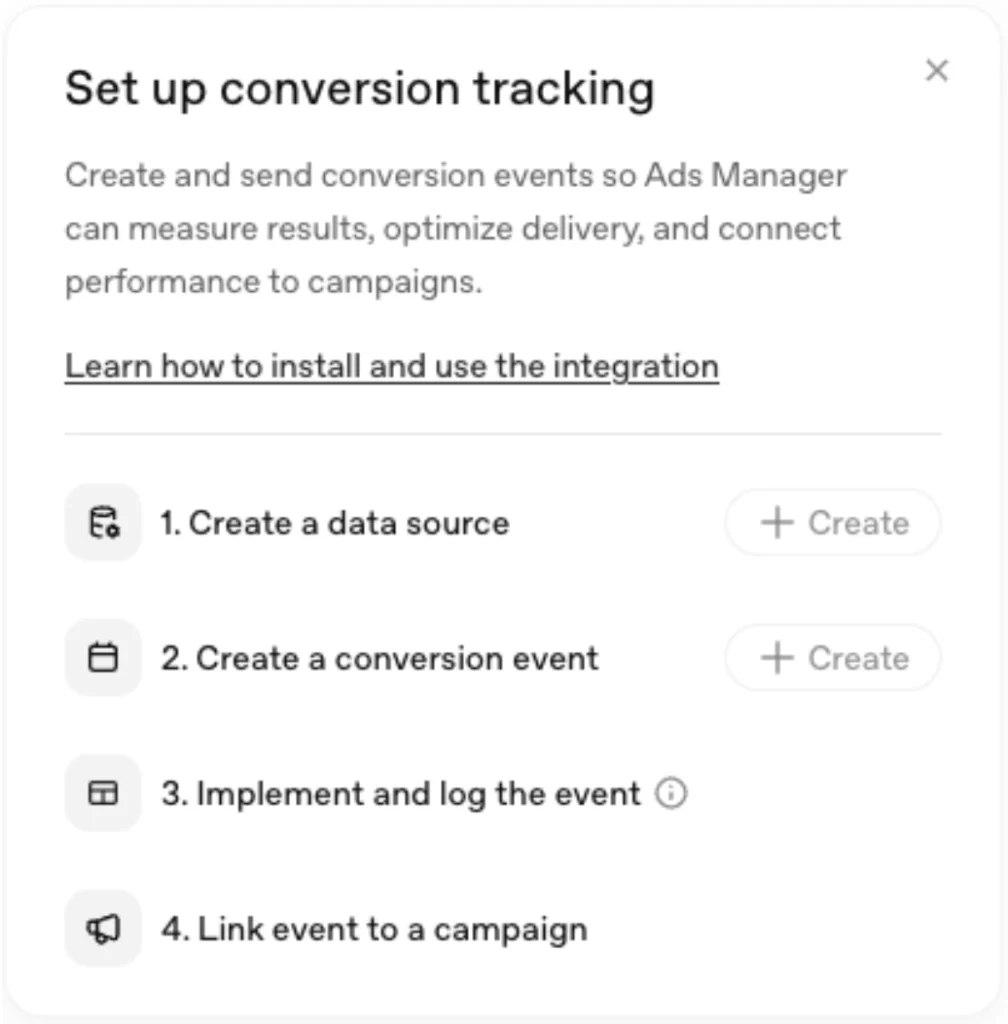
- Conversions: The most advanced tier, requiring the setup of conversion events via a tracking pixel or API integration.
A unique deviation from other platforms is the placement of Location Settings at the campaign level rather than the ad group level. Currently, OpenAI supports seven major geographical hubs, including the US, UK, Japan, South Korea, Australia, and New Zealand.

The Ad Group and Bidding Logic
Within the Ad Group, the bidding process provides immediate feedback—a feature highly praised by early adopters. When setting a bid (CPM, CPC, or CPA), the interface provides a "Delivery Indicator":
- Strong Delivery: Indicates a competitive bid likely to win auctions in the current market.
- May Not Deliver: A warning that the bid is too low to compete for high-quality conversational slots.
Context Hints: The End of Exact-Match?
Perhaps the most innovative feature is "Context Hints." Unlike traditional search ads that rely on exact-match keywords, Context Hints allow advertisers to describe the topics or types of conversations where their product is relevant. The LLM then uses semantic understanding to place the ad. For example, a brand selling "sustainable travel gear" might provide hints about "eco-tourism," "packing lists," or "European hiking," and the ad could appear when a user asks ChatGPT to "Plan a low-carbon trip to the Alps."
Official Responses and Market Sentiment
OpenAI has maintained a stance that user experience remains the primary priority. In internal briefings, company representatives have emphasized that ads are designed to be "additive rather than disruptive."

"The goal is not to interrupt the conversation, but to provide the next logical step for the user," an OpenAI product lead stated during the US launch. "If a user is asking how to bake a sourdough bread, a sponsored link to a high-quality proofing basket is a utility, not an intrusion."
Industry experts, however, are more focused on the competitive implications. Media analysts at major agencies suggest that OpenAI’s entry into advertising is a "defensive necessity" to offset the massive compute costs associated with running GPT-5 and beyond.
"We are seeing a migration of budget from Google Search to OpenAI," says Sarah Jenkins, a senior media buyer. "The intent in a ChatGPT session is often ‘higher’ than a search query because the user is already in a deep state of inquiry. They aren’t just looking for a link; they are looking for a solution."

Implications: The Future of the "Answer Engine"
The transition of ChatGPT into an ad-supported platform has profound implications for the future of the internet and brand-consumer relationships.
1. The Erosion of the Search-Click Model
For decades, the "Search-Click-Purchase" funnel has dominated. In the conversational model, the "Answer" is provided first. This means ads must now act as the "Fulfillment" of that answer. Brands that fail to provide a seamless transition from an AI’s advice to a physical product will likely see lower conversion rates.
2. The Rise of Third-Party Intelligence Tools
Because OpenAI does not yet have a public "Ad Library" (similar to Meta’s), a new secondary market for competitive intelligence has emerged. Tools like Trendos have become essential for brands to track their competitors’ "Impression Share" and creative strategies. The ability to see which prompts are triggering a competitor’s ad has become the new "SEO" for the AI era.

3. Account Hygiene and Automation
The inclusion of API keys within the Ads Manager signals OpenAI’s intention to allow full automation. Advertisers are already using these keys to connect their own LLM-driven tools to the manager, enabling the auto-generation of ad copy and real-time bid adjustments based on performance data.
4. Privacy and Ethics in Conversational Targeting
As ads become more integrated into personal conversations, the ethical boundaries of targeting will be tested. While OpenAI insists that personal data is anonymized before being used for ad matching, the "Context Hints" system inherently relies on the content of a user’s private dialogue. This will likely remain a point of contention for regulators in the UK and EU as the platform continues to scale.
Final Thoughts
The rapid ascent of OpenAI’s advertising platform—highlighted by the 315% surge in brand participation this summer—proves that the market was hungry for an alternative to traditional search. As ChatGPT continues to evolve into a "trusted source" for millions, the brands that master the art of conversational placement will be the ones that define the next decade of digital commerce.

The challenge for marketers is no longer just about being "seen"—it is about being a relevant part of the "answer." In 2026, the brands that succeed will be those that treat ChatGPT not as a billboard, but as a bridge to a more intelligent form of consumer engagement.