The global race to transition toward renewable energy is hitting a structural bottleneck. As countries and corporations scramble to deploy massive solar arrays to meet net-zero climate goals and ensure energy independence, the construction industry faces a daunting reality: there simply aren’t enough workers to install the hardware required. While the demand for solar infrastructure is skyrocketing, the manual labor force required to build it is shrinking, leaving developers scrambling to fill positions in remote, physically demanding, and often dangerous work environments.
Enter Gritt, a startup founded by Carnegie Mellon-trained roboticists Puneet Puri and Vishal Dugar. By leveraging the latest breakthroughs in artificial intelligence, Gritt is attempting to solve the labor crisis by turning industrial machinery into autonomous, "intelligent" construction workers. With a fresh $26 million in Series A funding, the company is positioning itself as the critical layer of "physical AI" required to modernize the construction site and accelerate the transition to green energy.
The Convergence of AI and Infrastructure
For decades, the promise of industrial robotics in unstructured environments—like a dusty, uneven, and unpredictable construction site—remained largely unfulfilled. Traditional robots were built for the "structured" precision of a factory floor, where every bolt and beam is positioned with mathematical certainty. Outdoors, however, variables like wind, rain, mud, and uneven terrain rendered these machines largely ineffective.
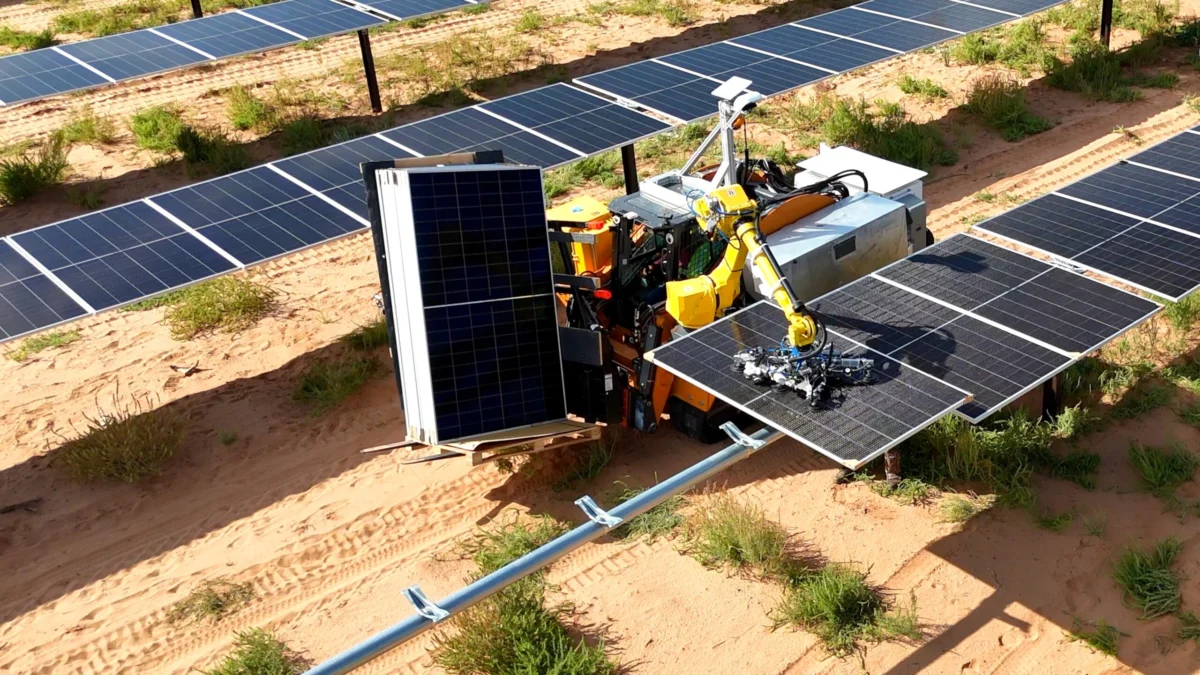
The recent explosion in generative AI and foundation models has changed that paradigm. Gritt’s approach is not to build a new robot from the ground up, but to build a universal "brain" that can be retrofitted onto existing, off-the-shelf industrial equipment. By utilizing rented skidders and robotic arms from manufacturers like Kawasaki, Gritt creates platforms governed by its proprietary AI models. This strategy allows the company to focus entirely on the software intelligence required to navigate the chaos of a job site, rather than the capital-intensive process of hardware manufacturing.
Chronology: From Stealth to Scale
The trajectory of Gritt reflects the rapid maturation of the robotics sector. Founded by Puri and Dugar—alumni of Carnegie Mellon’s prestigious robotics program—the company initially operated in stealth mode, quietly perfecting its vision-based navigation and manipulation systems.
- The Seed Phase: Early development was bolstered by a seed round featuring participation from First Round Capital, Climactic, Congruent Ventures, and VSC Ventures. This funding allowed the founders to transition from lab-based proof-of-concept to real-world field deployment.
- Exiting Stealth: On Tuesday, the company officially stepped into the spotlight, announcing a $26 million Series A round led by Obvious Ventures, with support from Union Square Ventures and Active Impact Investment. This brought the company’s total capitalization to $34 million.
- Current Deployments: The company currently has two operational systems in the field. These units are not merely performing tasks; they are continuously harvesting data to refine their behavioral models.
- The Roadmap: With confirmed contracts to assist in the installation of 2.8 gigawatts of solar capacity over the next 18 months, Gritt is moving from the pilot stage to industrial-scale implementation. The company aims to have 48 of its robotic systems deployed within the next six months.
Data-Driven Efficiency: Quantifying the Impact
The core value proposition of Gritt lies in its ability to amplify the productivity of human crews. In current industry standards, an eight-person team is typically capable of installing approximately 800 solar panels in a single workday. By integrating Gritt’s robotic systems, the same crew—repurposed to focus on higher-level tasks—can handle between 3,000 and 4,000 panels daily.
This represents a nearly 400% increase in productivity. The system excels at the "dull, dirty, and dangerous" aspects of the job: unloading massive glass solar panels, transporting them across rough terrain, and positioning them on mounting frames with sub-millimeter precision. This level of accuracy allows human workers to step in only for the final fastening, significantly reducing the physical strain on the crew.
Official Perspectives: The "Special Kind of Entrepreneur"
The investment community has taken note of Gritt’s unique positioning. Andrew Beebe, a partner at Obvious Ventures who led the Series A round, notes that the company’s founders distinguish themselves by their pragmatic approach to heavy industry.
"There are people who used to build rockets that went into space and had infinite budgets for the smallest little part, and then there are people who know what it means to get into dirty, dull, and dangerous jobs and scale them like mad," Beebe said. "These guys are in the second camp, and that’s a special kind of entrepreneur that has the technical chops, the AI, and the machine vision skills to make it work."
For the customers—the power construction companies—the value is not just in speed, but in safety and logistics. One customer, speaking on the condition of anonymity due to competitive sensitivities, emphasized the system’s role in remote site management. Attracting human labor to remote, sun-baked construction sites is a chronic difficulty for developers. Furthermore, by automating the lifting of 100-pound panels, the system drastically lowers the risk of workplace injuries, a major liability and cost factor in large-scale construction.
Competitive Landscape and Strategic Differentiation
Gritt is not alone in the pursuit of automated solar construction. Competitors such as Luminous Robotics, Cosmic, and China’s Trinabot are also developing hardware-heavy solutions for the sector. However, Gritt’s "software-first" philosophy serves as its primary differentiator.
By relying on off-the-shelf hardware, Gritt avoids the massive overheads associated with bespoke robot manufacturing. This "asset-light" approach to the robot itself may allow Gritt to scale faster and maintain more favorable margins. As the global demand for solar grows, the ability to rapidly deploy a standardized software layer across existing machinery may prove to be the decisive competitive advantage.
Implications for the Future of Construction
The vision for Gritt extends far beyond simply placing solar panels. The founders are already working on expanding the system’s repertoire. The goal is for Gritt’s robots to eventually handle the entire construction lifecycle, from drilling the foundational posts to installing the racking systems and even performing complex tasks like tying rebar.
The Rise of Generalizable AI
The shift from "task-specific" to "generalizable" AI is the catalyst for this expansion. Five years ago, training a robot to perform a new, complex task on a job site was a project that could take months or years. Today, because the underlying software architecture is transferable, a system trained to stack cinder blocks can be repurposed to tie rebar in a fraction of the time.
"Making a system for one solution was still possible to some extent five years ago," Puri explained. "But AI is now making that work generalizable—the same underlying pipeline can be reused and improve across tasks."
The "Layer of Physical AI"
Looking toward the long term, Gritt’s founders see their systems serving as the digital nervous system of the construction site. By equipping their robots with advanced sensor arrays, they intend to turn the machines into management tools. Imagine a robot that notices a trench has been left open in anticipation of a storm; it could alert the project manager to cover the area before water damage ruins expensive components. Similarly, the system could provide real-time inventory management, flagging missing or misplaced parts before they delay a project.
"Gritt becomes this layer of physical AI, which is doing this dextrous, labor-intensive task, plus it can help you take decisions on the site," Puri said.
In this vision, the construction site of the future is not a place defined by sheer brute force, but by a collaborative ecosystem where humans and machines work in concert. As Gritt prepares to scale its operations to 48 units and beyond, the company is not just installing solar panels; it is laying the groundwork for a new era of industrial productivity, proving that when AI meets the physical world, the pace of human civilization’s progress can be significantly accelerated.