LONDON — The digital advertising industry has reached a critical inflection point where the traditional battle for consumer attention is being superseded by a more technical struggle: the battle for algorithmic trust. According to the newly released State of PPC 2026 global report, a staggering 54% of performance marketing professionals identify data errors and missing product information as their primary hurdle in feed management.
This figure represents a persistent stagnation in operational efficiency that has plagued the industry for years. However, as the industry moves further into 2026, experts suggest the stakes have changed. What was once a routine maintenance task has evolved into the foundational pillar of "Agentic Commerce"—a world where AI agents, rather than human shoppers, are the primary gatekeepers of product discovery.
Main Facts: The Crisis of the Product Feed
The State of PPC 2026 report, which surveyed 1,306 industry professionals, highlights a growing disconnect between brand ambitions and technical reality. While marketers are eager to leverage cutting-edge AI tools like Google’s Gemini and Perplexity, more than half are failing at the most basic level of execution: maintaining an accurate and complete product feed.
The report identifies three core shifts defining the current landscape:
- The B2R Pivot: Marketing is no longer just Business-to-Consumer (B2C); it is now Business-to-Robot (B2R). Success depends on a machine’s ability to parse, trust, and surface product data.
- Regulatory Volatility: New global mandates, particularly within the European Union, have transformed product feeds from marketing assets into compliance documents.
- The Complexity Trap: The rapid diversification of channels—from Amazon and TikTok Shop to specialized AI search engines—has created an "operational discipline" gap that most brands are failing to bridge.
As brands move into the second half of the decade, the "creative problem" of advertising—copywriting and imagery—is being overshadowed by a "data infrastructure problem." Without a robust technical foundation, even the most inspired creative campaigns are failing to reach their intended audiences.
Chronology: From Simple Listings to Agentic Commerce
To understand the current crisis, one must look at the evolution of product data over the last decade.
2014–2019: The Era of Manual Optimization
In the mid-2010s, feed management was largely a secondary concern. Marketers focused on manual bidding and keyword harvesting. Product feeds were static files, often updated weekly or monthly, containing basic information like price, title, and a single image.
2020–2023: The Rise of Automation and P-Max
The introduction of Google’s Performance Max (P-Max) and similar black-box automated systems shifted the focus. Algorithms began taking over the "how" of bidding, placing a higher premium on the "what"—the data provided in the feed. Brands that failed to update their feeds in real-time began to see significant performance degradation as automated systems optimized for the wrong signals.

2024–2025: The Regulatory and AI Convergence
The last 24 months have seen a dual-pronged assault on feed stability. First, regulatory bodies introduced mandatory fields for product safety and compliance. Second, the "AI Search" revolution began. Tools like Perplexity and Google’s Search Generative Experience (SGE) started pulling data directly from Merchant Centers to answer complex user queries.
2026: The Dawn of Agentic Commerce
We have now entered the age of "Agentic Commerce," where AI agents act on behalf of consumers to find, compare, and eventually purchase products. These agents do not respond to emotional narratives; they respond to attribute completeness. A missing "material type" or "battery life" attribute is no longer just a minor omission—it is an invisibility cloak that hides the product from the AI-driven economy.
Supporting Data: The High Cost of "Good Enough"
The State of PPC 2026 report provides a sobering look at why 54% of professionals are struggling. The data suggests that the "moving goalposts" of channel requirements are the primary culprit.
- Platform Volatility: Amazon, for instance, frequently updates its attribute requirements, sometimes adding as many as five mandatory fields in a single month. For a brand managing 10,000 SKUs, this represents 50,000 new data points that must be sourced and verified almost overnight.
- The Compliance Burden: In Europe, the introduction of mandatory product safety documentation and compliance links has rendered thousands of previously "perfect" feeds non-compliant. Failure to meet these technical requirements results in immediate product suppression, leading to catastrophic revenue loss for unoptimized brands.
- The AI Advantage: Early data indicates that brands utilizing Google’s new "Conversational Attributes"—which include Q&A fields and document links—see a 15-20% higher visibility rate in AI-generated search results compared to those using standard legacy feeds.
The report also underscores a critical tactical error: treating all channels as interchangeable. A title optimized for Google Shopping (which prioritizes keywords) often fails on Amazon (which prioritizes brand and specific model numbers) or on AI platforms (which prioritize descriptive, natural language).
Official Responses: Insights from the Front Lines
Industry leaders and feed management veterans argue that the current struggle is not a lack of technology, but a lack of operational philosophy.
"The channels keep moving, and brands are trying to chase them with outdated maps," says one industry expert who has overseen feed infrastructure for over 17,000 brands. "The signals that determine whether a product surfaces in Gemini or Perplexity are technical, not creative. Attribute completeness, consistency, and accuracy are the new KPIs."
Google has indirectly addressed these challenges through the rollout of "Conversational Attributes" for Merchant Center. By introducing fields such as "Popularity Rank" and "Document Link," Google is signaling a move toward a more "literate" feed—one that provides the AI with enough context to answer nuanced consumer questions.
Retailers who have successfully navigated this shift emphasize a "Foundation First" approach. A spokesperson for Deiters, a major German retailer, noted that their success came from moving away from a "fix everything at once" mentality. By focusing on a hierarchy of requirements—prioritizing mandatory fields over optional optimizations—they were able to achieve a 100% eligibility rate for their product catalog.

Implications: The "Hero and Underperformer" Framework
The shift to B2R requires a radical restructuring of how marketing budgets are allocated. The State of PPC 2026 report suggests a move toward performance segmentation based on a "Hero and Underperformer" framework.
The Segmentation Strategy
Brands are encouraged to view their catalogs through the dual lenses of clicks and revenue:
- Heroes: Products with high clicks and high revenue. These require continuous refinement to maintain their lead.
- Underperformers: Products with high clicks but low conversion. This is the "gold mine" of feed optimization. High clicks indicate a demand signal, while low conversion suggests a data failure—perhaps a misleading title, a missing attribute, or a price mismatch that erodes trust at the point of sale.
The Deiters Case Study
The impact of this framework is not merely theoretical. When Deiters applied performance segmentation during the peak carnival season, they identified over 4,000 products that were receiving zero impressions despite having market potential. By restructuring their campaigns around these data-driven segments and fixing specific feed errors for "Underperformers," the retailer generated over €500,000 in additional revenue. Crucially, they reduced the number of "invisible" products from 4,000 to just 500, all while maintaining their target Return on Ad Spend (ROAS).
The Future of B2R
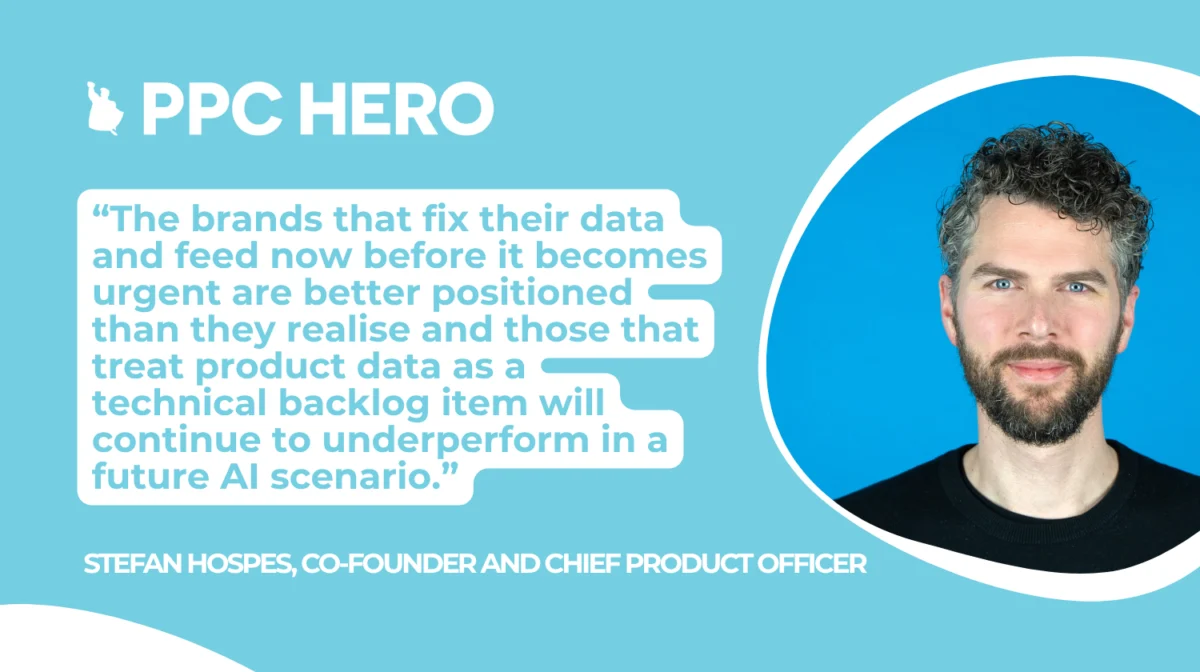
The ultimate implication of the 2026 report is that feed quality has moved from the "technical backlog" to the "strategic boardroom." In the age of AI, a well-known brand with a thin, inconsistent feed can easily be outranked by a smaller, more agile competitor whose data is precise and complete.
As AI systems become more sophisticated, they will increasingly prioritize products that "answer questions" rather than those that simply "occupy listings." A product titled "Blue Running Shoe" will lose to a product described as "Lightweight trail running shoe, recommended for marathon training, high-arch support, waterproof, 280g."
Final Thoughts: The Race Has Already Started
For the 54% of professionals still wrestling with basic data errors, the window of opportunity is closing. The State of PPC 2026 report serves as a final warning: the machine is already watching.
While the volume of transactions currently fully managed by AI agents remains a minority, the infrastructure for the next decade of commerce is being built today. Brands that treat product data as a maintenance chore are ceding ground in a race they may not even realize has begun. To survive the B2R era, companies must pivot their focus from convincing the consumer to informing the algorithm. The message is clear: fix the feed, or risk becoming invisible in the age of the robot.