In the high-stakes arena of digital advertising, where every click carries a literal price tag, a silent crisis is unfolding. While marketing departments pour billions into granular keyword targeting and sophisticated AI-driven bidding strategies, a significant portion of that investment is evaporating the moment a user arrives at the destination. The culprit is not the ad itself, but the "leaky bucket" of the generic landing page.
Industry data suggests that while the average conversion rate across all industries sits at roughly 2.35%, the top 10% of advertisers are seeing conversion rates five times higher. The differentiator is rarely the budget; it is the architectural alignment between search intent and the post-click experience.
Main Facts: The Disconnect Between Ad Spend and User Experience
The fundamental logic of Pay-Per-Click (PPC) advertising is relevance. However, a persistent gap remains between what a user expects and what a business delivers. When a user executes a specific search, they are effectively asking a question. If the landing page provides a broad, generic overview rather than a direct answer, the "Message Match" is broken, and the user exits.
Current market analysis reveals several core truths regarding the modern PPC landscape:
- The Specificity Mandate: As Google and Bing’s algorithms become more adept at understanding user intent, the penalty for "broad-brush" landing pages has increased. High bounce rates on landing pages directly negatively impact Quality Scores, which in turn raises the Cost Per Click (CPC).
- The Intent-Experience Gap: Most failed campaigns rely on a single "Master Page"—often a homepage or a standard service page—to serve multiple audiences. This forces the user to do the heavy lifting of navigating and filtering information, leading to "cognitive friction."
- Trust as a Currency: In an era of digital skepticism, the speed with which a page validates a user’s choice to click determines the likelihood of conversion. A mismatch between an ad’s promise (e.g., a 20% discount) and the landing page content (e.g., a generic "About Us" section) destroys brand trust within seconds.
Chronology: The Evolution of the Post-Click Experience
To understand the current necessity for hyper-specific landing pages, one must look at the trajectory of search engine marketing over the last two decades.
The Era of the Homepage (2000–2010)
In the early days of AdWords, the digital landscape was less crowded. Businesses often directed all paid traffic to their homepage. The goal was simply "traffic." However, as the volume of web content exploded, users became less patient, and the "three-click rule" became the standard for UX design.
The Rise of the "Squeeze Page" (2010–2018)
As competition increased, marketers moved toward dedicated landing pages designed for lead capture. These were often aggressive, high-pressure pages with limited navigation. While they improved conversion rates for transactional searches, they often failed to address the nuanced needs of researchers or B2B buyers who required more information before committing.
The Era of Intent-Based Personalization (2019–Present)
Today, the industry has entered a phase of "Intent-Based Personalization." With the rollout of Google’s BERT and subsequent AI updates, the search engine now understands the context of a query better than ever. This has forced advertisers to move away from keyword-stuffing and toward creating ecosystem-driven landing pages that mirror the user’s specific stage in the buying journey.
Deep Dive: Shaping Landing Pages via the Intent Spectrum
Expert practitioners now categorize search intent into three distinct pillars. Failing to distinguish between these when designing a landing page is the primary reason PPC budgets underperform.

1. Transactional Intent: The "Buy Now" Phase
These users have finished their research and are ready to execute. They search for terms like "buy vegan meal kit" or "emergency plumber near me."
- The Strategy: The landing page must be stripped of distractions. The Value Proposition should be the headline, followed immediately by a clear, low-friction Call to Action (CTA).
- Key Elements: One-click checkouts, visible pricing, limited-time offers, and "Trust Signals" like security badges.
2. Commercial Investigation: The "Compare" Phase
These users are narrowing down their options. They search for "best CRM for recruitment" or "SaaS vs. On-premise solutions."
- The Strategy: These users are risk-averse. The landing page should act as a comparative guide. It must provide the "proof" that the product is the right fit for their specific niche.
- Key Elements: Comparison tables, industry-specific case studies, third-party reviews (G2, Trustpilot), and detailed feature breakdowns.
3. Informational Intent: The "Research" Phase
These users are at the "Top of the Funnel" (TOFU). They are looking for solutions to a problem they may have just identified. Searches include "how to improve employee retention" or "benefits of solar energy."
- The Strategy: Hard-selling at this stage is a conversion killer. Instead, the landing page should focus on education and "lead magnets"—offering value in exchange for an email address to nurture the lead over time.
- Key Elements: Whitepapers, webinars, calculators, and educational blog content.
Supporting Data: The Technical Indicators of Success
To move beyond assumptions, high-performing marketing teams rely on quantitative data to refine their landing page strategy. Two tools have become the industry standard for this diagnostic work: Google Analytics 4 (GA4) and Microsoft Clarity.
GA4: The "What" and the "Where"
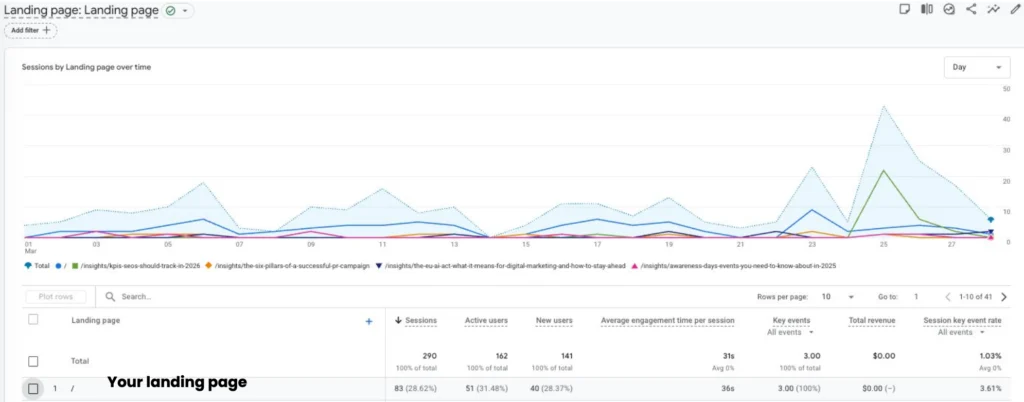
GA4 allows marketers to track "Engagement Rate" rather than just the traditional (and often misleading) "Bounce Rate." By analyzing the "Landing Page" report, advertisers can identify which specific URLs are failing to hold the user’s attention. If a page has a high traffic volume but a low "Average Engagement Time," it is a statistical red flag that the content does not match the ad’s promise.
Microsoft Clarity: The "Why"
While GA4 provides the numbers, behavioral tools like Microsoft Clarity provide the narrative. Through session recordings and heatmaps, marketers can witness:
- Rage Clicks: Users clicking repeatedly on an unlinked element, indicating a UX flaw.
- Dead Clicks: Clicks that result in no action, suggesting the user is confused by the interface.
- Excessive Scrolling: A sign that the user is hunting for information that should have been "above the fold."
Recent studies from UX institutes show that simplifying a landing page by removing a single unnecessary form field can increase conversion rates by up to 11%. Similarly, improving page load time by just one second can result in a 7% increase in conversions.
Official Responses and Expert Perspectives: Reducing Cognitive Load
Digital marketing strategists and UX researchers emphasize that the human brain can only process a limited amount of information at once. This is known as "Cognitive Load."
"The moment a user lands on a page, a countdown begins," says Sarah Jenkins, a Senior UX Consultant. "If they have to spend more than three seconds figuring out if they are in the right place, you’ve already lost them. We see a direct correlation between ‘visual clutter’ and high bounce rates in PPC. The most successful landing pages are those that anticipate the user’s next question and answer it before it’s even asked."

Furthermore, industry leaders from major PPC agencies suggest that the "Master Page" approach is essentially dead. "We are now building ‘Landing Page Clusters,’" notes one agency head. "If we have a client in the recruitment space, we don’t send all traffic to one page. We have a ‘Pricing’ page for transactional intent, a ‘Recruitment vs. HR’ comparison page for commercial intent, and an ‘E-book on Hiring Trends’ for informational intent. It’s more work to build, but the ROI is night and day."
Implications: The Long-Term Impact on ROAS and Brand Equity
The move toward hyper-specific landing pages has profound implications for the future of digital advertising.
1. Improved Quality Score and Lower Costs
Search engines reward relevance. A highly relevant landing page improves the ad’s Quality Score, which reduces the minimum bid required to maintain a top position. Over time, this creates a "virtuous cycle" where the most relevant advertisers pay the least for the best traffic.
2. Enhanced Customer Lifetime Value (CLV)
When a user has a seamless first experience with a brand—finding exactly what they need without friction—the foundation for long-term loyalty is laid. Conversely, a frustrating first click makes it unlikely the user will ever return, even through organic channels.
3. The Death of the "One-Size-Fits-All" Website
This shift signals a move toward "headless" or modular web design, where landing pages are treated as dynamic assets rather than static parts of a website hierarchy. Businesses that embrace this agility will be able to pivot their messaging in real-time based on market trends and search behavior.
Final Thoughts: A Checklist for PPC Success
To stop the quiet collapse of PPC campaigns, businesses must transition from a traffic-focused mindset to an intent-focused one. The path forward involves:
- Auditing the Journey: Does the headline of your landing page repeat the promise of your ad?
- Segmenting by Intent: Do you have separate pages for those researching, those comparing, and those buying?
- Continuous Optimization: Are you using heatmaps and session recordings to identify and remove friction points?
In the modern digital economy, the landing page is no longer just a destination; it is the most critical inflection point in the customer journey. Those who treat it with the same level of sophistication as their ad targeting will find that conversions are not disappearing—they are simply moving to the competitors who made the experience easier.