
The digital commerce landscape is currently undergoing a period of rapid, tech-driven transformation. As merchants face tightening margins, evolving consumer expectations, and the necessity for cross-border scalability, a new wave of service providers has emerged to address these pain points. This week’s roundup of industry updates highlights a significant shift toward AI-integrated workflows, omnichannel expansion, and specialized logistics.
From AI-powered video production to sophisticated tax-compliance integrations and the democratization of educational resources, the following report details the latest advancements reshaping the e-commerce ecosystem.
I. Main Facts: The New Tools for Merchants
The recent influx of service releases centers on four primary pillars: Content Creation, Payment Flexibility, Operational Efficiency, and Data Governance.
AI-Driven Content Transformation
Content production has become a bottleneck for many brands. Two key players have stepped in to alleviate these costs:

- PixPix has unveiled an AI-powered video editing feature designed to replicate camera styles, pacing, and visual atmosphere from existing high-performing videos. By allowing brands to swap products into established creative templates, they are effectively lowering the barrier to high-quality campaign testing.
- Vmake Labs has taken a different approach with their "Brainrot Marketing" styles. Targeting the viral nature of social media, their tool allows merchants to convert static product images into fast-paced, surreal, and high-energy videos in seconds, catering to the short-form content preferences of younger demographics.
Payment and Tax-Free Integration
Global expansion remains a priority for mid-market and enterprise retailers.
- Shift4 has launched "One," a hardware-software hybrid that integrates point-of-sale (POS) payments with currency conversion and tax-free shopping. By partnering with Global Blue, Shift4 is addressing the friction points of cross-border retail directly at the register.
- Payfuture has solidified its footprint in the Indian market by integrating with Shopify, enabling merchants to process payments through local favorites like the Unified Payments Interface (UPI) and NetBanking.
- Kintsugi has integrated with Shopline to automate the complex web of global sales tax, VAT, and GST compliance, providing real-time nexus monitoring and automated filing.
Operational and Strategic Scaling
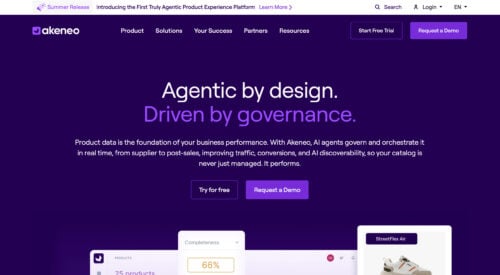
- Akeneo is moving beyond standard product information management (PIM) with the launch of "Agentic Ziggy." This platform utilizes AI agents to govern and orchestrate product data across its entire lifecycle, marking a shift toward "agentic" commerce.
- Eaton Hudson has introduced a dedicated E-Commerce Liquidation Division, providing a vital exit strategy for brands struggling with excess inventory or distressed merchandise.
II. Chronology: A Week of Strategic Rollouts
The following timeline highlights the rapid-fire succession of product launches observed this week:
- July 7: Payfuture announces its integration with Shopify in India, targeting local payment adoption.
- July 8: Robust AI and ShipLab initiate their "crawl-walk-run" automation model at a California facility, deploying mobile robots for tote transport.
- July 10: Vmake Labs introduces "Brainrot Marketing" to help small businesses leverage viral video trends.
- July 14: Shift4 and Global Blue launch the "One" payment platform across key European markets, including Germany and Spain.
- Throughout the Week: Major platform updates were released by Klaviyo (social marketing integration), MyCommunityToday (Deal Chief AI agent), and Amazon (opening Seller University to the public).
III. Supporting Data and Market Context
The intensity of these releases reflects broader macroeconomic trends in the e-commerce sector. According to industry analysts, the investment landscape for "recommerce" and AI tooling remains robust.
Fleek’s recent $25 million funding round—backed by major players like eBay and Burda Principal Investments—underscores the sustained interest in secondhand fashion. By utilizing their "Sort" model, which is trained on millions of historical transactions, Fleek demonstrates that AI is no longer just a marketing buzzword but a core operational requirement for scaling circular economy business models.

Furthermore, the partnership between Wix and Elavon signals a trend toward "Unified Commerce." Small businesses are increasingly moving away from fragmented tech stacks, preferring integrated suites that manage inventory, payments, and real-time analytics in a single dashboard.
IV. Official Responses and Industry Sentiment
The transition toward "agentic" and automated systems has been met with enthusiasm from merchant groups.
Regarding the new Akeneo platform, product data teams have noted that manual schema mapping and enrichment have long been a drain on resources. By automating the governance of product life cycles, Akeneo aims to reduce the "data debt" that often plagues large-scale retailers.
In the warehouse space, the collaboration between Robust AI and ShipLab serves as a case study for the "robots-as-a-service" model. ShipLab’s leadership noted that the initial deployment of tote-transport robots is merely the first phase. The goal is a fully automated picking operation that can compete with the logistics speeds of major global marketplaces.

Meanwhile, the opening of Amazon’s Seller University to the general public—regardless of whether they have a selling account—is being viewed as a significant branding move. By lowering the barrier to educational resources, Amazon is positioning itself as the definitive authority on commerce education, effectively creating a funnel for future sellers.
V. Implications: What This Means for Merchants
For the modern merchant, these updates carry several critical implications:
1. The Death of Generic Content
With tools like PixPix and Vmake Labs, the baseline for "professional" video content has shifted. Merchants who rely on static images will likely find themselves at a disadvantage. The new standard requires high-frequency, platform-native video content that is both affordable and rapid to produce.
2. Payments as a Growth Engine
The Shift4 and Payfuture announcements highlight that payments are no longer just a backend utility; they are a conversion optimization tool. Providing localized payment methods (like UPI in India or tax-free shopping in Europe) is now essential for conversion, rather than an optional luxury.

3. CRM Goes Omnichannel
Klaviyo’s latest move to integrate social media engagement into its CRM tool proves that first-party data is the ultimate currency. Merchants must move away from "siloed" social media metrics and toward a strategy where every comment, like, and share is used to enrich customer profiles for better email and SMS targeting.
4. The Rise of the "Agentic" Workflow
We are entering an era where software does not just store data; it makes decisions. Whether it is Kintsugi handling tax nexus monitoring or Akeneo’s AI agents orchestrating product data, the role of the merchant is shifting from manual data entry to "agent management."
5. Localized Intelligence
The launch of Deal Chief by MyCommunityToday illustrates that AI is not just for global conglomerates. Local neighborhood businesses are now gaining access to AI-powered sales agents that can generate leads and manage coupons, leveling the playing field against larger regional competitors.
Conclusion
As we look toward the second half of the year, the common denominator across all these updates is speed. Whether through automated robots in the warehouse, AI-generated marketing videos, or automated tax filing, the services launching this week are all designed to remove friction from the merchant’s path. For businesses that can successfully integrate these tools into their existing workflows, the coming months offer significant opportunities for scaling efficiency and enhancing the customer experience.
If your company has an e-commerce product release, please contact our editorial team at [email protected] to be considered for our next industry roundup.