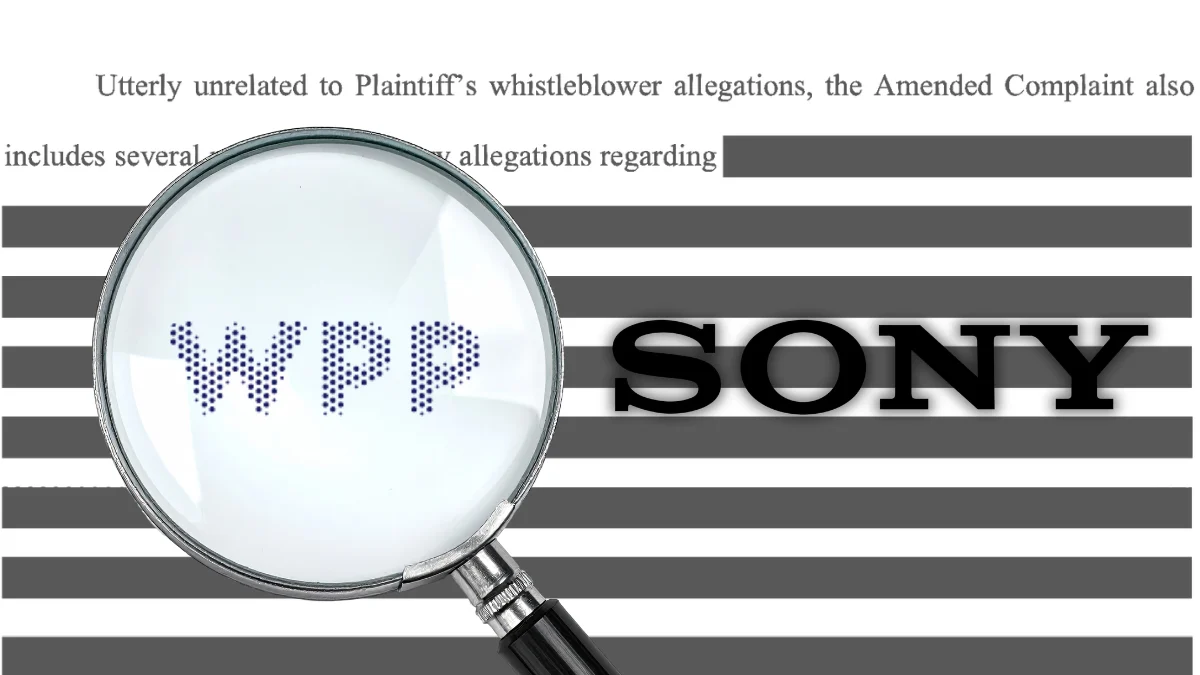
NEW YORK — The high-stakes legal battle between advertising giant WPP and a former senior executive has taken a dramatic turn. Newly unsealed court documents filed Thursday morning indicate that entertainment conglomerate Sony voluntarily provided information to the defense concerning its own independent investigation into WPP’s business practices.
The development adds significant weight to the ongoing wrongful termination and whistleblower lawsuit brought by Richard Foster, the former CEO of GroupM’s Motion Entertainment. Foster’s legal team claims that Sony’s internal findings corroborate allegations that WPP engaged in a widespread, global illegal rebate scheme—a practice that Foster asserts cost him his career after he attempted to expose it internally.
The case, which sits at the intersection of corporate governance, media buying practices, and whistleblower protection, continues to send shockwaves through the advertising and holding company landscape.
Main Facts of the Case
At the core of the litigation is a high-level corporate clash over transparency, financial practices, and executive retaliation.
Richard Foster filed his initial lawsuit against WPP in October 2025. In the original complaint, Foster alleged that he was systematically marginalized, retaliated against, and ultimately terminated by WPP executives after raising persistent red flags regarding the holding company’s financial dealings—specifically, what he characterized as a sophisticated, global illegal rebate scheme.
Rebates in the media buying industry typically refer to financial incentives, cash back, or volume discounts provided by media owners (such as TV networks, digital publishers, and production companies) to media agencies or holding companies based on the volume of ad spend they direct. While some forms of agency compensation and discounting are standard market practice, the legality hinges heavily on transparency, client consent, and whether these funds are rightfully passed back to advertisers or retained by the holding company without disclosure.
Foster’s lawsuit contends that WPP utilized opaque mechanisms to obscure these financial flows, sidestepping ethical guidelines and potentially violating federal and state laws. According to the plaintiff, his attempts to bring these issues to the attention of senior leadership were met with hostility, culminating in his dismissal.
The landscape of the lawsuit shifted radically on August 13, when Foster’s legal team filed an amended complaint. This updated filing introduced explosive new elements: internal documents and findings originating from a separate, independent investigation conducted by Sony. According to Thursday’s newly revealed documents, Sony’s investigation was not merely accessed via third-party discovery subpoenas; rather, the entertainment giant voluntarily shared information with the defense regarding its own inquiry into WPP’s commercial practices.
If proven, the involvement of a major media partner like Sony corroborating whistleblower claims introduces a formidable third-party validation that could fundamentally alter the trajectory of the defense and plaintiff arguments alike.
Chronology of Events
To understand the gravity of the current legal maneuverings, it is necessary to trace the timeline of events leading up to the recent document disclosures:
- The Internal Warnings (Pre-2025): Throughout his tenure as CEO of GroupM’s Motion Entertainment, Richard Foster reportedly flags multiple instances of what he perceives to be illicit rebate practices within WPP’s operational structure. He submits internal whistleblower reports to senior management and compliance officers.
- The Termination (2025): Citing irreconcilable differences or restructuring, WPP parts ways with Foster, removing him from his executive post at Motion Entertainment. Foster contends his exit was a direct act of retaliation for his whistleblowing activities.
- Initial Lawsuit Filed (October 2025): Foster officially files a wrongful termination and whistleblower retaliation lawsuit against WPP in court, publicly detailing allegations of a global illegal rebate scheme orchestrated within the holding company. WPP denies the allegations, defending its corporate governance and integrity.
- Sony’s Independent Investigation (Mid-2025): Concurrently, Sony—a major client and business partner interacting with WPP’s media-buying apparatus—initiates its own internal compliance and business practices investigation concerning commercial dealings with the holding company.
- The Amended Complaint (August 13, 2025/2026 cycle): Foster’s legal team files an amended complaint incorporating documents and findings from Sony’s internal probe. The plaintiff’s attorneys assert that Sony’s findings directly corroborate Foster’s years of internal warnings.
- Thursday Morning Filings: A fresh batch of court documents is made public, revealing that Sony voluntarily supplied information to the defense regarding its investigative findings, further entangling external corporate entities in the bitter employment dispute.
Supporting Data and Industry Context
The allegations leveled against WPP strike at the heart of modern media holding company economics. For decades, agency holding companies have operated under complex business models where buying power, negotiations, and volume commitments dictate profitability.
While holding companies have increasingly emphasized transparency in the wake of previous industry-wide probes—most notably the Association of National Advertisers’ (ANA) landmark 2016 report on media transparency—gray areas persist. The ANA report famously highlighted "non-transparent practices" across the U.S. media ad-buying ecosystem, including hidden rebates, kickbacks, and margin manipulation.
In Foster’s case, the financial stakes and operational mechanics described in court filings point to systemic vulnerabilities:
- Scale of Operations: As one of the world’s largest advertising conglomerates, WPP manages billions of dollars in global ad spend through its media investment arm, GroupM. Even fractional misallocations or undisclosed rebate retentions translate into massive financial figures.
- Third-Party Scrutiny: The involvement of Sony—itself a massive global spender and media creator—signals that the practices under review extend beyond internal bookkeeping disputes between an employer and a disgruntled employee. When major clients initiate parallel investigations, it suggests enterprise-level concern over commercial terms.
- Whistleblower Exposure: Employment law heavily penalizes retaliation against corporate whistleblowers, particularly when those individuals flag potential violations of financial regulations, fraud, or anti-corruption statutes. Should Foster successfully prove that his termination directly stemmed from exposing actionable illegalities, WPP could face substantial financial and punitive damages.
Official Responses and Stakeholder Stances
As the litigation progresses through the court system, the public postures of the primary entities involved reflect high-stakes corporate crisis management.
- WPP’s Position: WPP has consistently and vigorously denied the allegations brought by Foster. The holding company maintains that its business practices comply fully with industry standards, legal frameworks, and contractual obligations to clients. WPP’s legal representatives have characterized Foster’s claims as baseless, arguing that his termination was justified and entirely unrelated to any whistleblowing activity. Regarding the Sony documents, WPP has sought to minimize their applicability, suggesting that third-party reviews do not substantiate holding company wrongdoing or validate the plaintiff’s employment claims.
- Foster’s Legal Team: Conversely, Foster’s attorneys view the inclusion of Sony’s investigative files as a watershed moment. By demonstrating that an independent corporate partner’s findings align with Foster’s original internal complaints, the plaintiff aims to dismantle WPP’s narrative that the whistleblower reports were fabricated or exaggerated. The legal team maintains that the voluntary transfer of information from Sony to the defense underscores the objective validity of the compliance failures Foster originally attempted to rectify.
- Sony’s Stance: Sony has maintained a relatively low public profile regarding the ongoing litigation, treating its internal investigation as a matter of private corporate governance and compliance. However, the fact that its investigative materials have surfaced in a public court docket underscores the difficulty global enterprises face in keeping internal compliance reviews confidential once legal disputes erupt across intersecting supply chains.
Implications for WPP, GroupM, and the Advertising Industry
The fallout from the Foster v. WPP litigation extends far beyond the immediate parties in the courtroom, carrying profound implications for the broader advertising and media-buying ecosystem.
1. Heightened Scrutiny on Media Transparency
For years, holding companies have worked diligently to rebuild trust with major brand advertisers following historic transparency scandals. Allegations of a "global illegal rebate scheme"—backed by documentation from a major partner like Sony—threaten to revive client skepticism. Advertisers may demand more aggressive audits, open-book accounting for media buys, and tighter controls over how volume-based incentives are distributed or credited back to clients.
2. Corporate Governance and Whistleblower Protections
The case serves as a cautionary tale for corporate leadership regarding the handling of internal dissent. When executives raise compliance or ethical concerns, aggressive termination without airtight documentation of non-retaliation exposes organizations to catastrophic litigation risk. The willingness of external partners like Sony to share investigative data suggests that corporate silos are increasingly porous, and internal misconduct can easily spiral into public, multi-party legal battles.
3. Potential Regulatory and Financial Fallout
While the lawsuit is currently a civil matter centered on wrongful termination and whistleblower retaliation, findings of widespread illegal rebate schemes can attract the attention of regulatory bodies, such as the Department of Justice (DOJ), the Securities and Exchange Commission (SEC), or the Federal Trade Commission (FTC), should financial misrepresentation or fraud be suspected. For WPP, protecting its corporate reputation and mitigating potential legal exposure will require navigating these disclosures with extreme strategic precision.
As the court processes the latest batch of documents and prepares for subsequent phases of litigation, the advertising industry will be watching closely. What began as an employment dispute between a former executive and his employer has evolved into a high-visibility examination of how global media giants conduct business, manage partnerships, and treat those who speak out from within.