
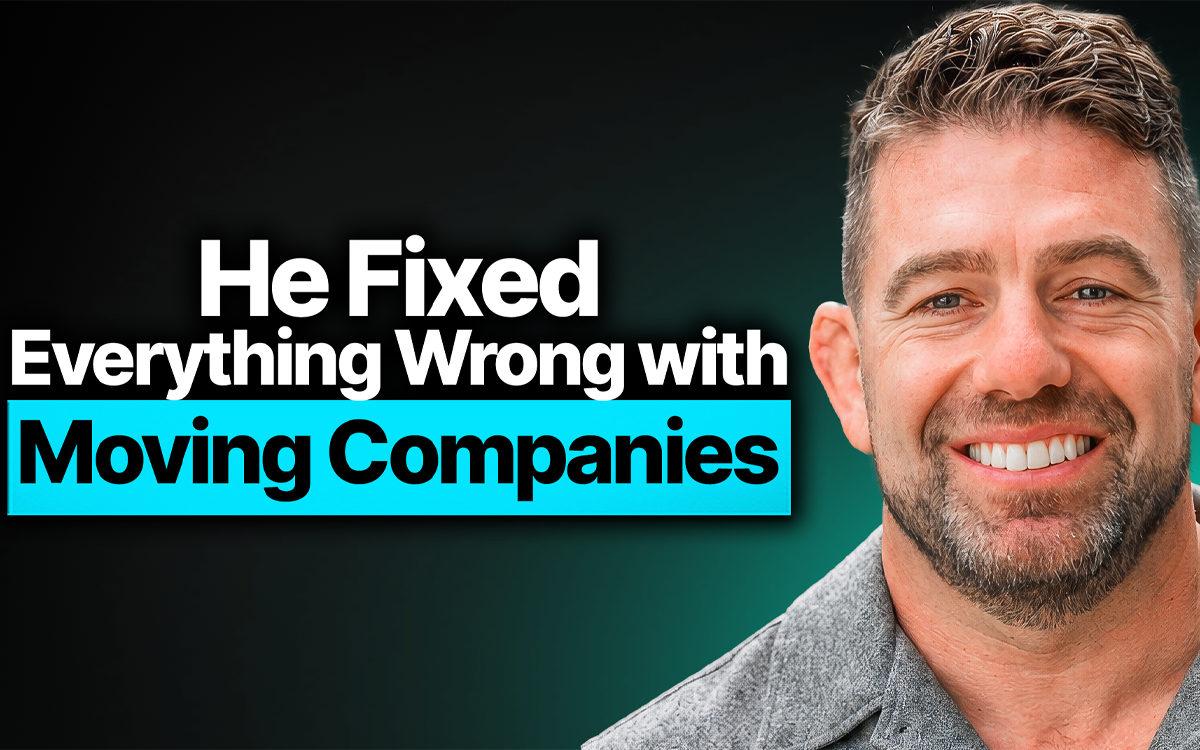
SAN LUIS OBISPO, Calif. — In the landscape of American entrepreneurship, few stories mirror the classic garage-to-greatness trajectory quite like that of Aaron Steed. What began nearly three decades ago as a modest way for a 17-year-old high school wrestler to earn extra cash has steadily compounded into an eight-figure powerhouse. Today, Meathead Movers spans nine thriving locations and two mini-storage facilities across California, anchored by a distinct operational model that marries athletic discipline with rigorous customer accountability.
Steed’s journey offers a masterclass in modern resilience. Over a span of 29 years, the enterprise weathered regulatory crackdowns, disconnected phone lines, catastrophic advertising failures, and complex multi-city expansions. Rather than relying on sudden venture capital infusions or overnight viral breakthroughs, Steed built his empire through a methodical, step-by-step strategy centered on protecting brand reputation and redefining service standards in an industry notoriously plagued by consumer distrust.
Main Facts
Meathead Movers operates as a premier regional moving and storage company on the West Coast, generating eight figures in annual revenue. Founded in San Luis Obispo, California, the company currently maintains nine operational branches and two mini-storage facilities, with a strategic rollout plan targeting two new offices annually.
The company’s defining structural innovation is its workforce model: it exclusively recruits collegiate and high school athletes. This athletic positioning is not merely a marketing gimmick; it dictates operational execution. Crews are trained to literally jog when not carrying heavy items, shortening standard move times significantly.
Beyond speed, the business is distinguished by its corporate mission to provide free moving and storage services to victims fleeing domestic violence—a philanthropic initiative integrated into every new market the company enters. Furthermore, Meathead Movers utilizes a progressive branch-ownership pipeline, allowing general managers to acquire up to a 40% equity stake in their respective locations using accumulated profit-sharing.
Chronology of Growth: Overcoming Early Hurdles
The Genesis in San Luis Obispo (1995–1999)
Growing up in San Luis Obispo—a community defined by its 50,000 to 60,000 permanent residents and an influx of roughly 30,000 Cal Poly students—Aaron Steed found his life revolving around wrestling. Seeking flexible income that accommodated his athletic schedule, Steed began knocking on the doors of friends’ parents, offering help with household chores and local relocations.
Within his first ten moves, customers frequently remarked that Steed provided the finest moving experience they had ever encountered. More revealing, however, were the horror stories clients shared about incumbent movers: crews that failed to show up, damaged belongings, extortionate last-minute price hikes, and a complete lack of recourse when things went wrong. Recognizing a glaring gap in the market, Steed realized his straightforward, reliable offer could scale. Because he was captain of his wrestling team and his brother played football, Steed had an immediate, high-trust labor pool at his disposal: fellow student-athletes accustomed to physical exertion, discipline, teamwork, and high-pressure competition.
The Regulatory Crisis and the Phone Line Blackout (2000)
As Meathead Movers gained traction throughout San Luis Obispo, established regional competitors took notice. Traditional operators challenged Steed’s right to operate without a formal professional moving license. At the time, Meathead Movers functioned primarily as a high-end labor service where customers rented and drove their own trucks. Regulators ultimately ruled against Steed’s operational structure.
In the summer of 2000, the company’s phone lines were abruptly disconnected. In a pre-internet local service economy heavily reliant on physical phone directories, a disconnected phone line was a death sentence. Anyone opening a directory and dialing Meathead Movers heard only a disconnected tone.
Instead of folding, Steed made a pivotal life decision: he deprioritized his collegiate wrestling career to save the business. Needing $25,000 to properly license, insure, and capitalize a fully compliant moving operation, Steed approached the local weekly newspaper, New Times. Anticipating that regulators might target his advertisements, he negotiated a series of revolving business names and phone numbers.
Building a Licensed Fleet
Cycling through multiple iterations of the business name and phone numbers allowed Steed to generate emergency revenue while quietly stacking capital. Within months, he secured the necessary insurance, established professional accounting systems, passed required regulatory examinations, and obtained his official state permits. Meathead Movers was reborn as a fully licensed professional moving company capable of renting and operating its own fleet.
Approximately a year later, Steed made another critical financial calculation. The company was spending between $8,000 and $9,000 monthly on truck rentals. By securing commercial financing through Mid-State Bank & Trust—despite having minimal credit history and no co-signer—Steed purchased a fleet of five brand-new trucks. This move slashed monthly overhead by roughly $2,000, cemented the company’s market infrastructure, and enabled it to outlast several of the very legacy competitors that had previously attempted to regulate it out of existence.
Expansion Setbacks and Digital Pivots (2005–2007)
Following years of steady regional control, Steed executed his first calculated expansion in 2005, opening an office in Santa Maria, just 30 miles from San Luis Obispo. This proximity allowed the founding team to stabilize logistical hiccups swiftly.
Buoyed by this success, Steed attempted a much bolder regional leap in 2007: expanding into Camarillo, roughly two and a half hours away, to capture Ventura County and northern Los Angeles County. Steed negotiated a major full-page advertising agreement with AT&T Yellow Pages, leased a 7,000-square-foot facility, and relocated six employees.
A month before the directories went to print, AT&T reneged on the agreement. Meathead Movers was left out of the phone books in a brand-new, highly competitive market after sinking substantial capital into real estate and personnel.
The team responded with an aggressive, boots-on-the-ground guerrilla marketing campaign, deploying staff to distribute flyers door-to-door and hand-deliver promotional materials across neighborhoods—an initiative so aggressive that team members occasionally had beverages thrown at them by hostile residents. Simultaneously, Steed redirected tens of thousands of dollars earmarked for the Yellow Pages straight into digital marketing and website optimization. Relocating to Ventura County personally for a year, Steed steered the branch through its turbulent infancy, turning a catastrophic marketing failure into the launchpad for the company’s modern digital presence.
Supporting Data & Operational Metrics
Meathead Movers’ long-term viability rests on hyper-quantifiable customer service metrics and sales responsiveness:
- Speed-to-Lead Conversion: Internal data reveals that the company closes approximately 50% of prospects it reaches immediately. Conversely, the close rate for leads the company fails to connect with instantly drops into the low 20% range—a staggering 30-percentage-point performance gap.
- Operational Velocity: Because crew members jog when not carrying heavy items, a typical move completed by Meathead Movers in three to four hours can take conventional operators five to seven hours, directly reducing hourly billing costs for the customer.
- Financial Scale: Operating across nine distinct locations and two mini-storage units, the firm maintains an aggressive expansion pipeline targeting two new offices annually across the West Coast.
- Accountability Frameworks: Steed contrasts his company’s policies against standard industry valuations (such as the customary moving liability rate of $0.60 per pound of damaged goods). Meathead Movers implements a fair refund guarantee, allowing managers to discount or refund a worker’s labor percentage if client expectations are not fully met.
Official Responses and Strategic Philosophy
Aaron Steed’s management philosophy centers on patient, deliberate scaling rather than reckless hyper-growth. In reflections on the company’s nearly three-decade history, Steed emphasizes that premature expansion fueled by cheap capital or ego is the primary killer of service-industry startups.
"We have seen periods when limited capital, lawsuits, market conditions, or internal capacity made expansion a poor decision," Steed notes. "My preference is always to wait rather than put employees into roles they aren’t prepared to handle or place unnecessary strain on the company’s finances."
This conservative financial discipline extends to internal culture and human resources. By instituting a branch-ownership model where general managers transition from profit-sharing recipients to co-owners holding up to a 40% equity stake, Steed has engineered a sustainable leadership pipeline. This framework allows working-class employees—many of whom joined the company straight out of high school or college as movers—to build genuine generational wealth without relying on outside equity partners.
Implications for the Local Service Industry
The trajectory of Meathead Movers offers critical insights for modern service-based enterprises navigating the shift from traditional offline directories to artificial intelligence-driven discovery ecosystems.
- The Death of Lead Latency: As consumer patience evaporates, businesses that fail to integrate instant lead-response mechanisms (such as the "double-tap" text-and-call protocols implemented by Meathead) will bleed high-intent prospects to hyper-responsive competitors.
- Brand Differentiation via Niche Identity: Merely stating quality standards is insufficient. By co-opting an athletic subculture ("meatheads") and embedding physical discipline into the operational rhythm (jogging between loads), the company turned a derogatory locker-room label into an unforgettable brand asset.
- Mission-Driven Brand Equity: Integrating social impact—such as providing free relocation services for survivors of domestic violence—proves that corporate social responsibility, when woven directly into the operational fabric of every new branch, builds unshakeable local goodwill that traditional advertising cannot buy.
- AI and Referenceability: As search engines transition toward AI-generated summaries and conversational answers, service brands must restructure their digital content, FAQs, and local landing pages to provide dense, authoritative data points that AI agents can easily parse and recommend.
Nearly 30 years after Steed first asked his friends’ parents if they needed help moving boxes in San Luis Obispo, Meathead Movers stands as proof that enduring entrepreneurial success is forged not by avoiding crises, but by systematically out-executing them.