A new public-facing domain blocklist seeks to crack down on the booming industry of automated email fabrication. But as the anti-abuse community weighs in, experts note that fighting deceptive cold outreach requires more than just a single tool.
Main Facts
In an aggressive move to curb the proliferation of deceptive email practices, data solutions provider Validity officially launched Heatwave on September 3. Drawing telemetry directly from the proprietary Validity Intelligence Network and hosted publicly at lookup.validity.tools, Heatwave is a specialized domain blocklist engineered to flag and track synthetic domain warming and aggressive, uninvited cold email campaigns.
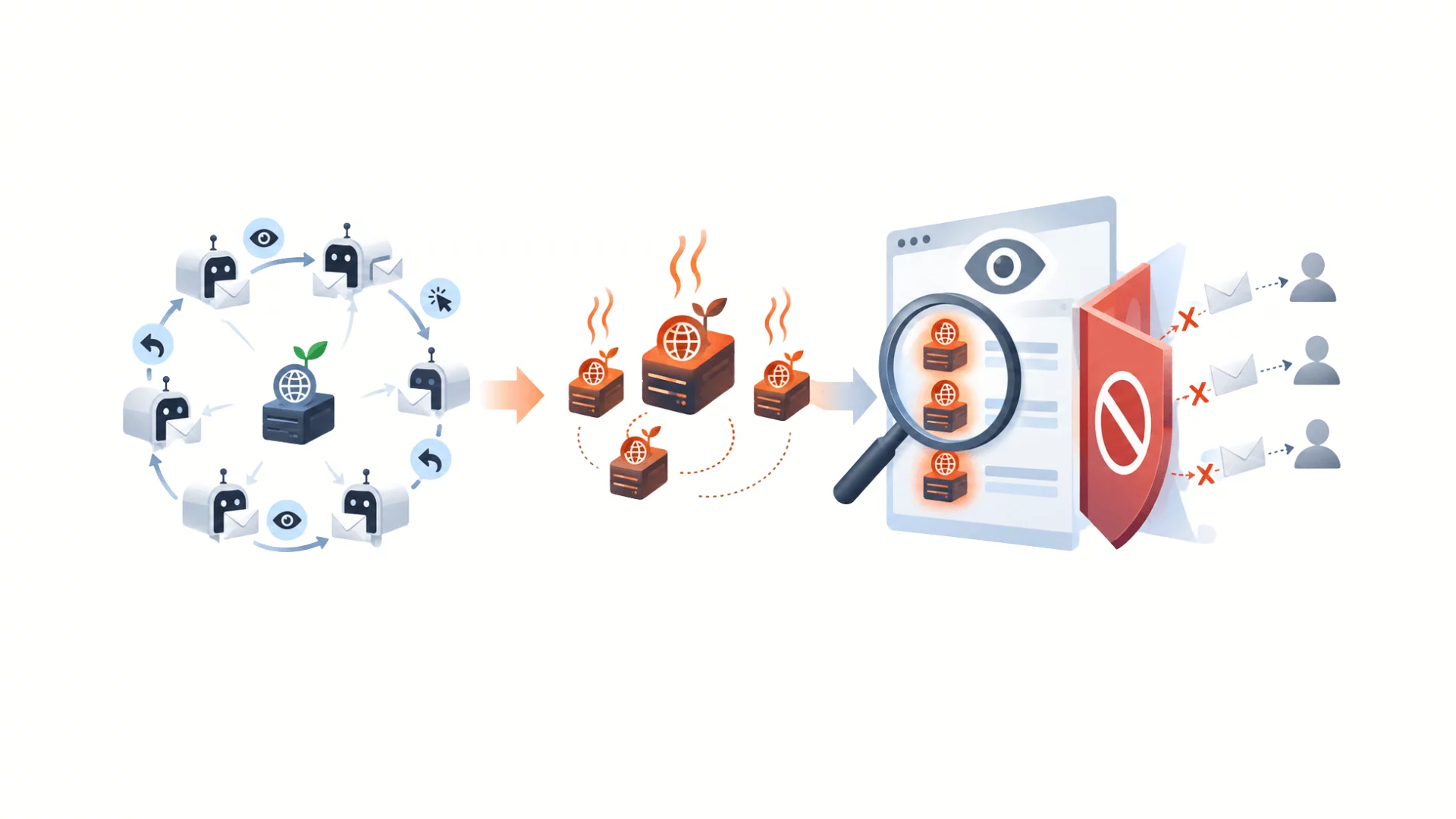
Unlike traditional blocklists that target offending IP addresses or broad network ranges, Heatwave focuses specifically on sending domains. Its primary trigger is “synthetic reputation warming”—an automated process where malicious actors or aggressive sales-tech vendors set up networks of controlled mailboxes that automatically exchange messages, opens, clicks, and replies. This orchestrated digital theater artificially inflates a young domain’s sender reputation, tricking inbox service providers (ISPs) into believing the domain is legitimate and trustworthy before it begins blasting cold outreach to unsuspecting users.
Key operational metrics of the Heatwave initiative include:
- Target Focus: Sending domains utilizing artificial reputation manipulation rather than generic spamming.
- Dual-Stage Tracking: The system distinguishes between domains currently in the "warming" phase and those that have graduated to sending live, active cold outreach campaigns.
- Public Transparency: Unlike legacy reputation data, which is typically locked behind proprietary vendor walls, Heatwave’s live metrics, pre-listed domains, and rolling tables are accessible for public queries.
- Industry Adoption: Major email security heavyweights—including Comcast, Proofpoint, Spamhaus, and SURBL—have already integrated or are evaluating the Heatwave signal.
Chronology
The rollout of Heatwave follows years of escalating friction between modern email marketers, security architects, and the burgeoning "cold email scaling" industry.
- The Rise of Automated Warming (2021–2023): As traditional email authentication protocols (such as SPF, DKIM, and DMARC) grew stricter, spammers and aggressive B2B lead-generation agencies found standard outreach hindered by poor initial domain reputation. This gave rise to third-party "domain warm-up" software and services designed to artificially simulate user engagement.
- Development and Testing (Early–Mid 2024): Recognizing that synthetic engagement was bypassing traditional spam filters, Validity leveraged the Validity Intelligence Network to map out the infrastructure behind these sprawling warming networks.
- September 3, 2024: Validity officially launched Heatwave, publishing the database to
lookup.validity.toolsalongside its explicit listing and delisting policies. - September 10, 2024: Just one week post-launch, system counters revealed a rapidly expanding database containing 1,052,595 listed domains, with nearly 7,000 new entries added within a single 24-hour window, processed from an underlying pool of 14.7 million trap signals. The database refreshes automatically every five minutes.
Supporting Data and Technical Architecture
While a count of over one million listed domains sounds massive, industry veterans point out that Heatwave represents just one slice of a much larger ecosystem. Established players like SURBL have tracked deceptive cold email infrastructure for years, handling volumes that dwarf nascent lists.
How the Scoring and Listing Works
Heatwave operates on an automated ingestion model. A domain is automatically flagged once its composite score—calculated using infrastructure metrics, domain age, and specific message characteristics—crosses a designated threshold.
- The Score: While domains are assigned a relative score from 1 to 100 (recomputed hourly), this number does not strictly dictate whether a domain is listed; rather, algorithmic thresholds trigger the flag.
- Exact-Match Lookups: The public tool operates on exact-match queries. Validity stresses that a "not currently listed" result is not a clean bill of health or an official certification of safety.
- No Expiry on Warming: Crucially, warming listings do not automatically expire. Simply stopping the warming behavior will not clear a domain from the blocklist. Delisting requires a formal review by Validity analysts—a process that takes between two and five business days—and is typically reserved for instances of misattribution, domain compromise, or impersonation.
Standout Technical Features
Heatwave introduces two distinguishing features that differentiate it from conventional blocklists:
- Related-Domain Discovery: When security analysts or system operators search a primary domain, the tool surfaces lookalike domains tied to the same warming operations. These are frequently registered by subcontractors several layers deep in a corporate supply chain. Validity’s advice to organizations caught in the net is straightforward: audit sales, marketing, and external vendors before assuming the listing is an error.
- Pre-Listing Capabilities: If Validity identifies an entire family of domains registered and operated in tandem for synthetic warming, sister domains within that family can be flagged before they even transmit a single email. These pre-listed domains are marked as "advisory" and display registration dates directly on the public dashboard.
Official Responses and Industry Perspectives
The email security community has responded to Heatwave’s launch with a mixture of endorsement, caution, and perspective regarding the sheer scale of the automated cold email epidemic.
Tom Bartel, M3AAWG board chair and a representative from Validity, emphasized the need for structural transparency in fighting modern abuse. However, industry peers have been quick to contextualize Heatwave’s footprint within the broader anti-abuse landscape.
Raymond Dijkxhoorn, co-founder of SURBL, highlighted the interconnected nature of modern spam infrastructure, noting:
"We see the same actors across hundreds of domains. Heatwave is one more independent view of that infrastructure, and each one makes it harder for operators to move. For the same actors we typically find 15 to 20 times as many domains as Validity does, so overlap matters more than count."
Other notable figures voicing support or contributing perspectives to the rollout include Alex Brotman (Comcast), Carel Bitter (Spamhaus), and Mariska Calabrese (beehiiv). Their involvement underscores a unified industry push to dismantle the infrastructure that enables high-volume, low-consent digital outreach.
Validity’s own guidance regarding Heatwave is notably restrained. The company advises network administrators and email service providers to filter traffic at their own discretion, incorporate the signal during onboarding phases, and treat the blocklist as "Validity’s measured opinion" rather than an absolute rule of law.
Implications for Marketers, Vendors, and Email Providers
The introduction of Heatwave signals a pivotal shift in how the email ecosystem handles the gray area between legitimate marketing and spam. For years, B2B lead-generation agencies operated with relative impunity, utilizing automated warm-up tools to bypass the filters of major ISPs. Heatwave directly threatens this business model by dragging the obscure mechanics of domain warming into the public light.
For Legitimate Businesses and Brands
Companies risk finding themselves unexpectedly blacklisted due to the actions of rogue third-party vendors. Because modern marketing operations frequently outsource lead generation to specialized agencies, a company’s primary domain or its lookalikes can be swept into a warming network without executive knowledge.
Validity’s related-domain discovery feature forces organizations to adopt stricter vendor management protocols. Companies must now audit not only their own internal software deployments but also the digital infrastructure utilized by outsourced marketing partners.
For Email Service Providers (ESPs) and Inbox Providers
By feeding Heatwave signals into established reputation zones and partnering with giants like Comcast, Proofpoint, and Spamhaus, Validity is helping fortify the perimeter against unwanted automated outreach. For ISPs, having access to real-time telemetry on synthetic domain warming means catching malicious or deceptive senders before they flood user inboxes with cold pitches disguised as trusted communications.
Ultimately, Heatwave’s success will not be measured solely by the sheer volume of domains in its database, but by how effectively its public transparency forces the creators of synthetic domain infrastructure into the open, raising the operational costs of unethical cold emailing for good.