In the modern enterprise software landscape, venture-backed companies routinely allocate millions of dollars to performance marketing, programmatic ad buys, agency retainers, and sponsored content. Yet, some of the most lucrative and high-converting marketing assets are entirely unprompted, uncoordinated, and fundamentally untrackable by standard CRM workflows.
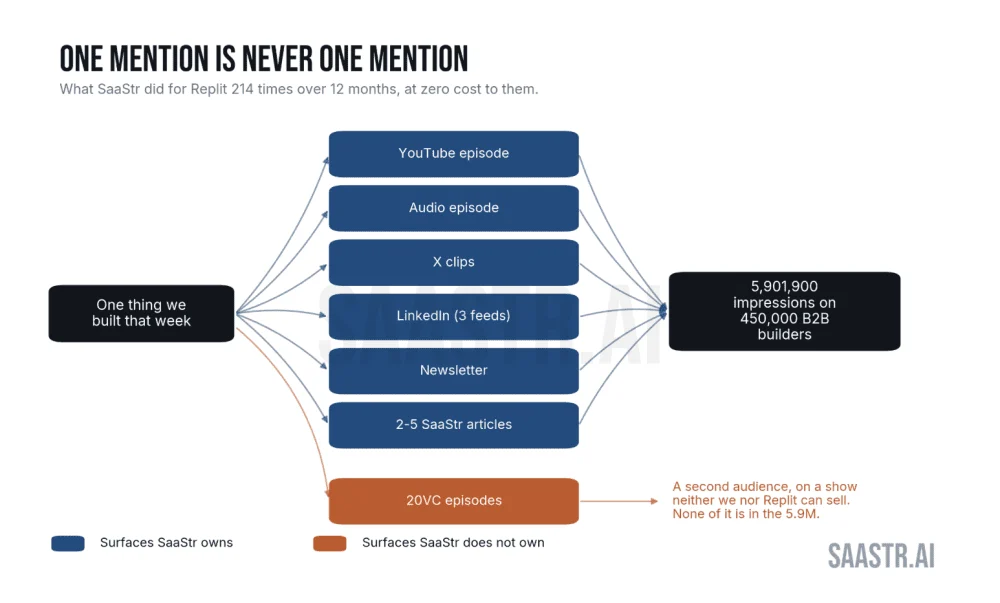
Over the past twelve months, SaaStr AI generated 214 articles, contributed to over 40 podcast episodes, and amassed nearly 5.9 million impressions directed squarely at an audience of roughly 450,000 elite B2B executives, founders, CEOs, and CTOs—all centering on cloud development platform Replit.
The total cost to Replit for this massive campaign? $0.
There was no deal, no marketing brief, no pre-approved messaging, and no "partner content" tag. This unprecedented organic advocacy offers a masterclass for B2B organizations on how product excellence, cross-functional continuity, and top-tier customer engineering can ignite a flywheel of advocacy that money simply cannot buy.
Main Facts: The Anatomy of an Unsolicited Marketing Engine
The core phenomenon centers on a simple reality: practitioners write about what they use to build real production software. Despite having no formal engineering background and being unable to write a line of Python from scratch, leadership at SaaStr utilized Replit daily to ship more than 10 production applications, which were subsequently used close to a million times. SaaStr.ai itself rocketed to 500,000 users in its first 45 days of operation.
Because this tooling allowed non-technical leaders to build real software, it naturally became the focal point of their daily output. Over the course of a year, this usage manifested as:
- 214 organic articles published across SaaStr channels detailing real-world development trials and triumphs.
- 40+ podcast mentions and appearances, including deep-dive discussions on shows like The Agents and high-profile cross-collaborations such as 20VC.
- 5,901,900 hyper-targeted impressions landing on an audience where the Ideal Customer Profile (ICP) overlap is nearly total.
While Replit eventually sponsored SaaStr AI 2026, built a packed "vibe coding cafe" activation, and provided world-class forward-deployed engineering support, all of these collaborative milestones occurred after the organic coverage had already established massive momentum.
Chronology: From Unprompted Utility to Strategic Partnership
Understanding how this relationship evolved requires looking at the sequence of events, which holds valuable lessons for SaaS leaders navigating customer advocacy.
Phase 1: Unprompted Product Utility
The relationship began entirely at the application layer. Without outreach from Replit’s sales or marketing teams, SaaStr leadership adopted the platform to build functional production tools. The software simply did the job it was designed to do, bridging the gap between non-technical vision and executable code.
Phase 2: Organic Amplification
As products were shipped, documented, and scaled to nearly a million uses, the process was broadcasted publicly. This included both successes and high-visibility failures—such as an AI agent accidentally deleting over 2,400 production records or reporting inaccurate test results. Because the coverage was authentic, granular, and practitioner-driven, it carried unmatched credibility.
Phase 3: Executive Intervention and Support
Recognizing the utility and the unprompted exposure, Replit’s leadership took a decisive operational step. CEO Amjad Masad assigned a dedicated, named forward-deployed engineer—Kody—to support the account. Crucially, this was not a rotating pool of support agents or a generic customer success representative, but a high-value engineering asset dedicated to maintaining continuity and understanding the customer’s specific technical stack.
Phase 4: Formalized Collaboration and Sponsorship
Only after months of organic advocacy and dedicated engineering collaboration did the relationship formalize into commercial sponsorship. Replit sponsored SaaStr AI 2026, deployed a high-converting experiential "vibe coding cafe," hosted role-specific hands-on classes, and secured the highest lead conversion rate of any sponsor at the event.

Supporting Data: The Media Math and the Credibility Multiplier
To understand the true weight of this organic flywheel, one must move past superficial impression counts and evaluate the underlying economic realities of B2B media.
Calculating Qualified Impressions
At a conservative B2B Cost Per Mille (CPM) of $50 to $100, 5.9 million impressions represent roughly $295,000 to $590,000 in raw media value. However, this arithmetic severely understates the true economic impact.
Standard advertising buys pay for broad reach where only a fractional percentage of viewers match the target buyer persona. In this scenario, the 5.9 million impressions landed directly on roughly 450,000 elite B2B decision-makers—founders, CROs, CTOs, and VPs of product. Because every member of this audience is a builder or controls budgets for builders, the ICP overlap is near-total. The cost per qualified impression makes this asset worth exponentially more than its standard programmatic equivalent.
The Credibility Multiplier
Sponsored content is universally recognized as advertising. Vendor logos on slide decks are filtered out by cynical buyers. In contrast, unprompted practitioner narratives—complete with admissions of technical failures, bugs, and real-time problem-solving—bypass psychological defenses.
This level of authenticity cannot be purchased via an agency line item. It is exclusively generated by building a product robust enough to solve difficult problems for credible voices within your core market.
Multi-Surface Distribution
The impact extended far beyond written articles. A single podcast clip about localizing an application into Spanish and Chinese in 20 minutes generated 24,000 impressions on X. Furthermore, discussions on third-party platforms like 20VC carried the narrative into investor rooms and broader operator circles where Replit had no direct marketing relationship.
Implications: Operational Failures and How to Fix Them
Despite the massive upside of organic advocacy, most B2B organizations suffer from a critical operational blind spot: their tech stacks cannot detect it.
Standard CRM systems trigger alerts for demo requests, pricing page visits, trial signups, and support tickets. They possess no data objects to identify when an influential practitioner with a massive following mentions the brand favorably for the fortieth time. Consequently, high-leverage marketing assets are frequently treated with the same bureaucratic indifference as low-tier self-serve accounts.
Common Corporate Missteps
When companies finally notice organic advocates, their reactions often cause active damage:
- The Over-Commercialization Trap: Attempting to immediately lock the advocate into a rigid, transactional contract or forcing corporate messaging into their authentic workflow.
- The De-prioritization Error: Reassigning dedicated support or engineering resources once the initial relationship appears stable, thereby destroying the context accumulated over months of collaboration.
- The Transactional Fatigue: Treating long-term goodwill as a permanent entitlement rather than a dynamic relationship requiring ongoing care.
Strategic Takeaways: What to Do on Monday
For B2B executives looking to replicate this dynamic within their own customer bases, a systematic shift in operational focus is required:
- Build Detection Systems: Implement monitoring protocols—whether via AI agents or designated team members—to actively surface unprompted mentions and advocacy from key figures within your target market. Assign clear internal ownership for nurturing these relationships.
- Prioritize Continuity in Engineering Support: If a high-impact advocate requires technical assistance, assign named resources and keep them on the account. Continuity of context is more valuable than rotating headcount.
- Measure ICP Value Over Contract Value: Do not evaluate customer value solely on initial seat count or ARR. Factor in the secondary influence your customers wield across your exact target market.
- Meet the Audience Where They Are: When engaging in sponsorships, prioritize experiential, hands-on environments (such as live builds and role-specific workshops) over passive banner ads and traditional booths.
Ultimately, B2B companies spend staggering amounts of capital trying to manufacture manufactured credibility. The most successful organizations, however, focus on protecting and elevating the unprompted goodwill their users hand them for free.