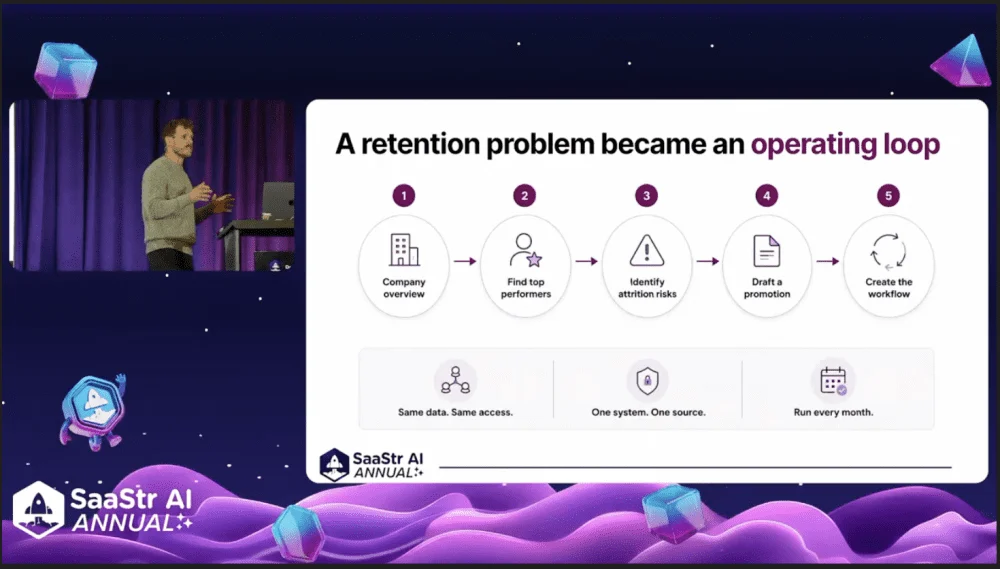
The enterprise software landscape is undergoing a tectonic shift. At the recent SaaStr AI conference, Arsalan Tavakoli-Shiraji, co-founder of data and AI powerhouse Databricks, delivered a sobering assessment of the current market. With Databricks currently operating at a staggering $6.9 billion revenue run-rate—fueled by an 80% year-over-year growth rate and AI-specific products contributing over $1.7 billion—Tavakoli-Shiraji occupies a unique vantage point. He sees where the enterprise budget is flowing, where it is stagnating, and, most provocatively, why the era of the "unassailable incumbent" is coming to a rapid, chaotic end.
His central thesis is as bold as it is unsettling for Fortune 500 leadership: "Any business with a monopoly today will not have a monopoly 12 to 24 months from now."
Main Facts: The "Token Maxing" Era
To understand the current state of enterprise AI, one must look past the hype cycle on social media and focus on the reality inside corporate headquarters. Despite the outward appearance of AI-driven transformation, the reality is a frantic, disorganized race for "token maxing."
CEOs across the globe have issued a universal mandate: adopt AI or risk irrelevance. This has led to a massive, indiscriminate surge in token consumption as employees are pressured to justify their budgets through AI usage metrics. However, there is a fundamental disconnect between spending and value. Most enterprises are currently unable to articulate a clear Return on Investment (ROI) for their AI initiatives. They are spending heavily, building experimental agents, and attempting to find a measurable outcome after the fact.
For founders and software vendors, this environment provides a narrow window of opportunity. The winners of this phase will not be those who simply deploy "agents," but those who can demonstrably tie AI spend to concrete business outcomes—driving revenue, reducing overhead, or accelerating time-to-market.
Chronology of the Data Shift
The narrative of data management has undergone three distinct phases in the last decade, leading us to our current inflection point:
- The Warehouse Era (2015–2020): The primary value proposition was the consolidation of data into "lakes" or warehouses. CIOs were sold on the promise of better analytics and operational efficiency. AI was frequently excluded from these pitches, as it was viewed as a fringe, futuristic concept associated with autonomous systems.
- The AI-As-Efficiency Era (2020–2023): As LLMs matured, the conversation shifted toward using data to power internal efficiencies. AI became a "back-office" play—a way to automate rote tasks and optimize internal workflows.
- The Top-Line Imperative (2024–Present): Today, AI is no longer a back-office optimization; it is a top-line revenue driver. Companies are now treating AI as a core strategic pillar. This shift has exposed the "Context Bottleneck." Enterprises are realizing that the quality of the model is secondary to the quality and availability of the context—the "tribal knowledge" of the organization—that feeds it.
Supporting Data: The Context Bottleneck
Tavakoli-Shiraji argues that the true hurdle to AI adoption is not the capability of the underlying LLMs, but the enterprise’s failure to maintain "live context."
Consider a simple business question: "Show me my top spenders on major cloud providers in EMEA for the last fiscal quarter." To a human, this is a query based on institutional knowledge. To an AI, it is a nightmare of ambiguity. What defines a "top spender"? What is the exact fiscal calendar? Which specific nations are included in the company’s internal definition of "EMEA"?
In the past, organizations attempted to solve this with static documentation. However, these documents are often obsolete the moment they are written. In a 100,000-person firm, definitions evolve through informal chats, emails, and meetings. Databricks’ response to this has been the development of the "Genie Ontology"—a self-improving context layer that continuously extracts and updates business knowledge from the enterprise’s digital exhaust. This represents a fundamental shift: the value lies not in the agent, but in the maintenance of the living, breathing context that makes the agent useful.
The Death of Traditional Business Intelligence (BI)
If the "context layer" is the new engine, then traditional BI dashboards are the "dashboard graveyard." For years, BI was limited to the 5% of an organization that possessed the technical acumen to write SQL queries. This created a bottleneck where business leaders had to wait a week for a data analyst to answer a simple question.
Databricks’ internal data shows that by democratizing this access through AI-driven interfaces like Genie, organizations can shift from a "dashboard-first" culture to a "question-first" culture. In one notable case, a major automotive manufacturer transitioned 70,000 employees from static dashboards to AI-driven, real-time data inquiry.
The result? Answers in 30 seconds rather than seven days. This creates a "flywheel of curiosity." When an answer is immediately available, it leads to a follow-up question, which drives deeper analysis. This capability effectively renders the traditional "BI tool" category obsolete, as it becomes absorbed into the broader fabric of organizational communication.
Implications: The End of Pricing Power
The most critical implication of this technological shift is the destruction of "lock-in" as a defensible moat. Historically, B2B software incumbents relied on high switching costs—the complexity of migrating data and retraining staff—to maintain pricing power.
AI has systematically dismantled these barriers in three ways:
- Semantic Translation: AI agents can now read legacy codebases, understand their function, and translate them into modern architecture.
- Automated Migration: LLMs can handle the heavy lifting of data migration and validation, reducing the time and cost of switching vendors from years to weeks.
- The Rise of Agent-Native Apps: We are entering an era where software is built for agents, not just humans. This allows for a modular, plug-and-play approach to enterprise tooling that incumbents are not equipped to offer.
Tavakoli-Shiraji’s warning is clear: Pricing power is disappearing. When the cost of switching drops to a 30-day migration cycle, buyers are no longer beholden to incumbents. They are willing to pilot and adopt new, cheaper, more efficient alternatives.
Official Responses and Future Outlook
The next 24 months will be defined by the "Great Unbundling." For incumbents, the strategy of "holding the line" through contracts and proprietary data silos is no longer viable. They must either undergo a radical transformation to become "agent-native" or face the slow erosion of their market share to leaner, faster, and more cost-effective challengers.
Conversely, for startups, the message is one of aggressive opportunity. The barrier to entry has lowered, and the willingness of the market to experiment has never been higher. The successful companies of the next decade will be those that provide clear, ROI-positive outcomes while helping enterprises navigate the complexity of their own data context.
The era of the protected monopoly is coming to a close. In its place, we are seeing the birth of an agile, hyper-competitive ecosystem where the only true competitive advantage is the ability to adapt to a world where software is always learning, and the cost of replacing yesterday’s solution is lower than ever before.